 Choose the Right C.A. Technologies Air Spray Gun for Your Application Choose the Right C.A. Technologies Air Spray Gun for Your Application
The Best Spray Gun Is the One That Fits the Work
Buying a good spray gun isn't difficult.
Choosing the right spray gun takes a little more thought.
A spray gun that performs beautifully with a wood finish in a cabinet shop may not be the best choice for an OEM production line, an automotive refinishing operation, a metal fabrication shop, or an applicator working with high-performance industrial coatings.
The gun is only one part of the finishing system.
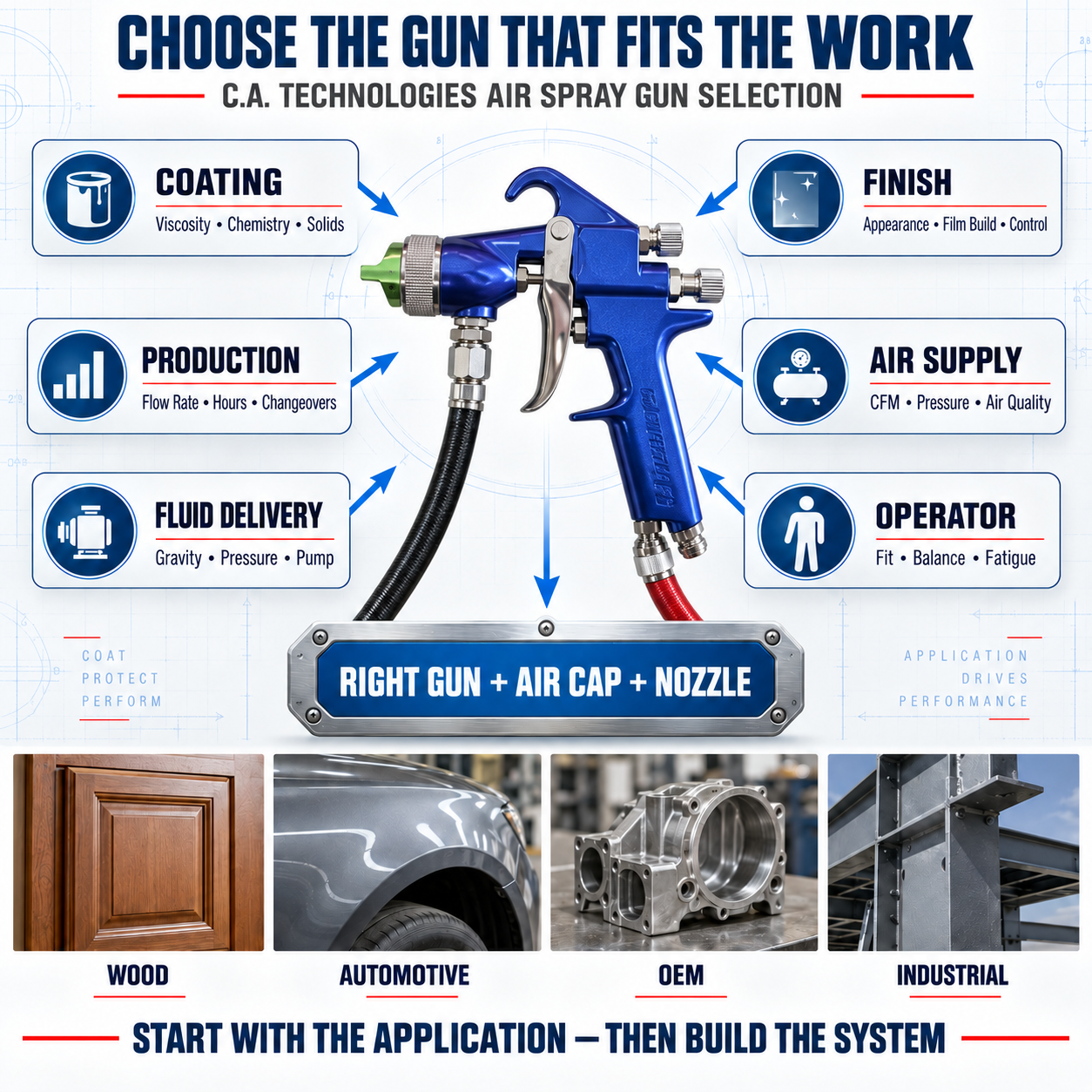
The coating, production rate, fluid delivery method, available compressed air, required finish quality, operator, and application all influence which spray gun will perform best.
That's why good equipment selection starts with understanding the work.
1. What Are You Spraying?
Start with the coating.
Different materials behave differently as they move through a spray gun and break into droplets during atomization.
Consider:
- Coating viscosity
- Solvent-based or waterborne chemistry
- Solids content
- Abrasiveness
- Corrosiveness or chemical reactivity
- Required fluid flow
- Desired film build
- Required finish quality
A thin stain used in wood finishing presents a very different set of requirements from a high-solids industrial coating.
The material should help determine the gun configuration, not the other way around.
2. What Fluid Passage Materials Do You Need?
The materials used inside the spray gun matter because those components are continuously exposed to the coating.
Depending on the coating chemistry, a gun may use conventional wetted components or stainless-steel fluid passages.
For many general finishing applications, conventional fluid passages may provide excellent service.
Waterborne, reactive, corrosive, or chemically aggressive coatings may require stainless-steel wetted components for better compatibility and service life.
C.A. Technologies offers different gun families and configurations for these requirements, including models within the TomCat, CPR, Panther, Jaguar, and CAT-X families.
Before selecting a gun, check the coating manufacturer's recommendations and confirm that the gun's wetted materials are compatible with the coating.
3. What Kind of Finish Are You Trying to Produce?
Not every application requires the same level of atomization.
A manufacturer applying a functional coating to an industrial component may have very different expectations from a cabinet shop spraying a clear finish or a refinisher applying a high-gloss topcoat.
Ask:
- How important is appearance?
- What film build is required?
- How complex is the part?
- How much control does the operator need?
- What production speed must be maintained?
- How much overspray is acceptable?
The objective isn't simply to produce the finest possible atomization.
The objective is to produce the right atomization for the coating and the finish requirement.
4. Who Will Be Using the Spray Gun?
A spray gun is a hand tool, and the person holding it matters.
Weight, balance, trigger pull, grip, controls, hose configuration, and overall ergonomics can affect operator fatigue.
That becomes increasingly important when a gun is used for hours at a time.
Operator fatigue isn't merely a comfort issue.
As fatigue increases, gun distance, angle, overlap, travel speed, and trigger control can become less consistent. Those changes can affect finish quality and material usage.
For production finishing, ergonomics should be considered part of process control.
5. How Long Will the Gun Operate Each Day?
A gun used occasionally for small batches has different requirements from one operating throughout a production shift.
Consider:
- Hours of use per shift
- Number of parts being finished
- Frequency of color or material changes
- Required production rate
- Cleaning requirements
- Available maintenance time
The longer the equipment operates, the more important durability, ergonomics, serviceability, and fluid delivery become.
6. How Much Material Do You Need to Deliver?
Material consumption helps determine more than the spray gun.
It also helps determine the fluid delivery system.
Gravity Feed
Gravity cups can be an excellent choice for smaller quantities, frequent material changes, test panels, touch-up work, and applications where portability is important.
Pressure Cups
Pressure-assisted cups increase material capacity and provide positive fluid delivery while retaining a relatively compact system.
Pressure Pots
Pressure tanks are useful when more coating must be supplied without repeatedly stopping to refill a cup. They can also provide consistent material delivery for many production applications.
Pump-Fed Systems
Higher-production operations may require diaphragm pumps, piston pumps, circulating systems, or other engineered fluid-delivery solutions.
The question isn't simply:
Which gun do I need?
The better question is:
Which gun and fluid-delivery system work together for my production requirement?
7. Do You Have Enough Compressed Air?
This is one of the most important and most frequently overlooked questions in air spray gun selection.
An air spray gun cannot atomize properly without an adequate supply of clean, regulated compressed air.
Don't look only at compressor horsepower or tank size.
Look at the gun and air cap's CFM requirement and compare it with the air actually available at the point of use.
Also consider:
- Compressor capacity
- Other equipment using air simultaneously
- Air hose diameter and length
- Regulators
- Filters and dryers
- Fittings and restrictions
- Pressure drop through the air system
A compressor may appear large enough on paper while the gun still receives inadequate airflow because of restrictions elsewhere in the system.
Low-CFM spray gun and air-cap configurations can be useful when compressed-air capacity is limited, but the complete air system still needs to be evaluated.
8. Which Air Cap and Fluid Nozzle Should You Use?
Choosing the gun body is only part of the decision.
The air cap, fluid nozzle, and needle combination has a major influence on how the gun handles a particular coating.
The proper setup depends on factors such as:
- Material viscosity
- Desired fluid flow
- Pattern size
- Atomization requirement
- Production speed
- Coating solids
- Finish-quality expectations
A larger fluid nozzle isn't automatically better.
More atomizing air isn't automatically better either.
The goal is balance: enough material flow to meet production requirements with enough atomization energy to produce the desired finish.
9. What Is the Application?
Professional finishing covers a much larger world than any single trade.
C.A. Technologies spray equipment can be used across applications such as:
Cabinet, Furniture & Millwork Finishing
Fine atomization, control, repeatability, and a soft, manageable spray pattern can be especially important when applying stains, sealers, lacquers, conversion coatings, and clear finishes.
OEM Product Finishing
Production environments may place greater emphasis on repeatability, durability, production rate, transfer efficiency, operator ergonomics, and integration with fluid-delivery systems.
Automotive & Transportation Refinish
Consistent atomization and precise operator control are critical when appearance and uniformity are primary finish requirements.
Industrial & Protective Coatings
Equipment selection may be influenced by coating chemistry, viscosity, solids content, production requirements, corrosion resistance, and durability.
Metal & Fabricated Products
Part geometry, coating type, production volume, finish specifications, and material handling can all influence gun selection.
Architectural & Specialty Finishes
Multi-color coatings, specialty textures, and other architectural materials may require equipment that provides controlled material delivery and efficient changeover.
Different trades may use the same basic spray technology, but they don't necessarily need the same equipment configuration.
10. Look at the Entire Finishing System
One of the easiest mistakes to make is choosing a spray gun in isolation.
A professional finishing system may include:
- Compressor
- Air treatment
- Regulators
- Air hoses
- Fluid container or pump
- Fluid regulators
- Fluid hoses
- Spray gun
- Air cap
- Fluid nozzle and needle
- Coating
- Booth or finishing environment
- Operator
Every component can influence the final result.
A premium spray gun connected to an undersized air supply or an improperly configured fluid system cannot perform to its potential.
Good finishing is the result of a system working together.
Before You Choose, Ask These Questions
- What coating am I spraying?
- Is the coating compatible with the gun's wetted components?
- What finish quality do I need?
- How much material must I apply?
- How many hours per day will the gun operate?
- How frequently will materials or colors change?
- What fluid-delivery method makes sense?
- How much compressed air is actually available?
- Which air cap and fluid nozzle match the coating?
- What does the complete finishing system need to accomplish?
If you can answer those questions, selecting the right gun becomes considerably easier.
The Bottom Line
There is no single C.A. Technologies spray gun that's right for every finishing operation.
And there shouldn't be.
A cabinet shop, OEM production facility, automotive refinisher, industrial coatings operation, metal fabricator, and architectural finisher may all need something different from their equipment.
The objective isn't to buy the biggest gun, the newest gun, or the most expensive gun.
It's to understand the application well enough to choose the right tool for the work.
That's where better finishing begins.
Finishing Starts With Understanding.
AirSprayTech.com
The Finishing Authority®
|