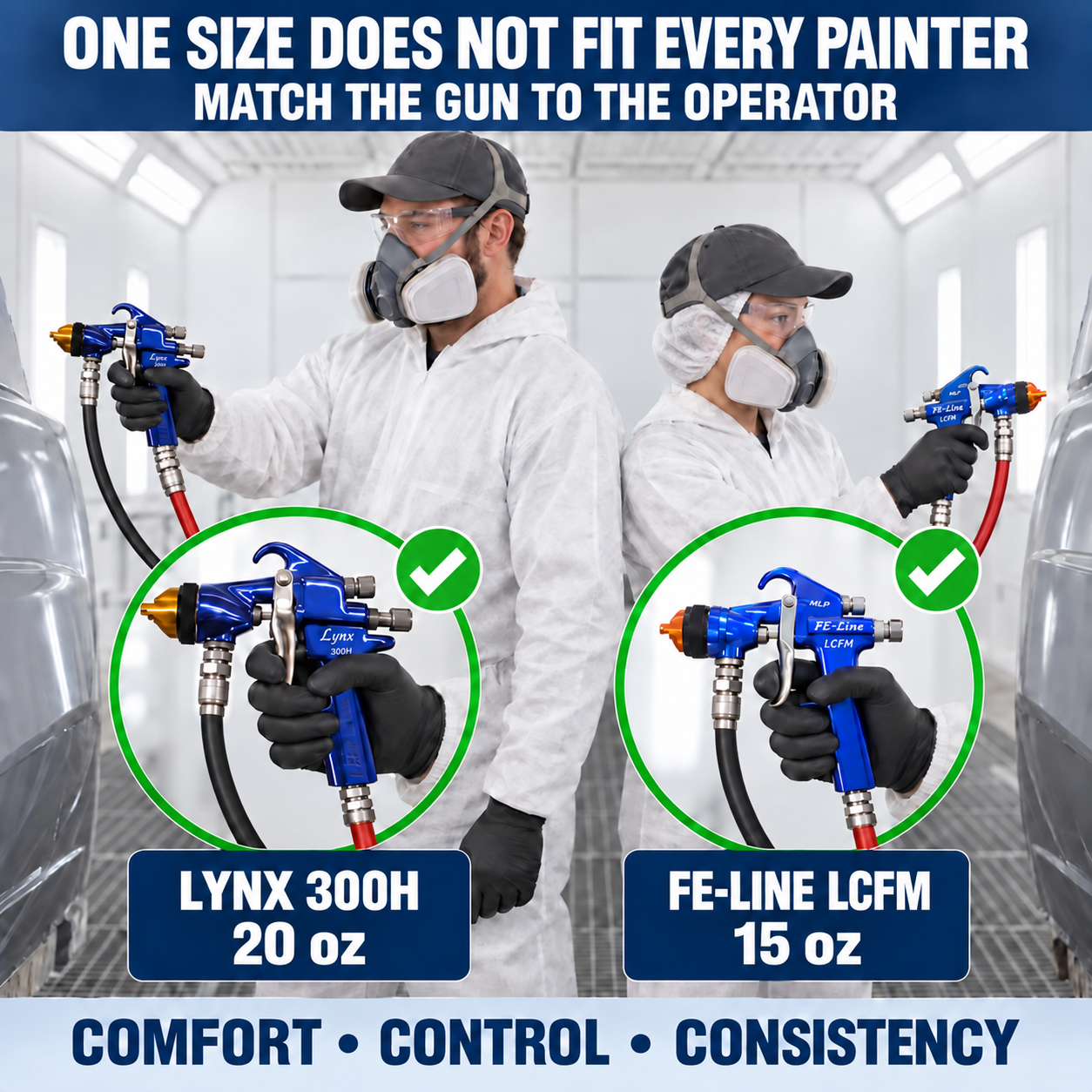
 Does Your Spray Gun Fit the Person Using It? Does Your Spray Gun Fit the Person Using It?
Why Operator Fit Should Be Part of Every Spray Gun Selection
When choosing a professional spray gun, most people begin with the application.
What coating will be sprayed? What fluid nozzle and air cap are required? How much material needs to be applied? What spray technology makes sense? How much compressed air is available?
Those are all important questions.
But there is another question that is often overlooked:
Who is going to hold the spray gun?
A spray gun can be technically correct for the coating and application and still be the wrong choice for the operator.
That matters because the operator is part of the finishing system.
Spray Gun Selection Is About More Than Specifications
Specifications help determine whether a spray gun can perform the job.
Operator fit can help determine how comfortably and consistently that job can be performed throughout a shift.
When evaluating a spray gun, consider both sides of the equation.
Application Requirements
- Coating being sprayed
- Required finish quality
- Fluid nozzle and air-cap requirements
- Production rate
- Fluid-delivery method
- Available compressed air
- Part size and geometry
Operator Requirements
- Grip comfort
- Trigger position and effort
- Gun weight
- Balance
- Control location
- Hose and cup configuration
- Time spent spraying during a shift
The best choice is the spray gun that satisfies both sets of requirements.
Why Does Spray Gun Ergonomics Matter?
A spray gun is a hand-held production tool.
The operator may repeatedly trigger, move, position, and adjust that tool hundreds or thousands of times during a workday.
A gun that feels slightly uncomfortable during a short demonstration may become considerably more noticeable after hours of production spraying.
Good ergonomics can make it easier for the operator to maintain:
- Consistent gun-to-target distance
- Proper gun angle
- Smooth travel speed
- Consistent overlap
- Good trigger control
That is where ergonomics and finish quality begin to connect.
Operator Fatigue Can Become a Finishing Problem
Consider two different situations.
One operator uses a spray gun for fifteen minutes at a time.
Another operator spends much of an eight-hour production shift spraying parts.
The importance of weight, balance, grip, and trigger effort can be very different between those two applications.
As fatigue increases, maintaining consistent technique may become more difficult.
The operator may begin changing gun angle, distance, travel speed, or body position without realizing it.
Eventually, an ergonomics problem may become visible as a finish-quality or productivity problem.
Don't Judge Spray Gun Weight by the Gun Alone
Published spray-gun weight is useful when comparing equipment, but the bare gun is not necessarily what the operator will be holding during production.
Consider the complete working assembly.
Gravity-Feed Guns
A gravity-feed gun also carries the cup and the coating inside it. Cup capacity and material volume affect the weight and balance felt by the operator.
Pressure-Feed Guns
Moving the coating supply to a remote pressure pot or pump can remove the material container from the gun, but the operator still has to manage air and fluid hoses.
Air-Assisted Airless Guns
Hose size, pressure requirements, connection location, and hose flexibility can all influence how the gun feels and moves during production.
The important question is not simply:
How much does the spray gun weigh?
A better question is:
How does the complete spray system feel to the operator while actually spraying?
Balance Can Matter as Much as Weight
The lightest spray gun is not automatically the most comfortable.
Where the weight is located can be just as important as the total weight.
A well-balanced gun can feel easier to control than another gun with a similar published weight but a different center of gravity.
Cup location, coating volume, hose connections, gun design, and the operator's grip can all affect balance.
This is one reason a specification sheet cannot tell you everything about how a spray gun will feel in actual production.
Pay Attention to the Grip and Trigger
Hands are different.
A grip that feels comfortable to one operator may feel awkward to another.
When evaluating a gun, consider:
- Grip diameter and shape
- Trigger location
- Trigger reach
- Trigger effort
- Access to fan and fluid controls
- Overall gun balance
These details become particularly important when the same movements are repeated throughout a production shift.
Consider the Workpiece Too
Operator fit cannot be separated from the part being sprayed.
Spraying flat cabinet doors at waist height is different from coating the inside of an enclosure.
Finishing small components is different from spraying a large fabricated structure.
Ask whether the operator will frequently be:
- Reaching overhead
- Spraying vertical surfaces
- Working inside cabinets or enclosures
- Coating complex shapes
- Moving around large products
- Performing repetitive production work
The physical demands of the application should be part of the spray-gun selection process.
One Spray Gun May Not Be Right for Every Operator
This can become especially important in production environments where several people share the same finishing equipment.
Operators can differ in hand size, reach, preferred grip, strength, experience, and spraying technique.
If several employees will use the same equipment, consider involving them in the evaluation process.
The person purchasing the spray gun may not be the person who spends forty hours a week holding it.
Ask the operator.
Try the Spray Gun Before Making the Decision
Whenever practical, the operator should evaluate the spray gun before the final equipment decision is made.
Don't just pick it up.
Hold it in the position in which it will actually be used.
Operate the trigger.
Reach the controls.
Consider the cup or hose configuration.
Think about what that gun will feel like after hours of repetitive spraying rather than only how it feels during the first minute.
User Fit Matters Across the Finishing Industry
Operator ergonomics is not limited to one finishing trade.
It should be considered in:
- OEM product finishing
- Cabinet and millwork finishing
- Furniture and wood finishing
- Automotive and transportation refinish
- Industrial and protective coatings
- Metal fabrication
- Manufactured products
- Architectural and specialty finishing
The coating changes.
The production requirements change.
The operator changes.
The equipment selection should account for all three.
The Bottom Line
Don't choose a spray gun from the specification sheet alone.
Choose the correct spray technology.
Match the gun to the coating.
Match it to the production requirements.
Match it to the air and fluid-delivery system.
And don't forget to match it to the person who will actually use it.
The right spray gun isn't simply the gun that can do the job. It's the gun that helps the operator do the job well.
Finishing Starts With Understanding.
AirSprayTech.com
The Finishing Authority®
|