|
|
|
Fluid Regulators Versus Air Regulators | Two Pressure Controls, Two Different Jobs Last Updated: 09/10/2026 |
|||||||||||||||||||||||||||||||||||||||
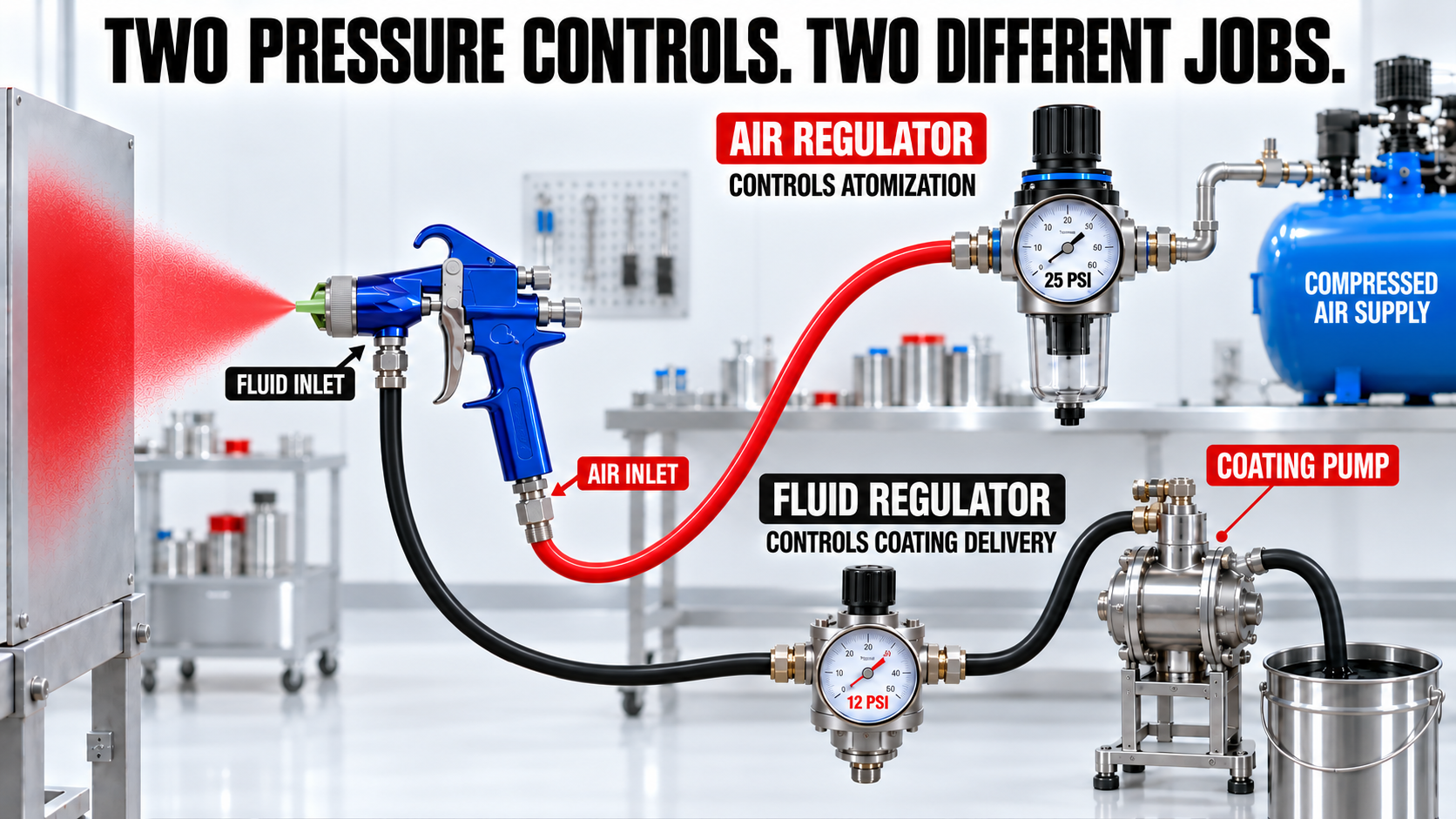 AirSprayTech.com Academy Fluid Regulators Versus Air RegulatorsTwo Pressure Controls, Two Different Jobs Air regulators and fluid regulators may both have pressure gauges and adjustment knobs, but they do not perform the same job. One controls compressed air. The other controls the pressure of the coating moving toward the spray gun. Confusing the two leads to a familiar scene: the operator adjusts atomizing air to correct excessive fluid delivery, then adjusts fluid pressure to correct poor atomization. Before long, every control has been moved, the original settings are lost, and the spray pattern still is not right. The solution begins by identifying which pressure is causing the problem. An air regulator controls compressed air. A fluid regulator controls coating pressure. Adjust the control that governs the condition you are trying to change. The Short Explanation
The difference sounds simple. The confusion begins because one finishing system may contain several air regulators and more than one type of fluid-pressure control. What Does an Air Regulator Do?An air regulator reduces a higher compressed-air supply pressure to a lower controlled downstream pressure. It should maintain the selected pressure as consistently as its capacity and operating conditions allow. In a finishing system, separate air regulators may control:
These air circuits may require different pressures and different flow capacities. A regulator selected for a small pneumatic signal may not have enough flow capacity to supply the atomizing air required by a production spray gun. Atomizing-Air PressureAtomizing air breaks the liquid coating into droplets and helps shape the spray pattern. Increasing atomizing-air pressure may produce finer droplets, but excessive pressure can create unnecessary overspray, bounce-back, dry spray, booth loading, and wasted compressed air. Insufficient atomizing air may create coarse droplets, heavy pattern edges, poor breakup, orange peel, or an unstable pattern. Atomizing-air pressure should normally be adjusted to the lowest pressure that produces the required atomization and pattern under actual spraying conditions. Check air pressure while the gun is triggered. Static pressure with no airflow may look acceptable even though pressure falls substantially when the gun begins consuming air. Pump-Air PressureAn air regulator installed at the inlet of an air-operated pump controls the air pressure driving the pump motor. This affects the pump’s available fluid-output pressure. A pump’s theoretical fluid pressure is related to its pressure ratio: Theoretical Fluid Pressure Pump air pressure × Pump ratio For example, a 10:1 pump supplied with 40 psi of operating air has a theoretical maximum fluid pressure of approximately 400 psi under no-flow conditions. Actual operating pressure can be affected by flow demand, restrictions, pump condition, material viscosity, hose size, elevation, and system design. The air regulator at the pump establishes the pump’s available driving pressure. It does not necessarily provide precise fluid pressure at each spray gun, particularly when several guns share a circulating system or when fluid demand changes. What Does a Fluid Regulator Do?A fluid regulator reduces and controls the downstream pressure of the coating or other liquid supplied to a spray gun, dispensing valve, or atomizing head. The fluid supply may come from a pump, circulating system, pressure tank, or another pressurized source. The regulator does not create fluid pressure. It controls pressure that already exists upstream. A correctly selected fluid regulator can help:
Graco describes fluid regulators as devices used for accurate, positive control of fluid pressure supplied to spray guns, dispensing valves, or atomizing heads. That is the fluid regulator’s job: controlling the coating—not the compressed air. Manual and Air-Operated Fluid RegulatorsManual Fluid RegulatorA manual fluid regulator is adjusted directly with a knob or screw. It is commonly used where the desired fluid pressure remains relatively constant and local adjustment is acceptable. Air-Operated Fluid RegulatorAn air-operated fluid regulator uses a controlled pneumatic pilot signal to adjust fluid pressure. The compressed air does not mix with the coating. It acts on the regulator mechanism to control the fluid passage. Air-operated fluid regulators are useful for remote adjustment, automatic finishing systems, recipe control, robot applications, and installations where the regulator is not easily accessible. An air-operated fluid regulator still controls fluid pressure. The pilot air is only the signal or force that operates the regulator. A Fluid Regulator Is Not a Back-Pressure RegulatorA downstream fluid regulator controls pressure after the regulator. A back-pressure regulator controls pressure before the regulator by restricting return flow.
The two devices may appear similar, but installing the wrong one in the wrong location can prevent the system from operating correctly. Why One Regulator Cannot Do the Other’s JobCompressed air and liquid coating have different physical properties, internal passage requirements, seals, pressure ratings, wetted materials, and control characteristics. An air regulator is not designed to pass paint. A fluid regulator must be selected for the coating chemistry, viscosity, solids content, abrasiveness, required flow, inlet pressure, outlet range, and cleaning process. Never substitute an air regulator for a fluid regulator. Use every regulator only with the media, pressure, and service conditions approved by its manufacturer. The Gauge Must Match the PressureA gauge does not control pressure. It reports pressure at its connection point. The regulator performs the control. For a useful reading, the gauge must be:
Trying to control 8 psi accurately with a gauge that reads from 0 to 5,000 psi is like measuring a business card with a highway mile marker. The number may be somewhere on the scale, but the instrument is poorly matched to the job. Pressure and Flow Are Related—but Not IdenticalPressure provides the force that moves the coating. Flow is the amount of coating moving during a given period. The relationship between them depends on system resistance. Fluid flow can be affected by:
Increasing pressure may increase flow, but pressure should not be used to overpower an undersized hose, clogged filter, incorrect nozzle, or regulator that lacks sufficient capacity. Correct the restriction instead of asking the pump to win an argument with it. Static Pressure Versus Dynamic PressureStatic pressure is measured when no material or air is flowing. Dynamic pressure is measured while the system is operating. A system may show adequate static pressure and then lose pressure when the gun is triggered. This can be caused by an undersized regulator, inadequate air or fluid supply, restricted filters, small hoses, excessive hose length, or insufficient pump capacity. Spray equipment should be adjusted and evaluated under actual operating flow—not solely while everything is standing still. How to Set Up a Pressure-Fed Air-Spray SystemAlways follow the equipment and coating manufacturers’ instructions. A general setup sequence is:
Which Control Should You Adjust?
Selecting an Air RegulatorConsider:
A regulator with the correct pressure range can still perform poorly if its flow capacity is too small. Selecting a Fluid RegulatorConsider:
A regulator that is too large may provide poor control at very low flow. One that is too small may create excessive pressure drop and starve the spray gun. Selection should be based on the required operating window, not merely the connection size. Common Mistakes
Safety Comes Before AdjustmentPressure can remain trapped inside pumps, hoses, filters, regulators, pressure tanks, and spray guns after the air supply has been shut off. Before installation, cleaning, inspection, or service:
High-pressure fluid can cause injection injury. A small puncture wound may conceal a severe medical emergency. Seek immediate emergency medical treatment for any suspected injection injury. The Bottom LineAir regulators and fluid regulators are not competing versions of the same device. They control different media and different parts of the finishing process. The air regulator supplies the controlled compressed air needed for atomization, pump operation, pressure-pot operation, or pneumatic control. The fluid regulator controls coating pressure delivered to the spray gun or dispensing device. Set fluid delivery first. Add only enough atomizing air to produce the required spray pattern. Make adjustments under operating flow, change one variable at a time, and record the settings that produce acceptable results. Air moves and atomizes. Fluid coats the part. Keep those jobs separate, and the spray system becomes much easier to understand, adjust, and troubleshoot. Technical ReferenceTechnical and safety notice: This article provides general educational information. Always follow the current instructions, pressure ratings, compatibility requirements, grounding procedures, and pressure-relief procedure supplied by the equipment and coating manufacturers.
Copyright © 2026 Azimuth Spray Systems, LLC. All rights reserved. Tags:
fluid regulator, air regulator, paint fluid pressure, spray gun air pressure, coating pressure control, atomizing air regulator, pump air regulator, back-pressure regulator, pressure-fed spray system, spray gun setup, fluid delivery control, paint pressu
|