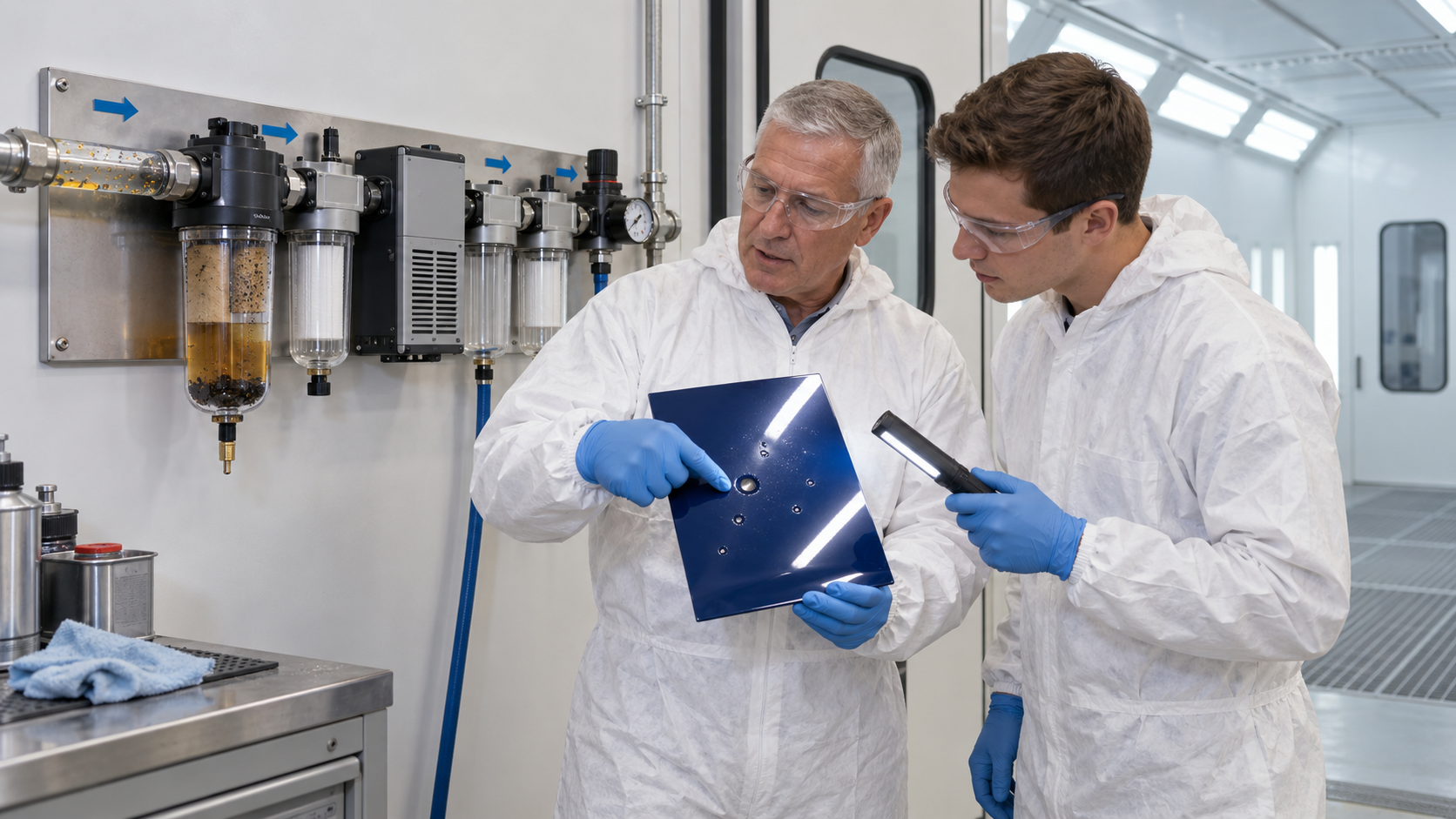
 The Importance of Compressed Air Quality in Spray Finishing The Importance of Compressed Air Quality in Spray Finishing
Your Finish Is Only as Clean as the Air Behind It
When a finish develops fish eyes, craters, inconsistent atomization, or other defects, the first suspects are often the coating, the spray gun, or the operator.
Sometimes the problem started much farther upstream.
It started with the compressed air.
Compressed air is part of the finishing system. Whether you're operating an HVLP spray gun, conventional air spray gun, air-assisted airless system, pressure pot, diaphragm pump, or other air-powered finishing equipment, the quality and condition of the air supply can affect the entire process.
For professional spray finishing, compressed air should be clean, dry, and free of unwanted oil contamination.
Why Does Compressed Air Quality Matter?
A spray gun uses compressed air to do more than simply push material toward the workpiece.
In an air spray system, compressed air is part of the atomization process. It helps break the coating into droplets and shape the spray pattern.
If that air carries water, oil aerosol, dirt, rust, or other contaminants, those contaminants may eventually find their way into the finishing process.
That can affect:
- Finish quality
- Atomization
- Spray-pattern consistency
- Equipment reliability
- Material usage
- Rework and rejection rates
- Production efficiency
You can have an excellent spray gun, the correct air cap, the right fluid nozzle, and a properly prepared coating and still struggle to produce a consistent finish if the compressed air feeding the system is contaminated.
Where Does the Water Come From?
The compressor doesn't have to be sitting in a puddle of water for moisture to become a problem.
The air around us naturally contains water vapor.
When atmospheric air enters a compressor, that moisture enters with it. Compression also raises the temperature of the air.
As the compressed air moves downstream and cools, some of that moisture can condense into liquid water.
Without proper cooling, separation, drying, drainage, and filtration, that water can travel through the distribution system toward the finishing equipment.
On a hot, humid day, the amount of moisture entering a compressed-air system can be substantial.
What Can Contaminated Air Do to a Finish?
Different coatings react differently to contamination, so not every air-quality problem produces the same defect.
Depending on the coating and contaminant, poor compressed-air quality may contribute to:
- Fish eyes or craters
- Blushing or cloudiness in some finishes
- Surface contamination
- Inconsistent atomization
- Irregular spray patterns
- Finish defects requiring sanding and rework
- Rejected parts
And that is where poor air quality becomes expensive.
The cost isn't just the coating that was wasted. It can include labor, booth time, sanding, recoating, production delays, filters, energy, and possibly a rejected product.
Water Isn't the Only Contaminant
Moisture gets much of the attention, but a professional compressed-air system may need to control several types of contamination.
Particulate Contamination
Rust, pipe scale, dirt, and other particles can develop or enter anywhere along the compressed-air system.
Oil Contamination
Depending on the compressor and system, unwanted oil aerosol or other hydrocarbon contamination may need to be removed before the air reaches the finishing process.
Water
Liquid water and water vapor require different treatment strategies. Removing visible condensate alone does not necessarily mean the compressed air is sufficiently dry for the application.
The required level of air treatment should be determined by the finishing process and the sensitivity of the coating being applied.
The Air System Is More Than a Filter at the Spray Gun
A common mistake is trying to solve every compressed-air problem with one filter mounted near the spray booth.
Point-of-use filtration is important, but good compressed-air quality begins upstream.
A properly designed system may include:
- Compressor
- Aftercooler
- Moisture separator
- Air receiver
- Automatic or manual drains
- Refrigerated or desiccant dryer
- Particulate filtration
- Coalescing filtration where appropriate
- Properly designed distribution piping
- Point-of-use filtration
- Regulators
Not every finishing operation requires exactly the same equipment.
The objective is to condition the air to the level required by the process.
What Does an Aftercooler Do?
Air leaving the compressor can be hot.
An aftercooler reduces the temperature of the compressed air, encouraging water vapor to condense into liquid so that it can be separated and drained from the system.
Cooling the air and removing condensed moisture early can reduce the amount of liquid water moving farther downstream.
What Does an Air Dryer Do?
A moisture separator can remove liquid water.
An air dryer addresses water vapor remaining in the compressed air.
Two common technologies are:
Refrigerated Dryers
Refrigerated dryers cool compressed air so additional moisture condenses and can be removed.
Desiccant Dryers
Desiccant dryers use a drying media to remove water vapor and can provide significantly drier compressed air when the application requires it.
Which type is appropriate depends on the required air quality, operating conditions, air demand, climate, and finishing process.
What Do Compressed-Air Filters Do?
Filters are selected for particular contaminants and performance requirements.
Depending on the system, filtration may be used to remove:
- Dirt
- Rust and pipe scale
- Liquid water
- Oil aerosols
- Other fine contaminants
One filter does not necessarily perform every job.
Filter selection should match the contaminant being removed and the air-quality requirement of the finishing process.
Don't Forget the Piping
You can purchase excellent air-treatment equipment and still create problems with a poorly designed distribution system.
Pipe size, layout, drainage, pressure drop, material, airflow demand, and point-of-use connections all matter.
A finishing system also needs enough airflow to operate the equipment correctly.
Clean air that arrives at the spray gun in insufficient volume is still a problem.
Air quality and air quantity need to be considered together.
Maintenance Is Part of Air Quality
Air-treatment equipment does not remain effective forever without attention.
A good maintenance program should include inspection and service of components such as:
- Filter elements
- Moisture separators
- Automatic drains
- Air dryers
- Regulators
- Hoses and fittings
- Distribution piping
A saturated filter or failed drain can turn a well-designed air system into a contaminated one.
When Troubleshooting a Finish, Check the Air
When a finishing defect suddenly appears, don't immediately start changing the spray gun.
Ask:
- Is there water in the air line?
- Are the drains working?
- When were the filters last serviced?
- Is the dryer operating correctly?
- Is oil contamination present?
- Has something changed elsewhere in the compressed-air system?
- Is sufficient CFM reaching the spray equipment while it is operating?
Sometimes the spray gun is simply the last component in the line to reveal a problem that started somewhere else.
Every Finishing Trade Depends on Good Air
Compressed-air quality is not just an automotive refinishing issue or a paint-contractor issue.
It matters in:
- OEM product finishing
- Cabinet and millwork finishing
- Furniture and wood finishing
- Automotive and transportation refinish
- Industrial and protective coatings
- Metal fabrication
- Manufactured products
- Architectural and specialty finishing
The coatings and equipment may change.
The need for clean, dry, properly conditioned compressed air does not.
The Bottom Line
Don't think of compressed air as something that simply comes out of a hose.
It is one of the working components of the finishing system.
The compressor, cooling equipment, moisture separation, dryer, filters, piping, drains, regulators, hoses, spray equipment, coating, and operator all have to work together.
If you're chasing finish problems, don't forget to look upstream.
Sometimes the problem isn't in the paint or the gun. It's in the air.
Finishing Starts With Understanding.
AirSprayTech.com
The Finishing Authority®
|