AirSprayTech.com Academy — Finish Defect Diagnostic Center
Incomplete Coating Cure: Causes, Diagnosis, Correction & Prevention
Dry Is Not Done: Diagnosing Incomplete Coating Cure
A coating may stop feeling wet and still be chemically or physically unready for handling, recoating, immersion, cleaning, assembly, or service. When cure stalls, the finish can remain soft, tacky, weak, solvent-sensitive, easily marked, or unable to deliver the protection promised on the data sheet.
What Incomplete Cure Looks and Feels Like
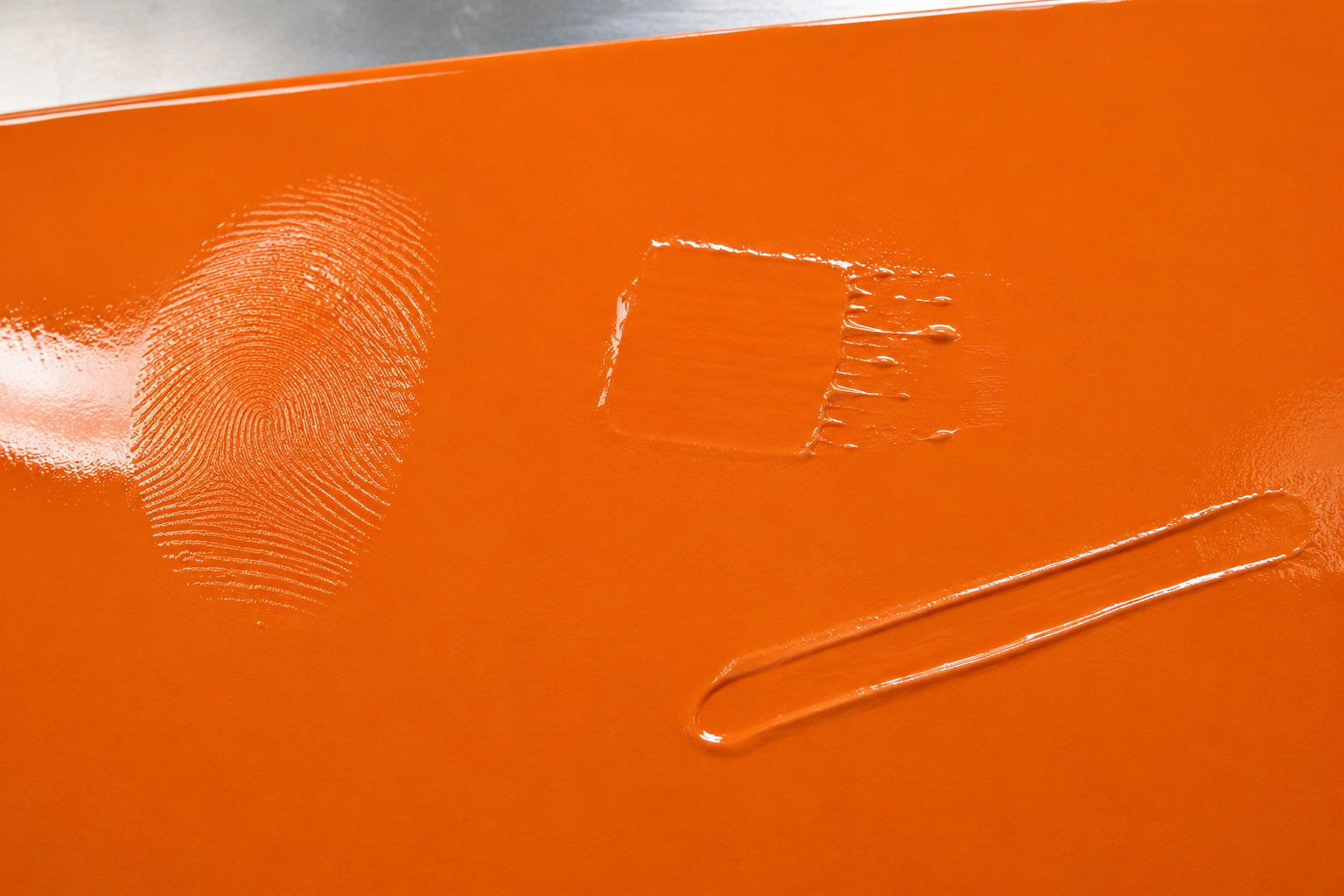
Common clues include fingerprints, pressure marks, blocking, tackiness, poor hardness, easy scratching, soft material beneath a firmer skin, color transfer to cloth, solvent sensitivity, lingering odor, poor sanding, dirt pickup, loss of gloss, weak adhesion, or damage when parts are stacked or assembled. In thick films, the top may appear cured while deeper material remains soft.
Not every soft coating is defective at the moment it is checked. Many systems require additional time before handling, recoating, chemical exposure, immersion, or full service. Compare actual surface temperature and elapsed time with the product’s current cure schedule rather than relying on a calendar alone.
Why Cure Remains Incomplete
Mixing and Material Errors
- Two-component materials are mixed at the wrong base-to-catalyst ratio.
- Components are not fully mixed, or material on the container walls and bottom remains unmixed.
- Required induction time is skipped, or material is used beyond its pot life.
- The wrong activator, hardener, reducer, batch, or incompatible additive is introduced.
Temperature, Humidity, and Air
- Low material or surface temperature slows chemical reaction and solvent release.
- Moisture-cured coatings lack sufficient humidity, while other chemistries are harmed by excessive moisture.
- Poor ventilation allows solvent or water vapor to accumulate near the film.
- Condensation, dew-point violations, or rapid temperature changes interfere with cure.
Film Build and Application
- Excessive thickness traps solvent and lengthens the diffusion path through the film.
- Heavy passes, short flash time, or recoating too soon seals volatile material beneath later coats.
- Runs, sags, corners, recesses, and pooled areas remain softer than correctly applied film.
- Incorrect thinner or too much reducer changes evaporation and cure behavior.
Process and Substrate Conditions
- A bake cycle is too cool, too short, uneven, or measured by oven air rather than actual part temperature.
- Contamination, residual solvent, plasticizer, oil, amine, wax, or incompatible old coating interferes with the reaction.
- Porous or cold substrates alter temperature and solvent release.
- The coating is exposed to water, chemicals, cold, handling, or service before minimum cure is achieved.
Let the Pattern Point to the Cause
| Observation | Likely Direction | What to Verify |
|---|---|---|
| Entire batch remains uniformly soft or tacky | Mix ratio, wrong component, inadequate cure time, low temperature, or material problem | Batch numbers, proportioning, mixing record, induction, pot life, surface temperature, and retained sample |
| Random soft patches occur within otherwise hard coating | Incomplete mixing, contamination, poor agitation, or variable film thickness | Container scraping, mixing method, applicator sequence, local DFT, substrate cleanliness, and pattern boundaries |
| Surface is firm but material beneath is soft | Skin-over, excessive build, forced surface drying, trapped solvent, or premature recoating | Layer thickness, WFT, flash time, airflow, thinner, bake profile, and cross-section |
| Coating is soft in corners, runs, or pooled areas | Localized overbuild and slower solvent escape or reaction | Geometry, application passes, sagging, local thickness, temperature, and cure time |
| Parts stick together or retain packing impressions | Blocking from insufficient cure, excess pressure, heat, plasticizer, or early stacking | Handling schedule, stack temperature, separators, coating hardness, and full-cure requirement |
| Baked coating varies from part to part | Uneven part-metal temperature, oven loading, air balance, line speed, or sensor placement | Temperature profile on representative parts, oven zones, rack density, dwell time, and cure window |
Incomplete Cure Versus Similar Conditions
- Slow drying: A coating may be progressing normally but more slowly because of temperature, humidity, thickness, or ventilation. Incomplete cure becomes a failure when the reaction has stalled, the process was wrong, or required properties are not achieved.
- Solvent entrapment: Retained solvent can keep a film soft or cause popping, blistering, or later shrinkage. It is one possible cause of poor cure, not a synonym for every cure problem.
- Blocking: Coated surfaces stick or print when pressed together. Insufficient cure is common, but heat, pressure, plasticizer, and coating design may also contribute.
- Plasticizer migration: Mobile material from a substrate, sealant, hose, gasket, or underlying layer can soften the surface even after the coating originally cured.
- Surface contamination: Oil, silicone, amine blush, wax, or residue may feel slick or tacky while the film beneath is cured.
- Thermoplastic behavior: Some coatings soften again with heat or solvent without being chemically under-cured.
- Incorrect product selection: A fully cured flexible coating may legitimately remain softer than a rigid coating. Compare it with the specified performance, not a different chemistry.
A Practical Cure Investigation
- Quarantine affected work. Prevent stacking, immersion, chemical exposure, shipping, assembly, or recoating until disposition is established.
- Record the symptoms. Photograph marks, tack, gloss change, dirt pickup, blocking, scratches, or transfer. Map soft and sound areas without creating unnecessary damage.
- Confirm product requirements. Review the current data sheet for mix ratio, induction, pot life, thickness, cure temperature, humidity, ventilation, recoat, handling, and full-service times.
- Calculate actual cure exposure. Use recorded substrate or part temperature, not only room or oven air temperature. Account for cold nights, heavy steel, thick film, and interruptions.
- Audit the material chain. Verify product identity, batch, shelf life, storage, component pairing, proportioning equipment, reducer, and any unauthorized additive.
- Review mixing and application. Check agitation, container scraping, induction, pot life, wet film, flash, recoat timing, airflow, and areas of overbuild.
- Use approved comparative tests. Compare affected areas with sound controls or retained samples using the specified hardness, solvent-resistance, drying, or laboratory method.
- Interpret the failure plane. Determine whether softness is limited to the surface, a particular layer, or the complete system. A cross-section may reveal trapped soft material.
- Consult the manufacturer. Provide complete records and obtain written guidance before attempting heat, extended cure, overcoating, or chemical exposure.
Tests That Can Support the Diagnosis
- ASTM D1640/D1640M — Drying, Curing, or Film Formation of Organic Coatings. Use only the applicable procedure and report its defined stage.
- ASTM D5402 — Assessing Solvent Resistance of Organic Coatings Using Solvent Rubs.
- ASTM D4752 — Measuring MEK Resistance of Ethyl Silicate Inorganic Zinc-Rich Primers by Solvent Rub. Its chemistry-specific scope matters.
- ASTM D3363 — Film Hardness by Pencil Test.
No single field test proves cure for every coating. Solvent rub, pencil hardness, indentation, tack, adhesion, and handling observations measure different properties and depend on film thickness, temperature, solvent, force, timing, operator, and coating chemistry. Use the test and acceptance criterion specified by the manufacturer or project.
Correcting Incomplete Cure
First determine whether the coating is simply early in a normal cure schedule. Additional time, controlled temperature, humidity, or ventilation may allow some correctly mixed systems to reach their properties, but only when the coating manufacturer confirms the remedy in writing. Heating an unknown or solvent-rich film can cause popping, blistering, fire, exposure, or further damage.
A two-component coating mixed at the wrong ratio, combined with the wrong hardener, used beyond pot life, contaminated, or fundamentally incompatible may never cure properly. Applying another coat does not correct a defective layer beneath it. Soft material can cause wrinkling, solvent attack, poor adhesion, imprinting, and later delamination.
When recovery is not technically supported, remove the affected coating to a sound, clean boundary or substrate. Correct material controls, temperature, ventilation, thickness, mixing, and schedule; then reapply the approved system. Verify cure before recoating or returning the item to service.
Preventing Cure Failures
- Confirm product, component, batch, shelf life, storage condition, and approved thinner before mixing.
- Measure multi-component ratios accurately or verify proportioning equipment at the required frequency.
- Mix for the specified time and method, scraping container sides and bottom; observe induction and pot life.
- Monitor material, air, and surface temperatures plus humidity and dew point throughout application and cure.
- Provide the airflow required to remove water or solvent without creating premature skinning or contamination.
- Control wet and dry film thickness, flash time, and recoat intervals for every layer.
- Profile actual part-metal temperature and dwell time in ovens rather than relying only on the controller display.
- Keep incompatible cleaners, oils, plasticizers, sealants, and additives away from prepared surfaces and coating materials.
- Do not stack, package, immerse, wash, assemble, or place coating in chemical service before the stated milestone.
- Retain batch, mix, environmental, thickness, oven, and cure records so a failure can be traced.
Application-Specific Clues
Two-component epoxies and polyurethanes: Ratio, mixing, induction, pot life, temperature, film build, and correct hardener are central. A soft patch within a hard area often suggests incomplete mixing or local contamination.
Moisture-cured coatings and inorganic zinc primers: Humidity, ventilation, film thickness, and chemistry-specific cure verification matter. Do not apply a generic solvent-rub rule to every product.
Baked liquid and powder coatings: Cure depends on the part’s time at the required metal temperature. Heavy and light sections on one assembly may reach different cure states even in the same oven.
Floors, linings, roofs, tanks, and immersion service: Early water, traffic, chemicals, condensation, or low substrate temperature can permanently affect performance. Full-service cure is usually more demanding than dry-to-touch or light foot-traffic time.
Technical References
- ASTM D1640/D1640M: Drying, Curing, or Film Formation of Organic Coatings
- ASTM D5402: Solvent Resistance of Organic Coatings Using Solvent Rubs
- ASTM D4752: MEK Resistance of Inorganic Zinc-Rich Primers
- ASTM D3363: Film Hardness by Pencil Test
© 2026 Azimuth Spray Systems, LLC. AirSprayTech.com — The Finishing Authority®. All rights reserved.