AirSprayTech.com Academy — Finish Defect Diagnostic Center
When Paint Turns to Powder: Understanding Chalking
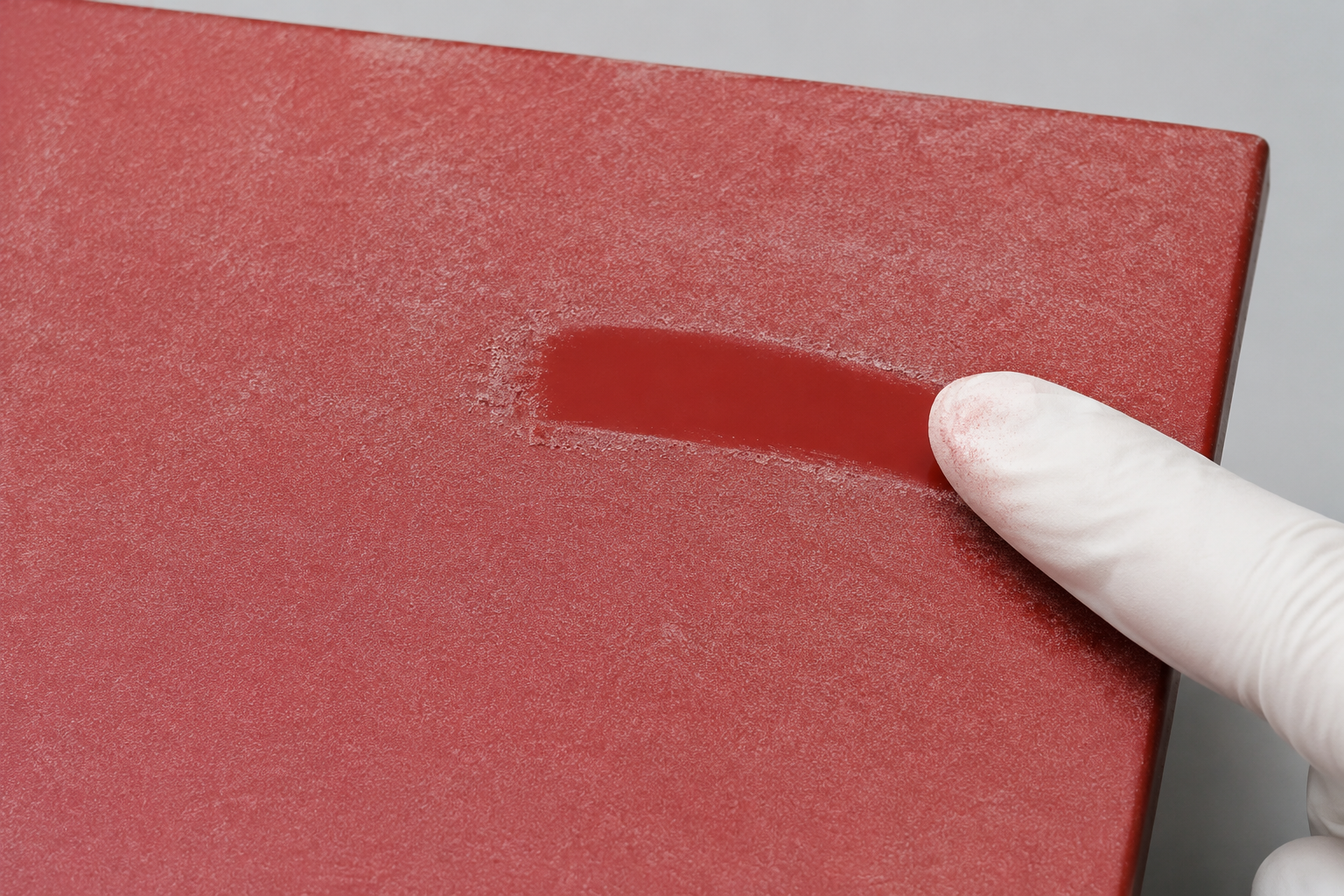
Chalking is the formation of a loose, powdery material at the surface of a coating. It commonly appears as a pale residue that transfers to a fingertip, glove, cloth, or tape. The coated surface may also look faded, dull, washed out, or uneven. Chalking is usually associated with weathering and degradation of the coating binder, which gradually leaves pigment and other solid particles less securely bound at the surface.
What Chalking Looks and Feels Like
- A fine powder on the coating surface, often white or lighter than the original finish.
- Residue that transfers readily to a hand, glove, cloth, tape, or nearby surface.
- Loss of color depth, gloss, and surface uniformity.
- More severe powdering on sun-facing, weather-exposed, hot, or chemically exposed areas.
- Chalk streaks or “run-down” staining on masonry, trim, windows, or equipment below the coated surface.
- Progressive thinning or erosion when degradation continues for a long period.
A small amount of controlled chalking may be a normal weathering characteristic of some exterior coating types. Heavy or premature chalking, however, may indicate that the coating is unsuitable for the exposure, was improperly formulated or applied for the service, has exceeded its useful life, or has been attacked by ultraviolet radiation, heat, chemicals, cleaners, or other environmental forces.
Why a Coating Chalks
A coating film depends on its resin or binder to hold pigment and other components together and to the surface. Weathering—especially ultraviolet exposure—can degrade that binder at the outermost layer. As the surface resin breaks down, pigment and filler particles become exposed and can be released as powder. Water, wind, cleaning, and abrasion then remove the loosened material, allowing weathering to continue into the film.
Exposure and Service
- Long-term ultraviolet radiation and exterior weathering.
- Heat, moisture, freeze-thaw cycling, wind, and airborne abrasion.
- Strong cleaners, repeated washing, chemical fumes, or incompatible service chemicals.
- Exposure beyond the coating system’s intended environment or service life.
Product Selection
- Interior coating used outdoors.
- Binder chemistry or pigment package with insufficient weathering resistance for the exposure.
- Topcoat omitted where a weather-resistant finish was required.
- Color or coating system selected without considering ultraviolet stability.
Application Variables
- Excessive thinning or an incorrect thinner or reducer.
- Insufficient dry-film thickness or uneven coverage.
- Improper mixing, ratio, induction, cure, or application conditions.
- Applying outside the manufacturer’s temperature, humidity, or recoat limits.
Substrate and System
- Porous substrate not sealed or primed as required.
- Incompatible underlying coating, repair material, or surface treatment.
- Uneven film build caused by geometry, access, application method, or absorption.
- Existing degraded coating left beneath a maintenance coat.
Chalking Versus Surface Contamination
| Condition | Typical Clue | Diagnostic Direction |
|---|---|---|
| Chalking | Fine material originates from the coating surface; exposed areas may be faded or dull and the residue can return as weathering continues. | Compare sheltered and exposed areas; evaluate coating age, film thickness, exposure, binder condition, and specified chalk rating. |
| Dust or jobsite dirt | Deposit may collect on horizontal surfaces, ledges, airflow paths, or areas near construction activity. | Identify the deposit and its source; inspect nearby uncoated objects and protected areas. |
| Overspray | Rough or powdery deposit follows spray activity, ventilation, or line-of-sight from another operation. | Review timing, airflow, adjacent work, and whether particles sit on top of an intact finish. |
| Soluble salts | Often associated with marine, industrial, concrete, or moisture exposure; appearance alone is unreliable. | Use the project-specified extraction and analytical method. Do not identify salts by taste or touch. |
| Efflorescence | White crystalline deposit commonly associated with moisture movement through masonry or concrete. | Investigate moisture source and substrate chemistry; determine whether the deposit is emerging from beneath the coating. |
| Poor gloss or fading | Appearance changes without significant loose powder transfer. | Measure or compare color and gloss as specified, and assess cure, cleaning damage, and weathering. |
A Practical Inspection Sequence
- Document before cleaning. Photograph the surface under direct and raking light. Record location, orientation, elevation, color, coating age, service, and weather exposure.
- Compare exposure zones. Examine sun-facing and shaded areas, vertical and horizontal surfaces, protected edges, undersides, and locations exposed to chemicals, heat, washdown, or abrasion.
- Perform a cautious screening wipe. Use a clean cloth or glove of contrasting color on a small area. Record the amount and color of material transferred. Do not treat this as a standardized numerical rating.
- Check whether the deposit belongs to the coating. Inspect nearby glass, metal, equipment, ledges, and uncoated areas for the same residue. Consider dust-producing work, overspray, salts, concrete deposits, and cleaning chemicals.
- Review the coating system. Verify product names, batch information, specified and measured film thickness, application records, cure conditions, intended exposure, and maintenance history.
- Use the specified test method. If the project requires a chalk rating, follow the stated edition, apparatus, reference standard, sampling plan, and acceptance criteria.
- Assess the remaining film. Determine adhesion, thickness, continuity, brittleness, erosion, corrosion, and substrate condition before selecting cleaning or recoating work.
Standardized Chalking Assessments
ASTM D4214-23, Standard Test Methods for Evaluating the Degree of Chalking of Exterior Paint Films, provides procedures for evaluating chalking, including transfer of chalk to a fabric, fingertip, or adhesive tape and comparison with applicable reference standards. Its scope and limitations must be reviewed before use; not every procedure or substrate is interchangeable.
ISO 4628-6:2023 addresses assessment of the degree of chalking by a tape method. ASTM and ISO results should not be assumed equivalent. Use the method and edition named by the project specification, coating qualification program, owner, or manufacturer.
Corrective Action
The proper response depends on whether the chalking is light and cosmetic or evidence of serious film erosion. Begin with a representative test area and obtain agreement on the cleaning and repair standard.
- Light chalking: The surface may be restored by cleaning, and some finishes may permit polishing. Follow the coating manufacturer’s instructions; aggressive polishing can remove additional film and is unsuitable for many protective, architectural, roof, floor, lining, and textured systems.
- Before recoating: Remove loose chalk, dirt, salts, oil, biological growth, and other contaminants by an approved method. Rinse when required and allow the substrate to dry. Verify cleanliness and adhesion with representative test areas.
- Heavy chalking or erosion: Remove degraded material to a sound, compatible surface. Repair corrosion, exposed substrate, failed seams, cracks, and other defects before applying the specified primer and finish system.
- Unknown existing coating: Confirm compatibility and perform adhesion testing of the proposed maintenance system. A new coating applied over loose chalk may adhere to the powder instead of the sound film and fail prematurely.
Pressure washing can remove chalk from some robust exterior surfaces, but it can also drive water into joints, damage soft coatings, scar wood or masonry, or create contaminated runoff. Select pressure, nozzle, distance, cleaner, containment, and drying time for the actual substrate and coating system. Observe environmental and worker-protection requirements.
Prevention
- Select a complete coating system rated for the expected ultraviolet, weather, temperature, chemical, and cleaning exposure.
- Use exterior-grade or weather-resistant topcoats where the specification requires them.
- Prepare and prime porous or weathered substrates according to the coating manufacturer’s instructions.
- Measure and document wet- and dry-film thickness; do not over-thin or spread the coating beyond its stated coverage.
- Control mix ratio, induction time, pot life, application conditions, recoat interval, and cure.
- Maintain coated assets before severe erosion exposes primers or substrates.
- Use cleaning chemicals and procedures compatible with the coating.
- Retain product records, approved samples, inspection data, and photographs for future comparisons.
Special Application Notes
Powder coatings: Exterior durability depends on resin chemistry, pigment selection, film thickness, cure, pretreatment, and exposure. A powder finish selected for indoor service may lose gloss, fade, and chalk rapidly outdoors. Verify the powder supplier’s exterior-durability classification and cure schedule.
Protective coatings, roofs, floors, and linings: A powdery deposit may be coating degradation, traffic wear, mineral residue, process contamination, efflorescence, or chemical attack. Determine the source before cleaning or recoating. On containment linings and immersion systems, consult the coating manufacturer and the governing specification because the consequence of film loss may be more important than appearance.
Automotive, aerospace, rail, and OEM finishes: Chalking may accompany ultraviolet degradation, chemical attack, repeated cleaning, heat, or an unsuitable repair system. Polishing may improve appearance only when the remaining film thickness and manufacturer’s procedure permit it.
Technical References
- ASTM D4214-23: Evaluating the Degree of Chalking of Exterior Paint Films
- ISO 4628-6:2023: Assessment of Degree of Chalking by Tape Method
- PPG Automotive Refinish: Chalking—Causes, Prevention, and Rectification
- Sherwin-Williams: How to Fix Exterior Paint Chalking
Technical notice: This article provides general educational guidance. Always follow the current coating technical data sheet, safety data sheet, project specification, equipment instructions, and applicable environmental and workplace requirements. Qualified inspection or laboratory analysis may be necessary when failure consequences are significant.
© 2026 Azimuth Spray Systems, LLC. AirSprayTech.com — The Finishing Authority®. All rights reserved.