AirSprayTech.com Academy — Finish Defect Diagnostic Center
When the Color Goes Cloudy: Diagnosing Blushing and Blooming
A finish can lose depth and clarity without cracking, peeling, or becoming rough. The milky haze may come from moisture trapped during solvent evaporation, a reaction product deposited on an epoxy, migrated ingredients, or service exposure—and each mechanism requires a different response.
What Blushing and Blooming Look Like
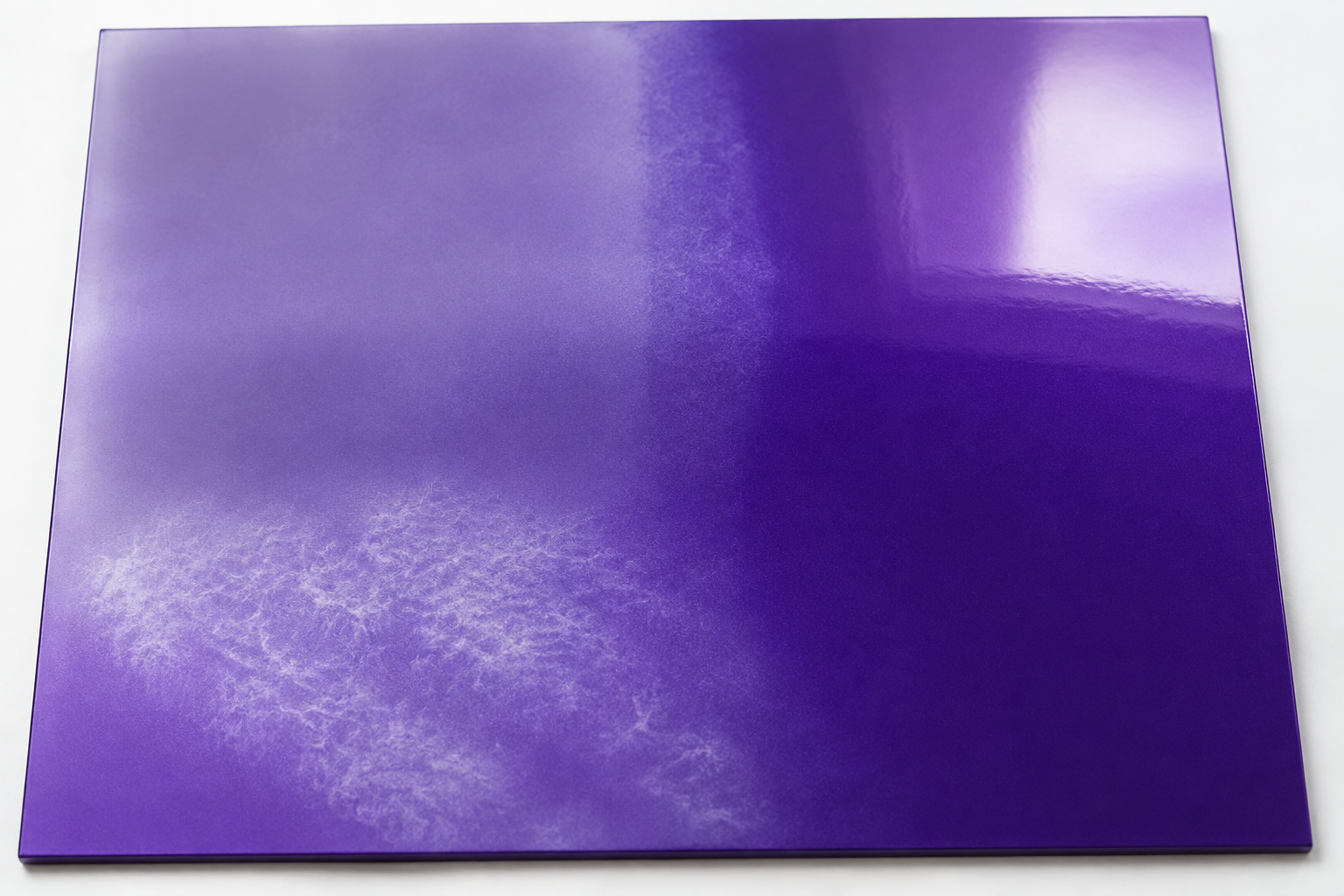
The defect may appear as a pale mist, fog, veil, whitish cast, loss of color depth, lowered gloss, or uneven cloudy patches. Dark and highly saturated colors usually make it easiest to see. Some blush appears within the film and remains smooth; some bloom sits at the surface and may feel waxy, greasy, powdery, or slightly tacky.
Patterns can follow spray passes, airflow, cold zones, thick areas, edges, water exposure, condensation paths, or the boundary between application shifts. Note whether the haze appeared while the coating was wet, during cure, after overnight exposure, or only after service. Timing is one of the strongest diagnostic clues.
How the Defect Develops
Evaporative Cooling and Moisture
- Fast solvent evaporation cools the wet film below the surrounding air’s dew point.
- Moisture condenses in or on lacquer, clearcoat, or another sensitive film before it closes.
- High humidity, cold material, cold parts, drafts, and excessive atomizing air increase cooling.
- A thinner or reducer is too fast for the temperature, humidity, coating, or repair size.
Epoxy Amine Blush
- Amine curing agents react at the surface in the presence of moisture and carbon dioxide.
- Cool, damp conditions and certain epoxy-hardener combinations increase visible residue.
- The deposit can interfere with sanding, bonding, recoating, and appearance if not removed.
- Product formulations vary; some are promoted as blush-resistant, but surface preparation requirements still apply.
Material Migration and Surface Bloom
- Wax, plasticizer, lubricant, surfactant, low-molecular-weight material, or additive migrates to the surface.
- Incompatible substrate, sealant, gasket, old coating, cleaner, or repair material contributes mobile ingredients.
- Temperature cycling or aging brings material to the surface after the coating initially looked acceptable.
- Incorrect formulation, mix, cure, or film build changes component mobility.
Application and Service Conditions
- Water, condensation, rain, cleaner, chemical vapor, or immersion contacts the film before full cure.
- Compressed air contains moisture or the spray area has unstable temperature and humidity.
- Heavy film, short flash, trapped solvent, or poor ventilation prolongs vulnerability.
- Heat, UV, chemicals, cleaning, and environmental deposits create later haze or blooming.
Use the Pattern to Narrow the Cause
| Observation | Likely Direction | What to Verify |
|---|---|---|
| Milky haze appears during spraying or immediately afterward | Evaporative cooling, moisture condensation, fast thinner, high humidity, or excessive airflow | Surface temperature, dew point, humidity, reducer selection, atomizing pressure, drafts, and material temperature |
| Waxy or greasy film appears on curing epoxy | Possible amine blush | Epoxy chemistry, hardener, cure temperature, humidity, manufacturer guidance, and water solubility |
| Whitish deposit returns after wiping | Ingredient migration, plasticizer, wax, surfactant, substrate contribution, or continued chemical reaction | Cleaner used, time to reappear, substrate, sealants, old layers, temperature, and laboratory identification |
| Haze follows spray passes or cold airflow path | Application-zone cooling or uneven evaporation | Gun pressure, pass thickness, booth airflow, cold spots, reducer, flash, and pattern overlap |
| Bloom appears after rain, washdown, immersion, or chemical exposure | Early service, water sensitivity, chemical attack, absorbed moisture, or residue | Full-cure time, exposure records, cleaner chemistry, film integrity, and product resistance |
| Cloudiness exists below a clear surface | Moisture or solvent trapped within a layer, affected undercoat, or intercoat haze | Layer sequence, flash, thickness, cross-section, repair history, and whether polishing changes the appearance |
Blushing and Blooming Versus Similar Defects
- Amine blush: a chemistry-specific surface residue associated with some curing epoxies. It should not be treated as identical to moisture trapped in a lacquer film.
- Poor or uneven gloss: changes reflected light but may not create the characteristic whitish or milky cast.
- Mottling and clouding: uneven pigment or metallic-flake orientation changes color distribution; blushing usually reduces clarity or saturation with a pale veil.
- Chalking: binder degradation creates removable pigment powder after weathering. Bloom can occur much earlier and may be waxy, soluble, or embedded.
- Overspray or dry spray: creates a rough, granular surface. True blush may remain physically smooth.
- Water spotting: produces discrete rings, spots, mineral deposits, or etching rather than a general mist.
- Fading: pigment or binder change reduces color strength over time and does not normally wipe away or respond like a moisture haze.
- Surface contamination: cleaner residue, dust, salt, wax, or polish can imitate bloom. Identify what is present rather than assuming it came from the coating.
A Practical Investigation Procedure
- Photograph before wiping. Record overall distribution and close details under diffuse and low-angle light. Include sound adjacent coating for comparison.
- Establish timing. Determine whether the haze formed during application, overnight cure, recoating, early water exposure, cleaning, or long-term service.
- Describe the surface. Note color, gloss, clarity, feel, tack, powder, waxiness, odor, and whether the defect appears within the film or on top.
- Map the pattern. Compare spray passes, airflow, elevations, cold zones, thick areas, batches, shifts, substrate types, water paths, and exposure boundaries.
- Review environmental data. Reconstruct air and surface temperature, relative humidity, dew point, material temperature, drafts, ventilation, and weather throughout application and cure.
- Audit materials and application. Verify product, batch, hardener, mix ratio, thinner or reducer, induction, pot life, gun settings, compressed-air quality, film thickness, flash, and recoat intervals.
- Perform controlled cleaning trials. Use only manufacturer-approved water, detergent, solvent, or polishing methods on small documented areas. Observe whether the haze transfers, dissolves, returns, or remains below the surface.
- Check adhesion and cure where required. Blush or bloom can be cosmetic, but it may also warn of affected undercoats, poor intercoat adhesion, trapped moisture, or incomplete cure.
- Use laboratory analysis when needed. Microscopy, spectroscopy, extraction, ion analysis, or cross-sections can distinguish migrated material, moisture effects, degradation, and contamination.
Measuring Appearance Changes
- ASTM D523-25 — Specular Gloss. Controlled gloss readings can document change, but gloss alone does not identify the cause of haze.
- ASTM D2244-25 — Calculation of Color Tolerances and Color Differences from Instrumentally Measured Color Coordinates.
Use the instrument geometry, illuminant, observer, calibration, substrate, measurement locations, and acceptance criteria required by the specification. Curved surfaces, texture, metallic finishes, gloss differences, and translucent layers can influence readings. Always compare representative sound and affected areas.
Correcting Blushing and Blooming
Do not choose a repair until the mechanism is known. A light moisture blush in a compatible solventborne finish may sometimes be corrected after proper drying by a manufacturer-approved polishing or reflow procedure. Severe haze, affected undercoats, trapped moisture, or poor adhesion may require sanding or removal and refinishing under controlled conditions.
For amine blush, follow the epoxy manufacturer’s instructions. Many systems require washing with clean water and an abrasive pad, drying, and then sanding as specified. Solvent wiping alone may spread or fail to remove a water-soluble residue. Never assume one epoxy manufacturer’s procedure applies to every formulation.
Recurring wax, plasticizer, surfactant, or chemical bloom requires correction of the source. Recoating over migrating material can cause adhesion loss or a repeat defect. Remove unsound or contaminated layers, correct the substrate, sealant, old coating, formulation, cure, or exposure problem, and verify compatibility with a test area.
Preventing the Defect
- Use the specified thinner or reducer for the coating, temperature, humidity, airflow, and repair size.
- Keep air, material, and substrate temperatures within limits and safely above the required dew-point margin.
- Avoid excessive atomizing pressure, direct drafts, or forced air that overcools the wet film.
- Maintain clean, dry compressed air and effective booth temperature, humidity, and ventilation control.
- Apply the correct film thickness and allow required flash, recoat, and full-cure time.
- Protect uncured coating from condensation, rain, washdown, chemicals, and early immersion.
- For epoxy systems, anticipate product-specific amine blush and complete the required wash and preparation before recoating.
- Verify compatibility with substrates, sealants, plastics, old coatings, cleaners, polishes, and repair materials.
- Document environment, batches, mixing, application settings, film thickness, and cure so patterns can be traced.
Application-Specific Clues
Automotive, wood, furniture, and lacquer finishes: Fast solvent, cold parts, high humidity, drafts, and excessive air pressure frequently produce a smooth milky haze during evaporation.
Epoxy floors, marine work, composites, and protective coatings: Separate amine blush from incomplete cure, water exposure, contamination, and trapped moisture. Recoat adhesion can be affected even when the appearance seems minor.
Industrial, OEM, aerospace, and rail: Review booth zones, compressed air, part temperature, clearcoat and undercoat flash, bake profile, sealants, plastic components, cleaners, and packaging contact.
Exterior, roof, tank, and immersion systems: Dew, rain, condensation, chemical vapor, early immersion, and substrate moisture can create haze while also threatening adhesion or barrier performance.
Technical References
- PPG: Blushing—Causes, Prevention, and Rectification
- WEST SYSTEM: Epoxy Surface Preparation and Amine Blush
- ASTM D523-25: Specular Gloss
- ASTM D2244-25: Instrumentally Measured Color Differences
© 2026 Azimuth Spray Systems, LLC. AirSprayTech.com — The Finishing Authority®. All rights reserved.