AirSprayTech.com Academy — Finish Defect Diagnostic Center
Rust’s Side Door: Diagnosing Undercutting and Rust Creep
Corrosion does not always attack straight through a coating. Once moisture and electrolyte reach steel at a scratch, edge, holiday, weld, or fastener, corrosion can travel sideways beneath apparently sound film and quietly enlarge the damaged area.
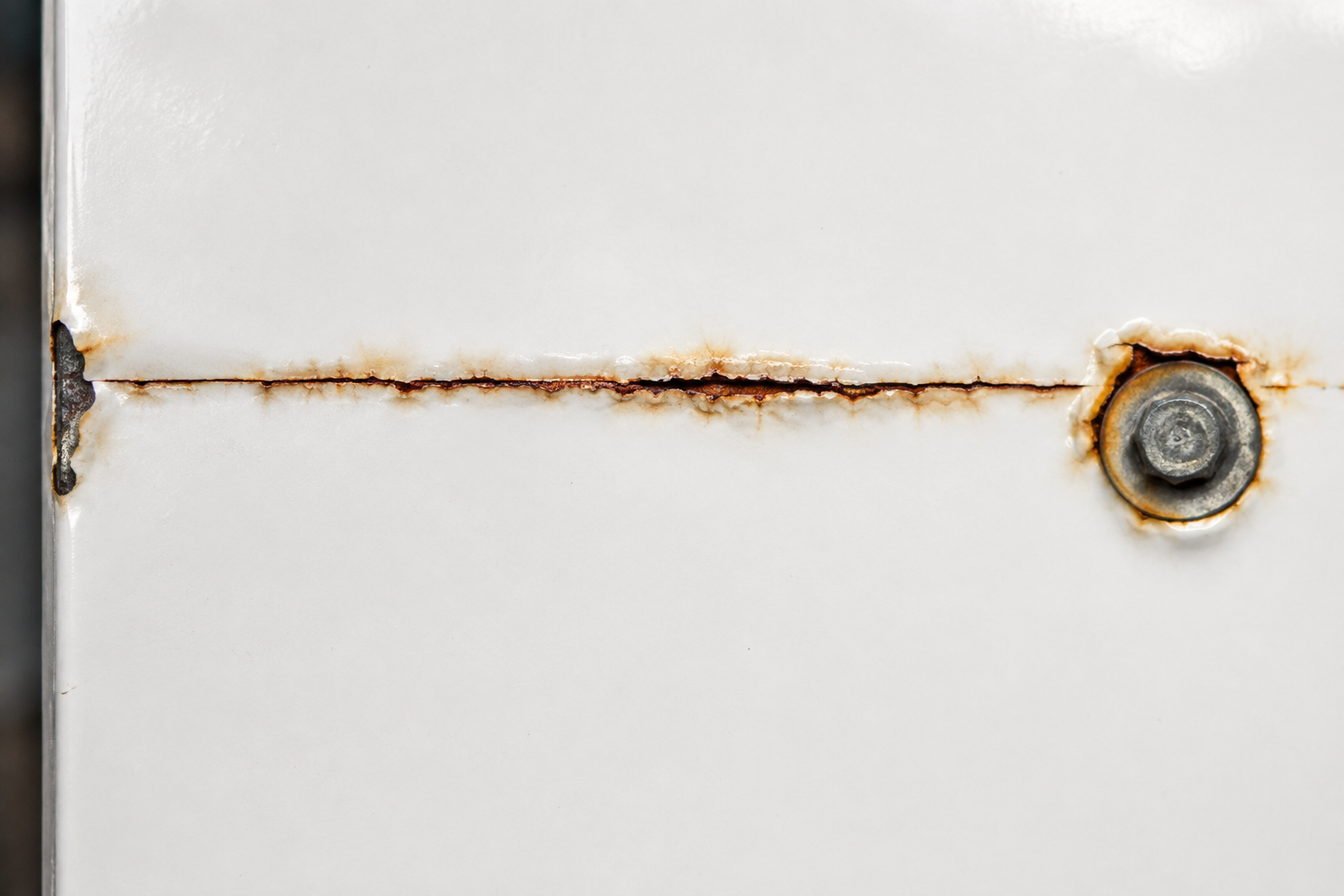
What Undercutting and Rust Creep Look Like
Typical signs include a narrow rust-colored band beside a scratch, scribe, chip, cut edge, weld, seam, fastener, or holiday. The adjacent coating may lift, blister, curl, crack, or sound hollow when gently probed under an approved inspection procedure. Rust staining can bleed outward onto the surface, making the affected area appear larger than the actual undercut zone.
On laboratory panels, creep is commonly evaluated after a deliberate scribe and controlled corrosive exposure. In service, the initiating defect may be accidental and irregular. The same principle applies: identify where the barrier was first breached, then establish how far corrosion and adhesion loss have progressed beneath the coating.
Why Corrosion Travels Beneath a Coating
The Entry Point
- Scratches, impacts, holidays, pinholes, cracks, chips, cut edges, and handling damage expose steel.
- Poor edge coverage, rough welds, seams, bolts, and difficult geometry leave thin or discontinuous film.
- Fabrication, drilling, welding, assembly, transport, or field installation damages a previously complete system.
- A repair boundary remains contaminated, poorly feathered, or inadequately overlapped.
Surface Preparation
- Oil, dust, salts, rust, mill scale, moisture, or cleaning residue remains beneath the coating.
- The required cleanliness or anchor profile is not achieved or prepared steel is allowed to flash rust.
- Soluble salts attract moisture and sustain corrosion beneath the film.
- Pits, laminations, weld spatter, sharp edges, and crevices are not properly prepared or detailed.
Coating-System Weakness
- The primer provides inadequate wet adhesion, corrosion resistance, or compatibility for the exposure.
- Insufficient film build, porosity, poor cure, incorrect mix, or excessive thinning weakens the barrier.
- Intercoat adhesion failure gives water and ions an easier lateral path.
- Aged, brittle, chalked, cracked, or permeable coating no longer limits moisture transport.
Service Environment
- Salt water, deicing salts, condensation, humidity, immersion, chemicals, or industrial fallout provides electrolyte.
- Wet-dry cycling can concentrate salts and repeatedly feed the corrosion cell.
- Heat, UV, vibration, flexing, abrasion, and thermal cycling enlarge the original defect.
- Poor drainage, water traps, crevices, insulation, and dissimilar metals intensify local attack.
Read the Pattern Before Removing Evidence
| Observed Pattern | Likely Direction | What to Check |
|---|---|---|
| Rust band spreads evenly from both sides of a scratch or scribe | Corrosion creep from a defined coating break | Average undercut distance, coating adhesion, primer performance, salts, exposure time, and surface preparation |
| Failure concentrates at cut edges, corners, welds, or fasteners | Thin film, edge geometry, crevice moisture, missed stripe coat, or assembly damage | Edge radius, weld finish, local DFT, stripe coat, sealing, drainage, and galvanic conditions |
| Orange-brown stain extends over firmly attached coating | Rust runoff or soluble corrosion products may have traveled across the surface | Clean gently in a test area, then separate staining distance from actual adhesion loss |
| Blisters form beside a holiday or scratch | Underfilm corrosion, osmotic action, salts, moisture, or cathodic activity | Blister contents, pH where appropriate, salts, failure plane, corrosion products, and moisture source |
| Threadlike corrosion branches under the coating | Possible filiform corrosion rather than a broad creep front | Substrate, pretreatment, humidity, coating permeability, edge defects, and filament morphology |
| Coating lifts far beyond visible rust | Water-driven delamination, weak adhesion, contamination, or intercoat failure may precede visible corrosion | Failure plane, back of removed film, wet adhesion, contamination, and substrate condition |
Undercutting Versus Related Defects
- Surface rust staining: discoloration lies on top of the coating and may come from nearby steel, fasteners, runoff, or airborne particles. It does not prove that corrosion has traveled beneath the film.
- General rusting: widespread corrosion may appear through many pores or thin areas without a single identifiable creep front.
- Blistering: domes form because adhesion is lost and pressure or products accumulate beneath the film. Corrosion may cause blisters, but not every blister contains rust.
- Peeling and delamination: coating separates from a substrate or another layer. Rust creep is specifically associated with corrosion advancing from a break, although the mechanisms can occur together.
- Filiform corrosion: narrow threadlike filaments travel beneath coatings, often on coated aluminum or steel under characteristic humidity conditions. Its shape differs from a broad rust-creep band.
- Edge breakdown: loss at an edge may result from low film build or damage. It becomes undercutting when corrosion progresses laterally beneath adjacent coating.
- Cathodic disbondment: adhesion loss associated with cathodic protection involves a specific electrochemical mechanism and test methods; it should not automatically be labeled ordinary rust creep.
A Practical Field Investigation
- Document before cleaning. Photograph the overall distribution, original opening, rust stain, lifted boundary, and representative details with a scale.
- Map initiation points. Note scratches, holidays, edges, welds, seams, fasteners, penetrations, repairs, water traps, insulation terminations, and damage from other trades.
- Separate stain from failure. Do not measure to the end of loose surface staining. Use the governing method to identify the actual undercut or disbonded boundary.
- Determine the failure plane. Where authorized, lift loose coating carefully and examine its back and the exposed steel. Record whether separation is at steel, within primer, or between coats.
- Measure the creep consistently. Establish the original scribe or damage line and use the formula, number of readings, preparation, and reporting rules required by the specified method.
- Assess surrounding coating. Record dry-film thickness, holidays, blisters, cracks, adhesion, chalking, and additional corrosion. Compare exposed and sheltered areas.
- Evaluate the substrate. Examine corrosion morphology, pits, mill scale, welds, edge condition, profile, soluble salts, moisture paths, and possible galvanic couples.
- Reconstruct history. Review surface preparation, environmental readings, delay before priming, products, batches, thickness, cure, repairs, handling, and service exposure.
- Use laboratory support when needed. Cross-sections, microscopy, elemental analysis, ion testing, and coating identification may be appropriate for widespread, high-value, disputed, or safety-critical failures.
Standards for Evaluating Rust Creep
- ASTM D1654-24 — Evaluation of Painted or Coated Specimens Subjected to Corrosive Environments. It includes procedures for evaluating corrosion and loss from a scribe on test specimens.
- ISO 4628-8:2012 — Assessment of degree of delamination and corrosion around a scribe or other artificial defect.
- AMPP TM01-69 — Method for Evaluating Scribe Undercutting on Coated Steel Test Panels Following Corrosion Testing.
- ASTM D610-25 — Evaluating Degree of Rusting on Painted Steel Surfaces. This rates visible rusting and should not be substituted for a specified scribe-creep method.
Different methods can define the measurement boundary, coating removal, number of readings, calculation, and rating differently. Results obtained by unlike procedures are not automatically interchangeable. Use the exact standard, edition, exposure, and acceptance criteria named in the specification.
Correcting Undercutting and Rust Creep
Coating over the visible rust line traps the active failure beneath a new layer. Determine the full extent of loose, undercut, contaminated, and corroded material first. Remove defective coating to a firmly attached boundary using the approved method, feather edges where permitted, and prepare exposed steel to the specified cleanliness and surface profile.
Remove soluble salts, dust, oil, moisture, corrosion products, and weak material with verified procedures. Correct the source of water, condensation, chemical exposure, crevice retention, galvanic contact, or mechanical damage. Repair sharp edges, weld defects, seams, and drainage details where the project permits.
Rebuild the specified primer and coating system at the required individual and total film thicknesses. Apply stripe coats, observe environmental and recoat limits, and allow full cure. Complete the required visual, thickness, adhesion, and holiday inspections. If creep is widespread or surrounding coating has poor wet adhesion, full removal may be more reliable than isolated spot repair.
Preventing Rust Creep
- Remove oil, salts, rust, mill scale, dust, moisture, and other contaminants to the specified condition.
- Create and verify the required surface profile; prime prepared steel before it deteriorates or flash rusts.
- Round or treat sharp edges, smooth welds, remove spatter, and address pits and crevices as specified.
- Stripe-coat welds, edges, corners, fasteners, and difficult geometry when required.
- Select a primer and system with corrosion resistance, adhesion, permeability, flexibility, and chemical resistance suited to service.
- Control wet and dry film thickness in local details as well as broad-area averages.
- Follow mix ratio, induction, pot life, thinner, flash, recoat, environmental, and cure requirements.
- Protect completed coating from fabrication, transport, erection, abrasion, welding, and impact damage.
- Seal water traps, manage drainage and condensation, and isolate dissimilar metals where the design requires it.
- Inspect and repair scratches, holidays, chips, and edge damage before corrosion establishes an underfilm path.
Application-Specific Clues
Marine, offshore, and coastal assets: Chloride contamination, wet-dry cycling, welds, edges, splash zones, crevices, and mechanical damage can accelerate lateral corrosion. Salt removal and verification are critical.
Industrial structures, tanks, and pipelines: Pay close attention to seams, bolted connections, insulation terminations, pipe supports, field joints, holidays, repairs, and water traps. Cathodic protection may change the failure mechanism and required evaluation.
Automotive, rail, agricultural, and mobile equipment: Stone chips, seams, hem flanges, fasteners, road salts, vibration, and trapped moisture often create recognizable creep paths. Pretreatment and edge coverage strongly influence performance.
Powder-coated and galvanized assemblies: Faraday-cage thin spots, cut edges, damaged pretreatment, fabrication after coating, and dissimilar-metal contacts deserve investigation. White corrosion products on zinc are not the same as red rust on exposed steel.
Technical References
- ASTM D1654-24: Evaluation of Coated Specimens Subjected to Corrosive Environments
- ISO 4628-8:2012: Delamination and Corrosion Around a Scribe
- AMPP TM01-69: Evaluating Scribe Undercutting on Coated Steel Test Panels
- ASTM D610-25: Evaluating Degree of Rusting on Painted Steel Surfaces
© 2026 Azimuth Spray Systems, LLC. AirSprayTech.com — The Finishing Authority®. All rights reserved.