AirSprayTech.com Academy — Finish Defect Diagnostic Center
Under Pressure: What Paint Blisters Are Trying to Tell You
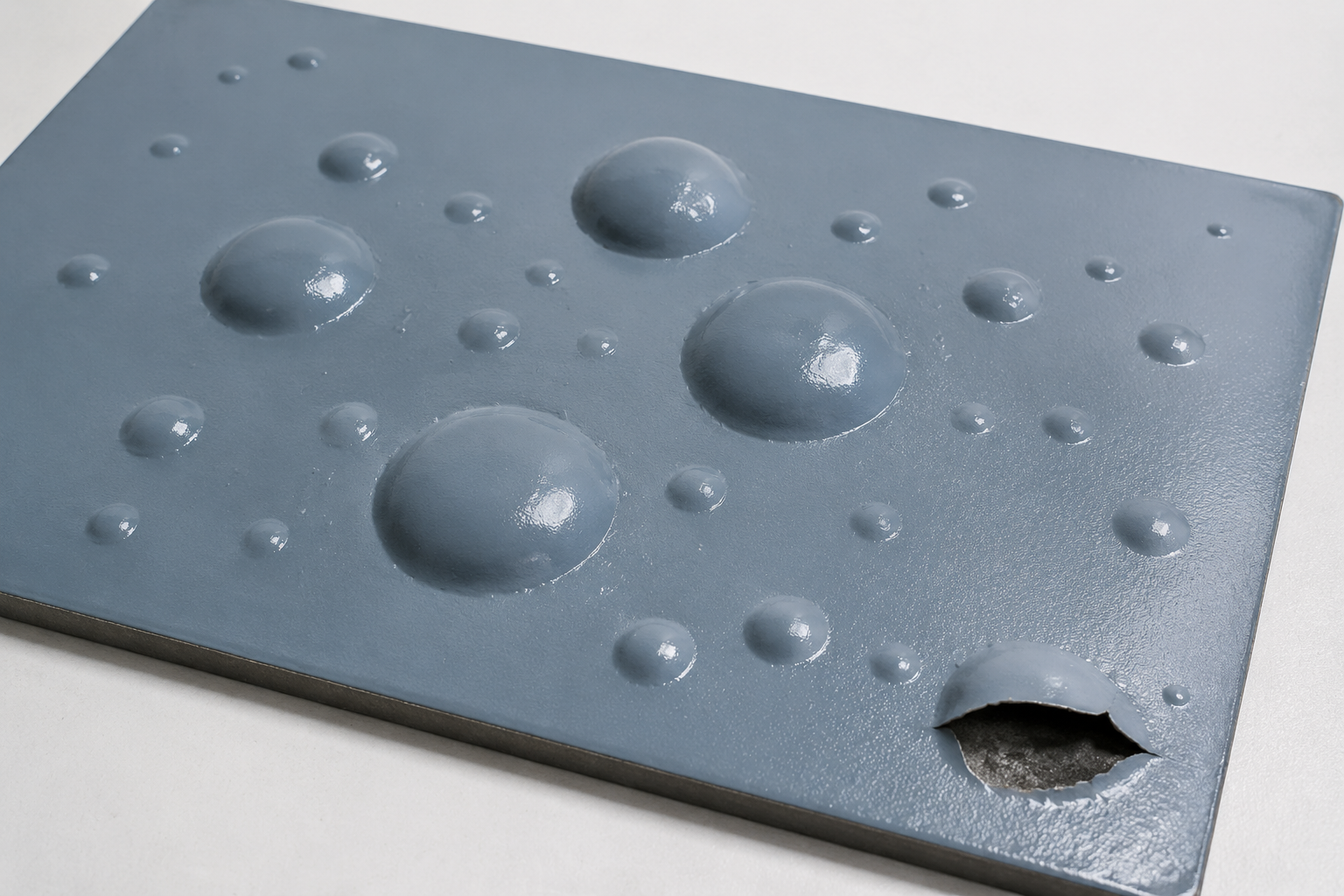
A blister is more than an ugly bubble. It is evidence that the coating has lifted from the surface below—and something has supplied enough pressure, weakness, or both to break that bond.
What Blistering Looks Like
Blisters range from pinhead-sized bumps to large, soft domes. They may occur singly, in dense clusters, along welds and edges, below the waterline, near leaks, or across an entire coated area. Fresh blisters may feel elastic; older ones may harden, crack, rupture, peel, or reveal corrosion.
A blister is defined by loss of adhesion and lifting. Do not classify every bump as a blister. Dirt inclusions, solvent popping, pinholes, craters, runs, and corrosion products can create raised or irregular features, but their shapes and cross-sections differ. Inspect at magnification before assigning a cause.
Why Coatings Blister
Moisture and Osmotic Pressure
- Water migrates through the coating or enters from behind the substrate.
- Soluble salts beneath the film attract water and create osmotic pressure.
- Porous concrete, masonry, wood, roofs, walls, floors, tanks, and linings transmit moisture.
- Immersion, condensation, leaks, hydrostatic pressure, dew, rain, or inadequate drainage supplies water.
Trapped Solvent, Air, or Reaction Gas
- A heavy top layer skins over before solvent or water escapes.
- Insufficient flash time traps volatile material between coats.
- Rapid heating expands trapped air or solvent vapor.
- Outgassing from porous castings, concrete, wood, welds, fillers, or powder-coated substrates lifts the film.
Heat and Application Conditions
- Painting a hot surface or in direct sunlight causes rapid surface drying and vapor expansion.
- Coating is applied outside the manufacturer's temperature, humidity, or dew-point limits.
- A warm substrate cools after coating and draws moisture into the system.
- An excessive wet film or incorrect reducer disrupts evaporation and cure.
Weak Adhesion or Film Integrity
- Oil, grease, dust, salts, release agent, soap, or other contamination remains beneath the coating.
- Surface preparation or anchor profile is inadequate.
- A previous coat is glossy, degraded, undercured, overcured, incompatible, or outside its recoat window.
- Corrosion, cathodic activity, excessive film thickness, incorrect mix ratio, or incomplete cure weakens the system.
Read the Blister Before Opening It
Document blisters intact before destructive examination. Record their size, frequency, shape, location, distribution, firmness, color, and whether they change with heat, sunlight, immersion, production cycles, or weather. ASTM D714 provides a standardized method for rating the degree of blistering by blister size and frequency.
| Observation | Possible Direction | Follow-Up |
|---|---|---|
| Blisters extend to bare substrate | Substrate contamination, moisture, salts, inadequate preparation, corrosion, or poor adhesion | Examine substrate, underside of film, profile, cleanliness, moisture, and soluble salts |
| Separation occurs between coats | Intercoat contamination, exceeded recoat window, incompatible layers, poor sanding, or weak lower coat | Identify the fracture plane and reconstruct application and cure history |
| Liquid inside blister | Moisture ingress, immersion, osmotic action, or chemical exposure | Collect uncontaminated liquid for conductivity, pH, ion, or laboratory analysis when warranted |
| Blisters appear soon after application or bake | Trapped solvent, water, air, outgassing, excessive film, or rapid heating | Review wet-film build, flash, reducer, substrate porosity, oven ramp, and cure schedule |
| Blisters cluster near leaks, seams, floors, roofs, or the waterline | Moisture pathway or hydrostatic pressure | Trace and correct the water source before repainting |
| Rust or dark corrosion lies beneath | Coating breakdown, underfilm corrosion, salts, holidays, or cathodic disbondment | Expand the investigation beyond the visible blister boundary |
Blistering Versus Similar Defects
- Solvent popping: Vapor breaks through the surface and leaves open pits, pinholes, or small craters; a blister normally retains a lifted dome until it ruptures.
- Pinholing: Tiny holes penetrate or interrupt the film without forming broad raised bubbles.
- Cratering or fisheyes: Wet coating pulls away into depressions, often with a raised rim.
- Wrinkling: The surface forms ridges and folds because the top skins while softer material moves below.
- Rust staining: Corrosion products may lift a film, but staining alone is not blistering.
- Adhesion failure: Peeling or delamination may occur without pressure-formed domes, although ruptured blisters can progress into peeling.
How to Investigate Blistering
- Establish the timeline. Determine when the defect first appeared relative to application, rain, washing, immersion, heating, cooling, service exposure, or shutdown.
- Map the environment. Record air and surface temperature, relative humidity, dew point, ventilation, sunlight, immersion depth, chemical exposure, and known moisture sources.
- Rate and photograph the area. Capture wide views and close-ups with a scale. Map blister size and frequency before cutting.
- Locate the plane of failure. Carefully open representative blisters. Determine whether separation is at the substrate, between coats, or within a coating layer.
- Observe the contents. Note gas, liquid, odor, color, corrosion, deposits, tackiness, or softened film. Avoid contaminating samples with dirty tools or fingers.
- Review surface preparation. Check cleaning records, abrasive, profile, dust, soluble-salt testing, concrete moisture, primer timing, and conditions before coating.
- Review the coating process. Verify products, batches, shelf life, mix ratio, induction, reduction, agitation, wet and dry film thickness, flash, recoat interval, and cure.
- Compare sound and failed areas. Use control samples and laboratory support when moisture, salts, chemicals, corrosion, adhesion, cure, or compatibility remains uncertain.
Useful Standards and Test Methods
- ASTM D714 — Standard Test Method for Evaluating Degree of Blistering of Paints. It provides reference standards for rating blister size and frequency.
- ASTM D4541 — Pull-Off Strength of Coatings Using Portable Adhesion Testers. Use only when appropriate to the system and investigation plan.
- ASTM D7091 — Nondestructive Measurement of Dry Film Thickness on metallic substrates within its stated scope.
- ASTM D4263 — Indicating Moisture in Concrete by the Plastic Sheet Method. Project requirements may call for other quantitative concrete-moisture methods.
No one measurement proves why blisters formed. D714 describes severity rather than root cause; adhesion, thickness, moisture, salts, cure, microscopy, chemical analysis, exposure history, and the location of separation may all be needed. Always use the edition required by the contract and follow the complete published method.
Correcting Blistered Coatings
Do not simply puncture blisters and paint over them. The detached film has already lost its protective bond, and the pressure source or weak interface may remain. Determine the cause and extent first.
Remove defective and unsound coating back to a firmly bonded boundary using a method suitable for the substrate and hazard controls. Correct leaks, condensation, drainage, vapor transmission, soluble salts, contamination, corrosion, cure problems, and incompatible layers. Prepare the exposed surface to the coating specification, feather sound edges where permitted, confirm acceptable moisture and environmental conditions, and rebuild the specified system.
Widespread osmotic blistering, lining failure, underfilm corrosion, or moisture coming through concrete, masonry, roofs, walls, or floors may require removal well beyond visibly raised areas. Obtain the coating manufacturer's and specifier's written repair procedure when the system protects a tank, pipe, aircraft, railcar, floor, roof, containment area, or critical structure.
Preventing Blistering
- Identify and stop moisture movement before coating; provide drainage, ventilation, vapor control, or waterproofing as designed.
- Remove oil, grease, dust, salts, release agents, corrosion, and incompatible films to the specified cleanliness.
- Verify substrate dryness and maintain required separation between surface temperature and dew point.
- Apply only within the product's temperature, humidity, wet-film, recoat, and curing limits.
- Use the correct components, mix ratio, induction time, reducer, viscosity, agitation, and pot life.
- Allow specified flash and ventilation between coats; avoid trapping solvent or water under a fast-drying top layer.
- Control film thickness rather than assuming more coating always means more protection.
- Use appropriate sealers, primers, preheating, or application schedules for porous or outgassing substrates.
- Inspect holidays, edges, welds, seams, and difficult geometry before service.
- Use representative test patches or panels when substrate history or coating compatibility is uncertain.
Application-Specific Clues
Architectural walls and wood: Moisture may travel through the substrate and push outward. Sherwin-Williams identifies heat, damp surfaces, early exposure to rain or humidity, contamination, poor ventilation, and moisture migration among common possibilities.
Concrete floors, roofs, and masonry: Vapor transmission, hydrostatic pressure, incomplete concrete cure, surface laitance, salts, and trapped moisture deserve early attention. A dry-looking surface is not proof that the slab or assembly is suitable for coating.
Immersion linings and protective coatings: Examine soluble contamination, permeability, chemical and temperature resistance, holidays, corrosion, cathodic protection, and service conditions. Osmotic blistering can involve water movement toward soluble material beneath the film.
Automotive, aerospace, rail, OEM, and powder finishing: Early blister-like domes may arise from outgassing, trapped volatiles, pretreatment contamination, porous castings, excessive build, insufficient flash, or cure profile. Production records and defect location on the part are especially valuable.
Technical References
- Sherwin-Williams: Blistering
- American Coatings Association: Weathering and Field Defects
- AMPP Materials Performance: Investigation of Osmotic Blistering in a Pipeline Lining
- ASTM D714: Evaluating Degree of Blistering of Paints
© 2026 Azimuth Spray Systems, LLC. AirSprayTech.com — The Finishing Authority®. All rights reserved.