AirSprayTech.com Academy
The Color That Wouldn't Stay Buried: Bleeding and Staining
Finish Defect Diagnostic Center
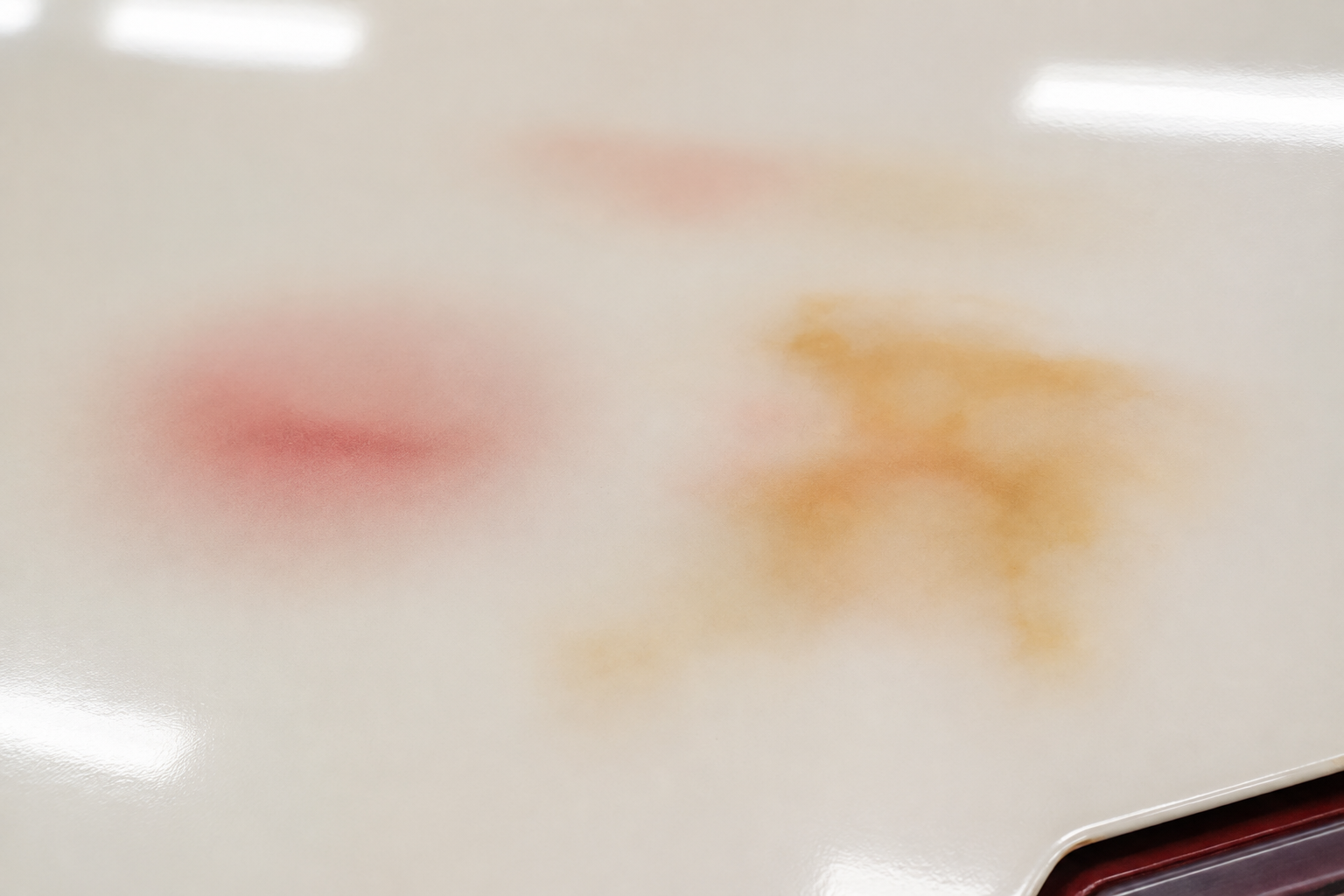
A new topcoat may leave the gun in the correct color and still develop pink, yellow, brown, gray, or irregular discoloration as it dries. When color migrates upward from an old finish, marking material, substrate, or another underlying layer, the defect is commonly called bleeding. When a chemical or material discolors the coating from the surface or its immediate environment, the result is generally described as staining.
Bleeding Versus Staining
| Condition | Where It Begins | Typical Appearance |
|---|---|---|
| Bleeding | Beneath the visible coating | Soluble dye, pigment, bitumen, marker, or substrate extract migrates into the new film, often producing red, pink, yellow, or brown discoloration. |
| Surface staining | At the coating surface | Irregular spots, streaks, rings, or color changes caused by chemicals, water, process fluids, packaging, soil, biological material, or environmental fallout. |
| Internal chemical discoloration | Within the coating system | Color changes caused by incompatible layers, incorrect cure, reaction products, excessive heat, or chemical exposure that penetrates the film. |
The terms overlap in everyday shop language. The important question is not what someone calls the defect, but whether the discoloring material is migrating from below, reacting within the film, or attacking from above.
Common Causes of Bleeding
Soluble Pigments and Dyes
- Solvent in the new coating dissolves colorants in an old finish.
- Strong red, maroon, yellow, or organic pigments migrate into a light-colored topcoat.
- An incompatible coating system provides no effective barrier.
Marks and Repair Materials
- Permanent markers, layout inks, crayons, grease pencils, chalks, or inspection stamps remain beneath the coating.
- Body fillers, glazing products, adhesives, or sealants contain mobile colorants.
- Repair edges or spot-primed areas are not completely isolated.
Substrate-Derived Material
- Wood tannins, knots, extractives, asphalt, bitumen, coal tar, or creosote migrate upward.
- Rust products or soluble salts create brown or yellow discoloration.
- Plasticizers, mold-release compounds, or additives migrate from plastic, rubber, or flexible substrates.
Application and Cure
- Topcoat solvent is aggressive enough to mobilize the underlying color.
- The sealer or barrier coat is missing, too thin, porous, incompatible, or undercured.
- Heavy wet coats and short flash times increase solvent contact with a sensitive layer.
Common Causes of Staining
- Acids, alkalis, cleaners, disinfectants, process chemicals, hydraulic fluid, fuels, lubricants, or solvents.
- Water containing minerals, iron, salts, or process residues.
- Bird droppings, insects, tree sap, road tar, industrial fallout, and biological growth.
- Rubber, foam, cardboard, paper, plastic film, tape adhesive, or packaging left against insufficiently cured coating.
- Heat, ultraviolet exposure, welding fumes, oven contamination, or chemical vapors.
- Color transfer from dirty racks, slings, gloves, pads, tires, seals, or adjacent painted surfaces.
Do Not Confuse It with Another Defect
| Condition | Typical Distinction |
|---|---|
| Bleeding | Color migrates through the coating from an underlying source and may return after recoating without isolation. |
| Poor hiding | The substrate or undercoat is visible because the topcoat lacks opacity or film build; the underlying color has not necessarily migrated. |
| Color mismatch | The applied color is uniformly wrong because of formula, mixing, application, lighting, or batch differences. |
| Blushing | A milky or cloudy appearance commonly associated with moisture and rapid solvent evaporation rather than colored material migrating upward. |
| Water spotting | Discrete rings or droplet-shaped marks related to water contact, often at the surface. |
| Corrosion staining | Brown, orange, or reddish discoloration associated with corrosion products, often near breaks, fasteners, seams, or porous areas. |
| Chalking or fading | A broader surface change caused by weathering or binder degradation, not localized migration from beneath. |
A Practical Investigation
- Photograph before cleaning. Record the color, shape, location, gloss, boundaries, and relationship to seams, repairs, markings, packaging, spills, or drainage paths.
- Establish when it appeared. Determine whether discoloration developed during application, cure, bake, storage, shipping, installation, or service.
- Map the pattern. Compare repaired and unrepaired areas, light and dark colors, individual substrates, contact points, racks, batches, ovens, operators, and exposure zones.
- Check the surface carefully. Following the coating manufacturer's guidance, test a small inconspicuous area with the approved cleaner. A removable deposit supports surface staining; failure to clean it does not automatically prove bleeding.
- Inspect the layers. Magnification or a cross-section can show whether discoloration sits on the surface, is distributed through the topcoat, or begins at an underlying layer.
- Review the history. Identify old coatings, repair products, markers, fillers, sealers, wood species, plastics, rubber, asphaltic materials, chemical exposure, and cleaning agents.
- Verify the coating process. Record mix ratio, film thickness, flash, cure, reducer, substrate temperature, oven profile, and compatibility of every layer.
- Run a controlled test. Prepare representative panels with and without the suspected source and barrier coat. Apply the complete system at specified thickness and cure, then compare.
Useful Tests—and Their Limits
There is no single universal jobsite test for every form of bleeding or staining. Visual comparison under standardized lighting, solvent or detergent cleaning trials approved by the manufacturer, microscopy, cross-sectioning, color measurement, and laboratory chemical analysis may all contribute. A spectrophotometer can quantify a color difference, but it does not identify the migrating material or exposure source.
ASTM D868 is specifically intended to determine the degree of bleeding of traffic paint. It should not be presented as a universal bleeding test for automotive, OEM, aerospace, architectural, protective, or other coating systems. Use the project specification and coating manufacturer's approved methods.
Repairing Bleeding
- Identify and remove the soluble source where practical. Simply adding more topcoat may intensify or temporarily hide the problem.
- Allow the affected system to cure as directed before repair evaluation.
- Remove unstable, incompatible, or contaminated layers. Feather and prepare sound edges according to the approved system.
- Apply the manufacturer-recommended stain-blocking or two-component barrier/sealer at the specified film build. Not every primer is an effective isolation coat.
- Allow the barrier to cure fully, then apply the approved topcoat system.
- For severe or recurring bleeding, complete removal to a stable substrate may be the only dependable correction.
Correcting Surface Staining
First identify the contaminant and consult the coating manufacturer. Begin with the least aggressive approved cleaning method. Rinse and neutralize only when the written procedure requires it. If staining has penetrated, etched, softened, swollen, or chemically changed the film, polishing may be inadequate; sanding, coating removal, and refinishing may be required. Never combine cleaners or use an unapproved solvent merely because it removes the visible color.
Prevention
- Identify sensitive old finishes and unknown substrates before production coating begins.
- Remove permanent marker, crayon, adhesive, grease-pencil, dye, tar, corrosion products, and soluble contamination during preparation.
- Use only compatible fillers, primers, sealers, cleaners, reducers, and topcoats from an approved coating system.
- Apply the specified barrier coat uniformly at the required thickness and cure it completely.
- Avoid excessively wet topcoats and observe flash and recoat intervals.
- Make a full-system test panel when coating unknown repairs, strong colors, wood, plastic, asphaltic materials, or previously painted surfaces.
- Keep chemicals, oils, dirty racks, rubber pads, packaging, and protective films away from coatings until sufficiently cured.
- Verify chemical-resistance and service-exposure requirements before selecting the system.
Application Notes
Automotive refinish: red or yellow pigments from an old finish can be dissolved by new topcoat solvent and appear as pink or yellow discoloration. Isolate the sensitive finish using the coating manufacturer's approved two-component undercoat or sealer.
Wood finishing: tannins, knots, sap, dyes, and previous stains may migrate through light-colored coatings. Test the wood and use a compatible blocking system designed for that extractive.
Industrial, protective, floor, roof, and lining work: asphalt, coal tar, rust products, soluble salts, process chemicals, tire plasticizers, and standing liquids can create similar symptoms. Establish whether the source is below or above the film before specifying repair.
Plastic and flexible parts: plasticizer or dye migration can discolor and soften a topcoat. Confirm substrate compatibility and use the specified pretreatment, primer, and coating system.
Powder coating: discoloration may arise from substrate contamination, marker ink, silicone, oil, prior coating, oven fumes, excessive bake, incompatible powder, or color carryover. Because powder contains no conventional liquid reducer, diagnose the actual migration or reaction mechanism rather than assuming liquid-paint solvent attack.
What to Document
Record photographs under consistent lighting; discoloration color, dimensions, and pattern; affected layer; substrate and previous finish; surface preparation; markings, fillers, sealers, and repair materials; coating products and batches; film thickness; flash and cure history; chemical or packaging contact; cleaning trials; test-panel results; corrective action; and post-repair verification. Separate confirmed observations from suspected causes.
Technical References
- PPG Automotive Refinish: Bleeding
- Sherwin-Williams Automotive Finishes: Troubleshooting Refinish Problems
- Axalta: Paint Defects Manual
- ASTM D868: Determination of Degree of Bleeding of Traffic Paint
Technical notice: This article provides general educational guidance. Follow the coating manufacturer's current product data sheet, safety data sheet, approved repair procedure, project specification, and applicable safety and environmental requirements.
Return to the Finish Defect Diagnostic Center
© 2026 Azimuth Spray Systems, LLC. AirSprayTech.com — The Finishing Authority®. All rights reserved.