AirSprayTech.com Academy — Finish Defect Diagnostic Center
When Gravity Wins: Diagnosing Paint Runs and Sags
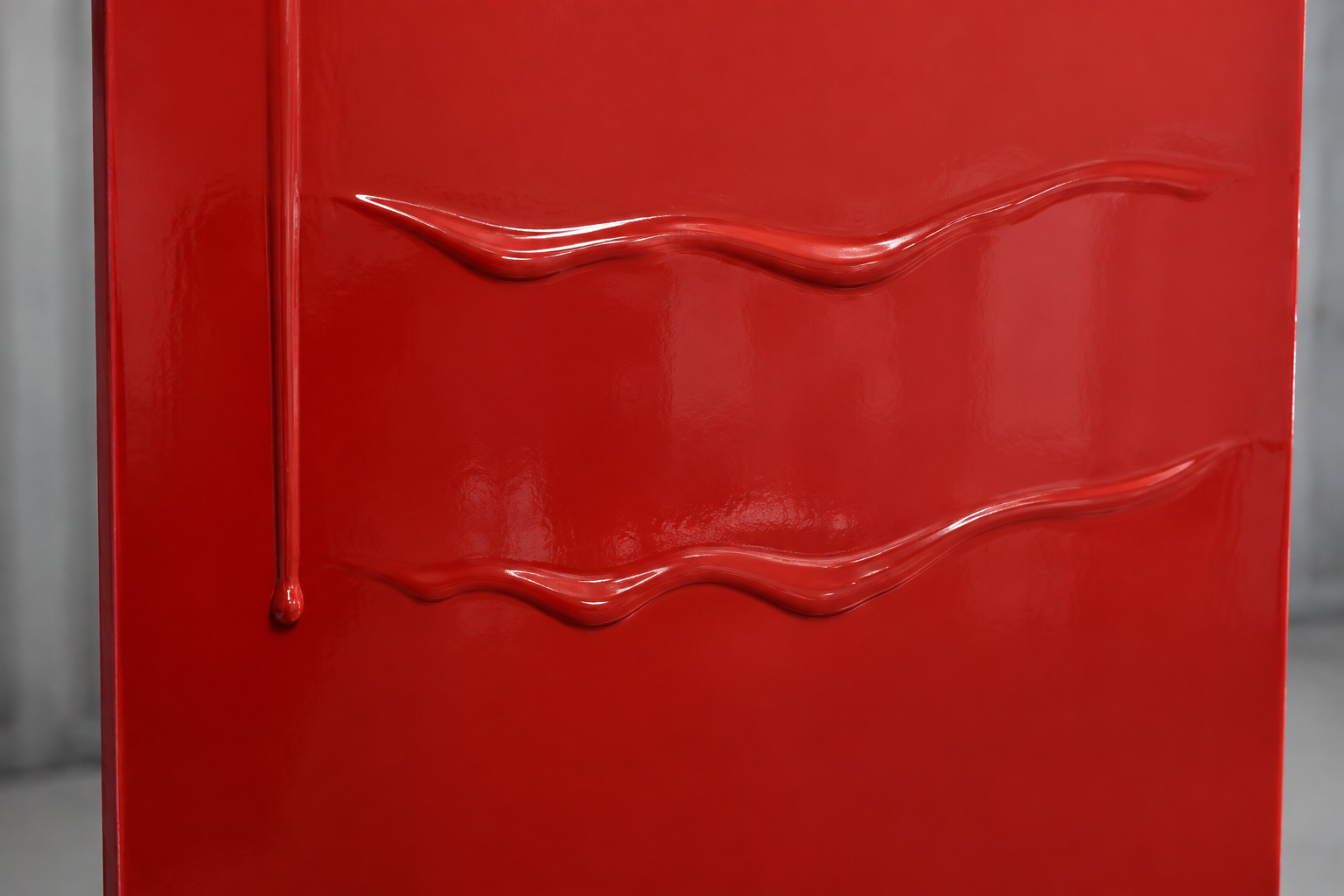
Runs and sags form when wet coating moves downward before it develops enough body to remain in place. A run is usually a narrow stream or drip-like trail. A sag is broader—a wave, ridge, curtain, or locally thickened area on a vertical or sharply sloped surface. Both indicate that the balance among film thickness, viscosity, atomization, solvent release, temperature, and application technique has been lost.
What Runs and Sags Look Like
- Narrow vertical trails ending in a rounded bead or teardrop.
- Wavy horizontal ridges or curtain-like folds across a vertical face.
- Local thickening below an edge, fastener, seam, recess, or overlap.
- Gloss and color differences caused by uneven film thickness.
- Metallic or effect-pigment disturbance inside the flowed area.
A coating may move immediately after application, during flash, or as it warms in an oven. Record the timing. Immediate flow points strongly toward application and rheology; movement after heating can indicate early force drying, excessive film build, or a viscosity drop as the coating warms.
Common Causes
Too Much Coating
- Excessive wet-film thickness.
- Too many passes or excessive overlap.
- Gun travel too slow, too close, or paused while triggered.
- Fluid pressure or material delivery too high.
Poor Atomization or Pattern
- Atomizing pressure too low for the material flow.
- Fan too narrow or poorly balanced.
- Wrong nozzle, air cap, tip, or worn components.
- Heavy center or tailing spray pattern.
Material and Solvent
- Viscosity too low or excessive reduction.
- Reducer too slow for temperature, airflow, film build, or part size.
- Incorrect mix ratio, missing component, or poor agitation.
- Material outside its temperature or pot-life limits.
Part and Environment
- Coating or substrate temperature too low.
- Insufficient flash between coats.
- Sharp edges, recesses, complex geometry, or poor part orientation.
- Surface contamination causing localized flow or loss of wet-film hold.
Read the Pattern
| Observed Pattern | Investigate First |
|---|---|
| Run begins at the end of each pass | Trigger timing, gun hesitation, reversal point, and travel speed. |
| Sags follow every overlap | Overlap percentage, pass count, wet-film thickness, and fan uniformity. |
| Only recesses or lower edges run | Part geometry, rebound, wrap, pooling, gun angle, and excessive local passes. |
| Entire vertical face curtains | Overall film build, viscosity, reducer speed, temperature, and flash. |
| Only one gun or operator is affected | Equipment setup, pressure at the gun, fluid delivery, distance, and technique. |
| Defect develops in the oven | Pre-bake flash, actual part-temperature ramp, film build, and cure schedule. |
| Runs occur around isolated spots | Oil, silicone, cleaner residue, condensation, or another surface contaminant. |
Do Not Confuse Them with Other Defects
| Condition | Typical Distinction |
|---|---|
| Runs and sags | Wet coating has moved under gravity, leaving thick trails, beads, waves, or curtains. |
| Orange peel | A repeating pebbled texture caused by inadequate flow and leveling, not downward bulk movement. |
| Wrinkling | A network of puckers or folds associated with surface skinning, solvent attack, or cure imbalance. |
| Fisheyes or craters | Localized depressions where coating pulls away rather than accumulating in a downward ridge. |
| Edge buildup | Excess thickness concentrated along geometry; it may later become a run but is not necessarily mobile. |
| Flow marks in powder | Usually related to powder melt, flow, film build, heat, or substrate geometry—not gravity acting on sprayed liquid paint. |
A Practical Investigation
- Preserve the first evidence. Photograph the defect under normal and low-angle light before sanding. Record part orientation and the direction of gravity.
- Establish timing. Ask whether flow began during spraying, flash, handling, or cure.
- Map each origin. Mark pass ends, overlaps, edges, recesses, rack positions, and oven zones.
- Check wet-film thickness. Measure during controlled reproduction and compare sound areas with locations that normally sag. Do not press a wet-film gauge into a defect needed for evidence.
- Measure cured thickness. Where the substrate and specification permit, compare the ridge, adjacent film, and target DFT.
- Verify material. Record product, batch, mix ratio, induction time, pot life, reducer type and amount, viscosity, and material temperature.
- Inspect the spray pattern. Spray a safe test card using actual production settings. Look for a heavy center, tails, spits, surging, or uneven distribution.
- Record equipment settings. Include tip or nozzle, air cap, atomizing pressure at the gun, fluid pressure, fan width, gun distance, speed, angle, and overlap.
- Review conditions. Record air, material, and surface temperatures, humidity, airflow, flash intervals, and actual part-temperature profile.
- Change one variable. Run controlled panels to isolate film build, viscosity, pressure, technique, temperature, or reducer selection.
Testing and Standards
There is no universal field test that assigns the cause of a production run or sag. Useful evidence includes wet- and dry-film measurements, viscosity checks using the product-specified method and temperature, spray-pattern tests, environmental records, and oven profiling.
ASTM D4400 evaluates the relative sag resistance of paints using a multinotch applicator on a test chart. It is principally a controlled laboratory comparison; it does not reproduce every spray pattern, geometry, film-build distribution, or production condition and should not be treated as a universal jobsite acceptance test.
Correcting the Finish
- Allow the coating to cure thoroughly before leveling unless the manufacturer provides a specific wet-repair procedure.
- For an isolated run in a polishable solid-color finish, carefully level the high area, refine sanding marks, compound, and polish according to the approved procedure.
- Do not sand only the highest ridge and assume the film is uniform. Verify that adjacent thin or disturbed areas still meet requirements.
- Severe curtains, multiple runs, exposed substrate, soft trapped material, or performance-critical coatings generally require sanding or removal to a sound layer and recoating.
- Metallic, pearlescent, textured, matte, and effect finishes frequently require repainting because pigment orientation, texture, or sheen cannot be restored by polishing.
- For protective linings, immersion service, aerospace, or specified industrial work, use the approved repair procedure and repeat required inspection after cure.
Prevention
- Mix accurately and maintain the specified application viscosity and material temperature.
- Use only the recommended reducer for actual temperature, airflow, part size, and coating system.
- Set atomization and fluid delivery together; pressure alone is not the goal—a uniform pattern is.
- Keep gun distance, angle, speed, overlap, and trigger timing consistent.
- Apply the specified wet-film build through properly flashed coats rather than one heavy pass.
- Stripe-coat or address difficult geometry according to the approved procedure without overloading adjacent faces.
- Orient parts to minimize pooling and uncontrolled flow when production design permits.
- Verify surface, air, and material temperatures and provide the required flash before heat.
- Maintain tips, nozzles, needles, air caps, pumps, regulators, and hoses to prevent surging and distorted patterns.
- Train operators to inspect a test pattern and record a proven process window at startup and after material or weather changes.
Application Notes
Automotive and high-gloss finishing: Solid colors may sometimes be leveled and polished after cure, but metallic or effect pigments normally require refinishing when flow has disturbed orientation.
Industrial liquid and protective coatings: A run can conceal excessive local DFT, retained solvent, slow cure, cracking risk, or an adjacent thin area. Inspect performance, not appearance alone.
Floors, roofs, and linings: Sloped and vertical transitions, penetrations, edges, and stripe coats require special attention. Material may drain from one location and accumulate in another.
Powder coating: Conventional powder does not form spray-stage liquid runs. Similar curtains or heavy flow occur during melt and cure and should be investigated through powder film build, part temperature, oven profile, powder formulation, substrate geometry, and reclaim condition.
What to Document
Record photographs, part orientation, defect origin and direction, affected quantity, coating system and batch, mixing and reduction, viscosity and temperature, wet- and dry-film thickness, equipment setup, operator technique, flash and cure history, environmental conditions, test-panel results, repair method, and verification results. Separate measurements and observations from conclusions.
Technical References
- PPG Automotive Refinish: Runs and Sags
- Sherwin-Williams: Liquid Coatings Troubleshooting Guide
- Axalta: Paint Defects Manual
- ASTM D4400: Sag Resistance Using a Multinotch Applicator
Technical notice: This article provides general educational guidance. Follow the coating manufacturer's current product data sheet, safety data sheet, approved repair procedure, project specification, and applicable safety and environmental requirements.
Return to the Finish Defect Diagnostic Center
© 2026 Azimuth Spray Systems, LLC. AirSprayTech.com — The Finishing Authority®. All rights reserved.