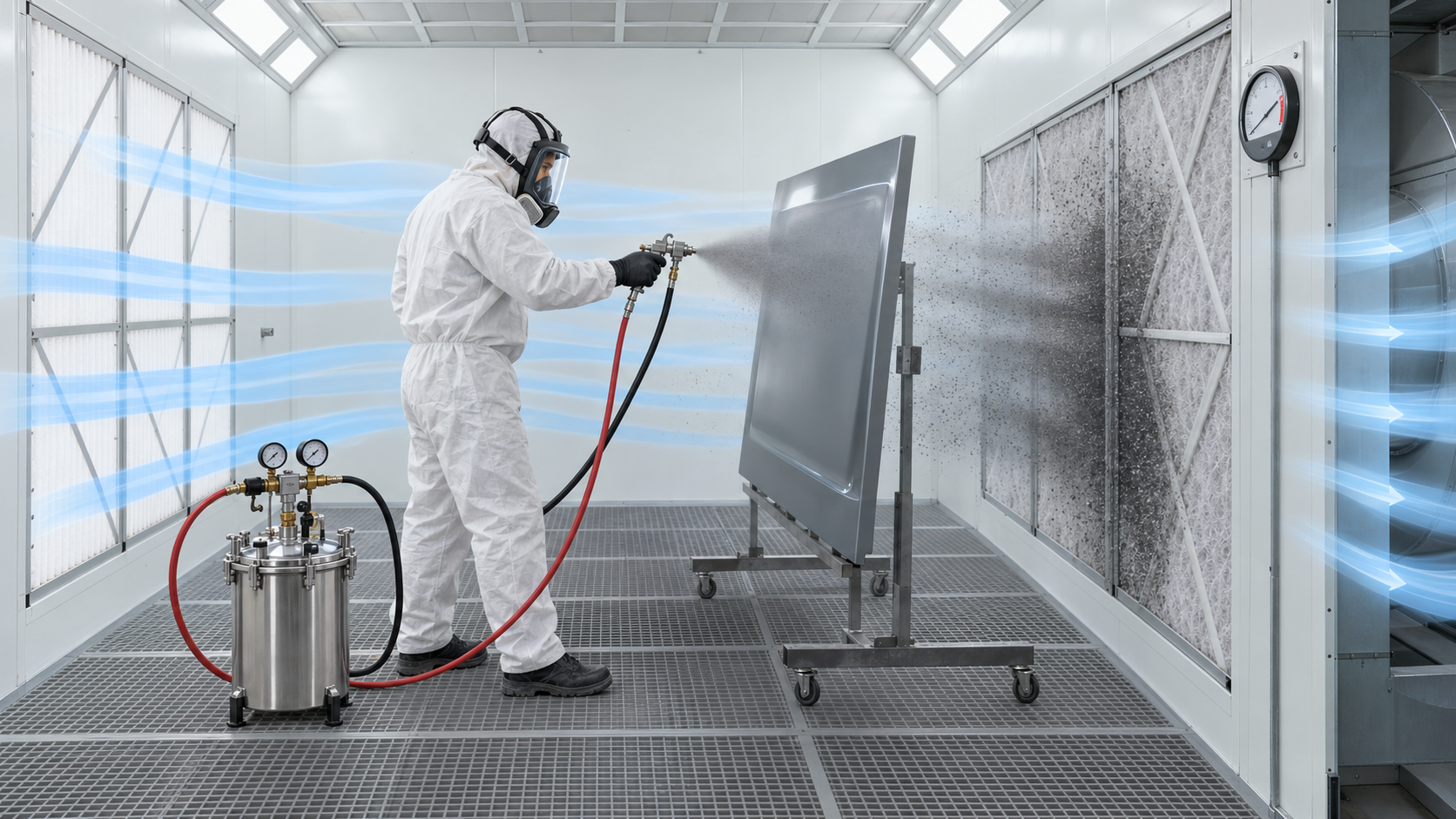
 A Filter Is Part of the Booth—not an Afterthought
A spray booth depends on controlled airflow. Clean air must enter the booth, move evenly across the work area, capture airborne overspray, and carry contaminated air through the exhaust filters.
When the filters are properly selected and maintained, the booth has a better chance of producing clean finishes, controlling overspray, protecting employees, and operating as designed.
When the filters are wrong, damaged, incorrectly installed, or overloaded, the entire booth can suffer. Airflow may decrease, booth pressure may change, dirt may appear in the finish, and overspray may escape the exhaust system.
Choosing a spray-booth filter is not simply a matter of finding a pad that fits the frame. The filter must match the booth, coating, airflow, application rate, and environmental requirements.
The Three Jobs of Spray-Booth Filtration
Depending on its design, a spray booth may use several filtration stages.
1. Intake Prefilters
Prefilters capture larger particles before incoming air reaches the booth’s primary intake or ceiling filters. They can extend the life of more expensive final-stage intake filters and reduce the amount of dust entering the booth.
Prefilters are commonly found in heated makeup-air units and multistage intake systems.
2. Intake or Ceiling Filters
Intake filters clean the air entering the spray area. In a crossdraft booth, they may be installed in the front doors or intake plenum. In a downdraft or semi-downdraft booth, the final intake filters are commonly installed in the ceiling.
These filters help:
- Remove airborne dirt before it reaches the workpiece
- Distribute incoming air evenly across the booth
- Reduce turbulence and uneven air velocity
- Protect the finish from contamination
- Maintain the booth’s intended pressure relationship
3. Exhaust Filters or Paint Arrestors
Exhaust filters capture airborne coating droplets and solid particles before the exhaust air leaves the booth.
In a crossdraft booth, exhaust filters are normally located in the wall opposite the intake. In a downdraft booth, they may be located in the floor, pit, or lower exhaust chambers.
Exhaust filters are also called paint arrestors or overspray arrestors. Their primary purpose is to capture coating particles. Most standard paint-arrestor filters do not remove solvent vapor or volatile organic compounds from the exhaust air.
Match the Filter to the Booth Design
A filter selected for one booth should not automatically be used in another.
The correct filter depends on:
- Crossdraft, downdraft, side-draft, or semi-downdraft airflow
- Wet or dry spray-booth design
- Booth fan capacity
- Available filter area
- Required air velocity
- Permitted pressure drop
- Coating type and solids content
- Overspray loading rate
- Required capture efficiency
- Applicable environmental permits and regulations
Use the spray-booth manufacturer’s specifications as the starting point. The manufacturer designed the fan, ductwork, filter area, and controls to operate within a particular pressure range.
A filter with excessive resistance may reduce booth airflow even when it is new. A low-resistance filter with inadequate capture efficiency may allow overspray to pass into the fan, ductwork, stack, or surrounding environment.
Understand Filter Efficiency
Filter efficiency describes how effectively a filter captures particles of specified sizes under established test conditions.
A higher efficiency rating is not automatically better for every filter position. Greater efficiency may also produce greater resistance to airflow. The booth fan must be able to move the required volume of air through the selected filter.
Filter selection requires a balance among:
- Particle-capture efficiency
- Initial pressure drop
- Final recommended pressure drop
- Paint-holding capacity
- Airflow requirements
- Service life
- Cost
Do not compare filters based only on thickness or appearance. Two filters that look similar may have very different airflow resistance, construction, efficiency, and paint-holding capacity.
Paint-Holding Capacity Matters
An exhaust filter must capture overspray without loading so quickly that booth airflow drops after only a short production run.
Paint-holding capacity is the amount of overspray a filter can retain under specified conditions before reaching its recommended final resistance or another defined limit.
The actual service life will vary with:
- Daily production volume
- Coating transfer efficiency
- Coating solids content
- Spray-gun setup
- Atomizing pressure
- Painter technique
- Part size and shape
- Filter area
- Booth airflow
- Filter construction
A high-production industrial booth spraying high-solids coatings may load filters much faster than a booth used occasionally for small parts.
Choose the Right Exhaust-Filter Design
Dry spray-booth exhaust filters are available in several designs, including:
- Fiberglass paint arrestors
- Polyester pads
- Multilayer synthetic filters
- Expanded-paper filters
- Accordion-style paper filters
- Cardboard baffle filters
- Combination paper-and-synthetic filters
- Bag, pocket, cube, or panel filters
Each design handles overspray differently. Some rely on progressively denser fiber layers. Others force the air to change direction so coating particles strike and collect on internal surfaces.
The best choice depends on the coating and application—not which filter has the lowest purchase price.
Coating Type Changes the Selection
Not every coating behaves the same after it leaves the spray gun.
Consider:
- Whether the coating remains wet and tacky
- Whether it dries before reaching the filter
- Whether the overspray is fibrous, sticky, powdery, or abrasive
- The coating’s solids content
- The size of the atomized droplets
- Whether the coating contains hazardous metals or other regulated materials
- Whether the product presents a combustion or heat-release concern
A filter that performs well with a conventional solventborne coating may not be the best choice for a high-solids plural-component material, adhesive, gel coat, waterborne coating, or specialty finish.
Ask the filter supplier to evaluate the actual coating and application conditions.
Do Not Use Ordinary HVAC Filters as Paint Arrestors
A heating-and-air-conditioning filter is designed primarily to capture airborne dust. It may not have the paint-holding capacity, overspray-capture performance, flame characteristics, or construction required for spray-booth exhaust service.
Only use filters intended and approved for the specific spray-booth location and application.
Install Filters in the Correct Direction
Many filters are directional. Air must enter the correct side for the filter to perform as designed.
An incorrectly installed filter may:
- Load prematurely
- Release fibers into the booth
- Reduce capture efficiency
- Increase pressure drop
- Allow overspray to penetrate the exhaust system
Look for airflow arrows, color-coded sides, backing material, support grids, or installation instructions. Do not assume that either side can face the airflow.
Filters should fit securely without gaps. Air will follow the path of least resistance, and even a small opening can allow unfiltered air or overspray to bypass the filter.
The Calendar Is Not the Best Change Gauge
“Change the filters every Friday” may be easy to remember, but time alone does not measure filter condition.
One week may involve light production and low overspray loading. The next may involve continuous spraying of large parts with a high-solids coating.
A good filter-change program combines:
- Pressure-differential readings
- Booth airflow measurements
- Manufacturer’s final-resistance limit
- Visual inspection
- Finish-quality observations
- Production records
- A maximum time-based interval
Use the Manometer or Differential-Pressure Gauge
A manometer or differential-pressure gauge measures the resistance created as air moves through the filter system.
As a filter loads with dust or overspray, resistance normally increases. The gauge gives the operator an objective way to monitor that change.
The correct final reading is not universal. It depends on the booth design, fan capacity, filter type, and manufacturer’s specifications.
Do not copy another shop’s change point or rely on a generic number. Obtain the correct initial and final pressure-drop values from the booth or filter manufacturer.
Establish a Clean-Filter Baseline
After installing clean filters, operate the booth under normal conditions and record the initial pressure reading. This becomes the clean-filter baseline.
Check and record the gauge regularly. The trend is often more useful than a single reading because it shows how quickly the filters are loading.
If the gauge suddenly changes, investigate for:
- Damaged or collapsed filters
- Missing filter sections
- Air bypass around the frames
- Incorrectly installed filters
- A fan, belt, damper, or motor problem
- Blocked ductwork
- A change in intake or exhaust conditions
Pressure Drop Is Important—but It Is Not the Only Criterion
A filter may require replacement before it reaches the final pressure-drop limit.
Replace or investigate filters when:
- The manufacturer’s final pressure-drop limit is reached
- Booth airflow falls below the required level
- The booth cannot maintain its intended pressure balance
- The filter is damaged, torn, collapsed, or wet
- Overspray is passing through or around the filter
- The filter no longer fits securely in its frame
- Visible contamination appears downstream
- Dirt or overspray begins affecting finish quality
- The established maximum service interval is reached
- The booth manufacturer or filter supplier requires replacement
Watch the Booth for Warning Signs
The booth itself often provides clues that the filtration system needs attention.
Possible warning signs include:
- Overspray hanging in the booth longer than normal
- Clouds drifting toward the painter
- Changes in door resistance
- Difficulty maintaining booth pressure
- Dust nibs or fibers appearing in the finish
- Uneven airflow across the workpiece
- Overspray collecting on booth walls or lights
- Paint deposits downstream of the exhaust filters
- Noticeably reduced exhaust at the filter face
- Longer clearing time after spraying stops
These signs do not automatically prove that the filter is the only problem. Fans, belts, dampers, ductwork, makeup-air systems, door seals, and booth balance should also be inspected.
Measure Airflow—Do Not Guess
A pressure gauge indicates filter resistance, but it does not directly prove that the booth has the required airflow.
Airflow should be measured and documented using an appropriate method and instrument. Readings may be taken at specified booth locations or across the booth face, depending on the design and applicable requirements.
Compare the results with the booth manufacturer’s specifications, applicable OSHA requirements, environmental permit conditions, and fire-protection requirements.
Smoke, tissue paper, or a hand held near the opening may show general air direction, but these are not substitutes for proper airflow measurement.
Change Filters as a Complete, Balanced Set
Replacing only the dirtiest-looking section can create uneven resistance across the filter bank.
Uneven resistance may cause air to favor one section of the booth, producing turbulence, dead zones, and uneven overspray capture.
Unless the manufacturer provides another procedure, replace filters in complete matched sets for the affected stage. Use the same approved filter type, size, thickness, and orientation throughout the bank.
Do Not Blow Out Loaded Paint Filters
Compressed air should not be used to clean loaded paint-arrestor filters.
Blowing a filter can release hazardous dust and coating particles into the employee’s breathing zone and surrounding work area. It may also damage the filter media and reduce its ability to capture overspray.
Disposable filters should be replaced and handled according to the coating hazards, facility procedures, and waste requirements.
Protect Employees During Filter Changes
Changing filters can disturb accumulated overspray, pigment, dust, and uncured coating residue.
Before beginning:
- Stop spray operations.
- Follow the booth manufacturer’s shutdown procedure.
- Control electrical and mechanical hazards as required.
- Review the hazards of the captured coatings.
- Wear the appropriate gloves, protective clothing, eye protection, and respiratory protection.
- Avoid shaking, tearing, or compressing loaded filters.
- Place used filters directly into the approved waste container.
- Clean the filter frame and inspect it for damage.
- Install the replacement filters in the correct direction.
- Confirm that there are no gaps or bypass openings.
After installation, restart the booth according to the manufacturer’s procedure, inspect the filter bank, and record the new pressure reading.
Used Filters May Require Special Disposal
A used booth filter does not automatically become ordinary trash.
The disposal decision depends on the materials captured by the filter and applicable federal, state, and local waste requirements.
Filters may contain:
- Flammable coating residue
- Heavy-metal pigments
- Isocyanate-containing materials
- Uncured resins
- Solvent-contaminated solids
- Other regulated ingredients
The facility is responsible for properly characterizing the waste. Review the coating Safety Data Sheets and consult the company’s environmental professional, waste contractor, and appropriate regulatory authorities.
Do not mix used filters with incompatible wastes or allow them to accumulate in an unsafe location.
Build a Filter-Change Record
A simple written record can reveal how the booth is actually performing.
Record:
- Date and time of inspection
- Filter location and type
- Pressure-differential reading
- Airflow reading, when taken
- Booth pressure condition
- Visible filter condition
- Production volume or coating usage
- Finish-quality observations
- Date of replacement
- Name of the employee performing the work
- Unusual conditions or corrective actions
After several filter cycles, the shop can begin predicting service life based on actual production rather than guesswork.
A Practical Selection Checklist
Before purchasing spray-booth filters, confirm:
- The exact booth make, model, and airflow design
- The filter’s intended location
- The correct dimensions and thickness
- The required particle-capture efficiency
- The initial pressure drop
- The recommended final pressure drop
- The paint-holding capacity
- The approved airflow range
- The filter’s flame and construction characteristics
- Compatibility with the coatings being sprayed
- Applicable environmental-permit requirements
- The correct installation direction
- Manufacturer-recommended replacement criteria
A Practical Change-Out Checklist
Before returning the booth to service, confirm:
- All filter sections are installed.
- The filters are facing the correct direction.
- There are no gaps or bypass openings.
- The retaining grids and frames are secure.
- The pressure gauge is operating and readable.
- The clean-filter pressure reading has been recorded.
- The booth airflow is within the required range.
- The booth maintains its intended pressure balance.
- Used filters have been properly contained.
- The change has been entered in the maintenance record.
The Bottom Line
The least expensive filter is not always the lowest-cost filter. A filter that loads rapidly, restricts airflow, contaminates finishes, or allows overspray to escape can cost far more than its purchase price.
Select filters according to the booth manufacturer’s specifications, the coating being sprayed, the required capture efficiency, airflow resistance, paint-holding capacity, and applicable regulations.
Then change them using measured criteria—not guesswork.
Clean air in. Overspray captured. Airflow maintained. That is how the booth was designed to work.
This article provides general educational information. It is not a substitute for the spray-booth manufacturer’s instructions, a workplace-specific hazard assessment, environmental-permit requirements, professional safety or engineering advice, or applicable federal, state, and local regulations.
Authoritative Resources
© 2026 Azimuth Spray Systems, LLC. All rights reserved.