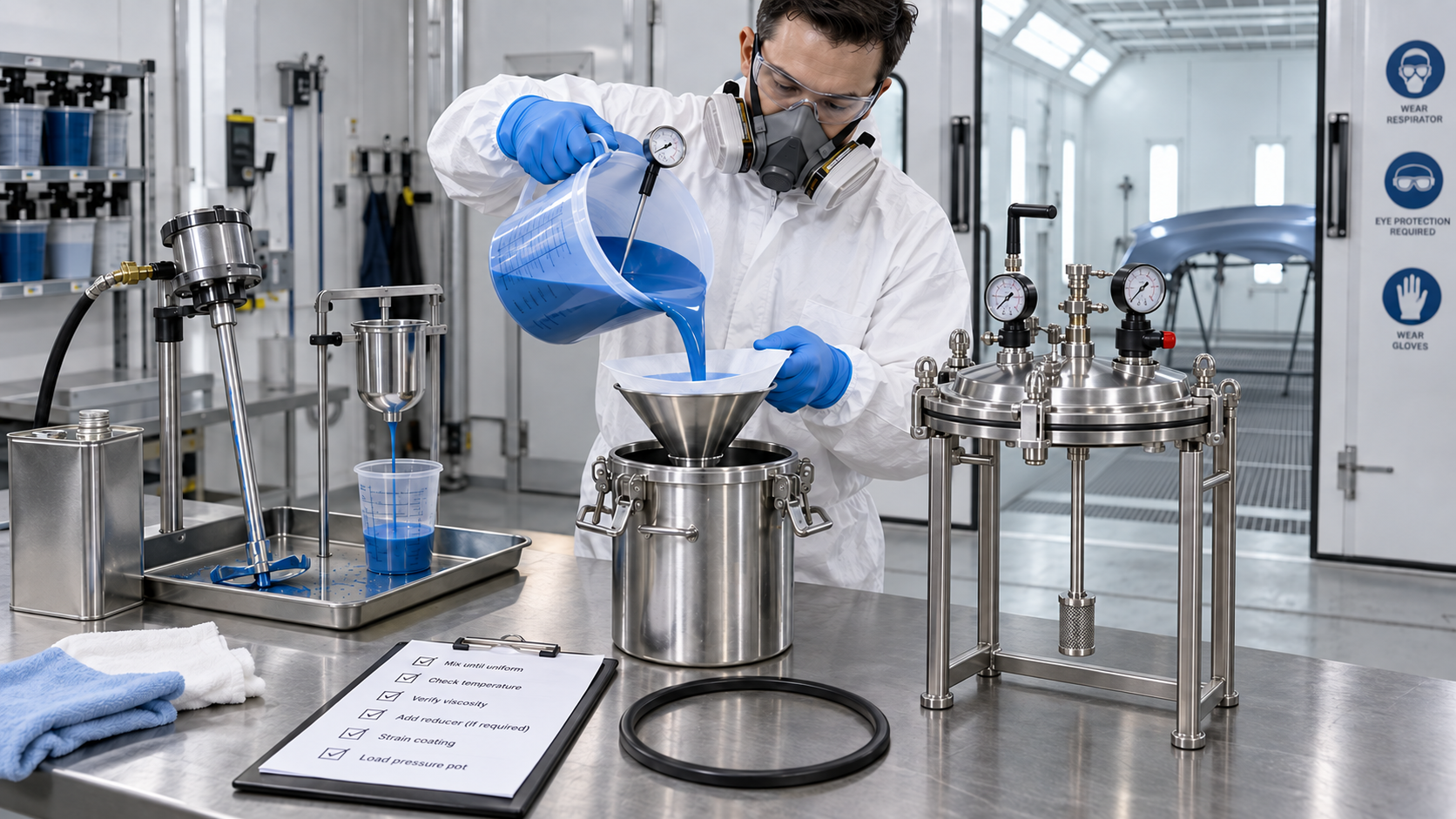
 Paint Conditioning
Prepare the Coating Before You Prepare to Spray
Before picking up the spray gun, ask one important question:
Is the coating ready to spray?
The surface may be prepared, the work area masked, and the spray
equipment properly adjusted. But if the coating has not been properly
conditioned, the finish can still suffer from poor atomization,
inconsistent color, uneven film build, slow application, and avoidable
defects.
A spray gun can only atomize the material it receives. Begin with a
coating that is within specification, properly mixed, and ready for
application.
What Is Paint Conditioning?
Paint conditioning is the process of preparing a coating so it performs
as its manufacturer intended. The exact procedure depends on the coating
chemistry and may include:
- Confirming shelf life and storage history
- Bringing the material to the recommended application temperature
- Restoring settled pigments and solids to uniform suspension
- Combining multicomponent materials in the correct ratio
- Reducing the coating to the specified viscosity
- Observing required induction time and pot life
- Straining the coating before it enters the spray system
Always consult the coating manufacturer's current technical data sheet
for the correct temperature range, mixing ratio, reducer, viscosity,
induction time, pot life, application method, and curing requirements.
Confirm the Coating Temperature
Coating temperature can significantly affect viscosity, material flow,
atomization, film build, drying, and curing. Material stored in a cold
warehouse may be considerably thicker than the same coating at its
recommended application temperature.
-
Determine whether the coating was stored in a cold or unusually warm
shop, warehouse, vehicle, or outdoor storage area
-
Bring the coating into the manufacturer's recommended application
temperature range before mixing and spraying
-
Allow enough time for the complete container—not merely its
surface—to reach the proper temperature
-
Check the substrate and surrounding air temperature when required by
the coating manufacturer
Do not compensate for cold, overly viscous material by automatically
adding reducer. Adjusting the formulation without following the
manufacturer's instructions can affect film build, appearance, drying,
and coating performance.
Use Inventory Within Its Approved Shelf Life
Good material management begins before the container reaches the spray
area. Use the FIFO principle: First In, First Out, while
also confirming that every container remains within its approved shelf
life.
- Check the batch number, manufacture date, and expiration date
- Confirm that the material was stored under approved conditions
-
Inspect opened containers for contamination, skinning, gelling,
unusual separation, or other deterioration
-
Do not use expired or questionable material without direction from
the coating manufacturer
Mix the Coating Thoroughly
The material near the bottom of the container should have the same
composition as the material near the top. Settled pigments and solids can
change color, gloss, coverage, viscosity, and protective performance as
the container is emptied.
-
Restore uniform suspension:
Mix settled components completely into the coating
-
Select the proper equipment:
Use an appropriate paddle mixer, air-powered agitator, or another
manufacturer-approved mixing device
-
Avoid excessive agitation:
Overmixing can introduce air, create foam, generate heat, or damage
shear-sensitive materials
-
Measure accurately:
Combine multicomponent coatings according to the specified mixing
ratio
-
Observe induction time:
Allow the mixed coating to stand when required before application
-
Track pot life:
Do not continue spraying mixed material beyond its usable working
time
-
Maintain suspension:
Use properly selected agitation during production when the coating
is prone to settling
Reduce and Strain as Required
If reduction is permitted, use only the reducer and proportion specified
by the coating manufacturer. Confirm viscosity with the recommended
method rather than relying solely on appearance.
Strain the conditioned material through an appropriate coating filter
before it enters the cup, pressure tank, or pump. Proper filtration can
help remove skins, debris, and agglomerated material that might otherwise
restrict the fluid nozzle or damage the finish.
Agitate Safely
Confirm that the mixer, agitator, container, air supply, and installation
are compatible with the coating and work area. Follow applicable
grounding, ventilation, fire-protection, and hazardous-location
requirements.
Air-powered equipment does not automatically certify a complete
installation for use in every hazardous location. The facility operator
must confirm equipment ratings and all applicable safety requirements.
Adjust the Spray Equipment After Conditioning
Once the coating is properly conditioned, adjust the fluid delivery,
atomizing air, fan pattern, and gun-to-target distance. Evaluate the
actual spray pattern and wet film rather than relying on a pressure-gauge
number alone.
Need Help with Material Preparation or Mixing Equipment?
AirSprayTech can help match an agitator, mixer, pressure tank, pump,
filter, regulator, or material-delivery system to your coating and
production requirements.
Call
817.490.1777
or email
the finishing authority
for equipment-selection assistance.