|
|
|
Measuring Coating Viscosity With Zahn and Ford Cups | Seconds That Control the Finish Last Updated: 09/10/2026 |
|||||||||||||||||||||||||||||||||||||||||||||||||||||||||
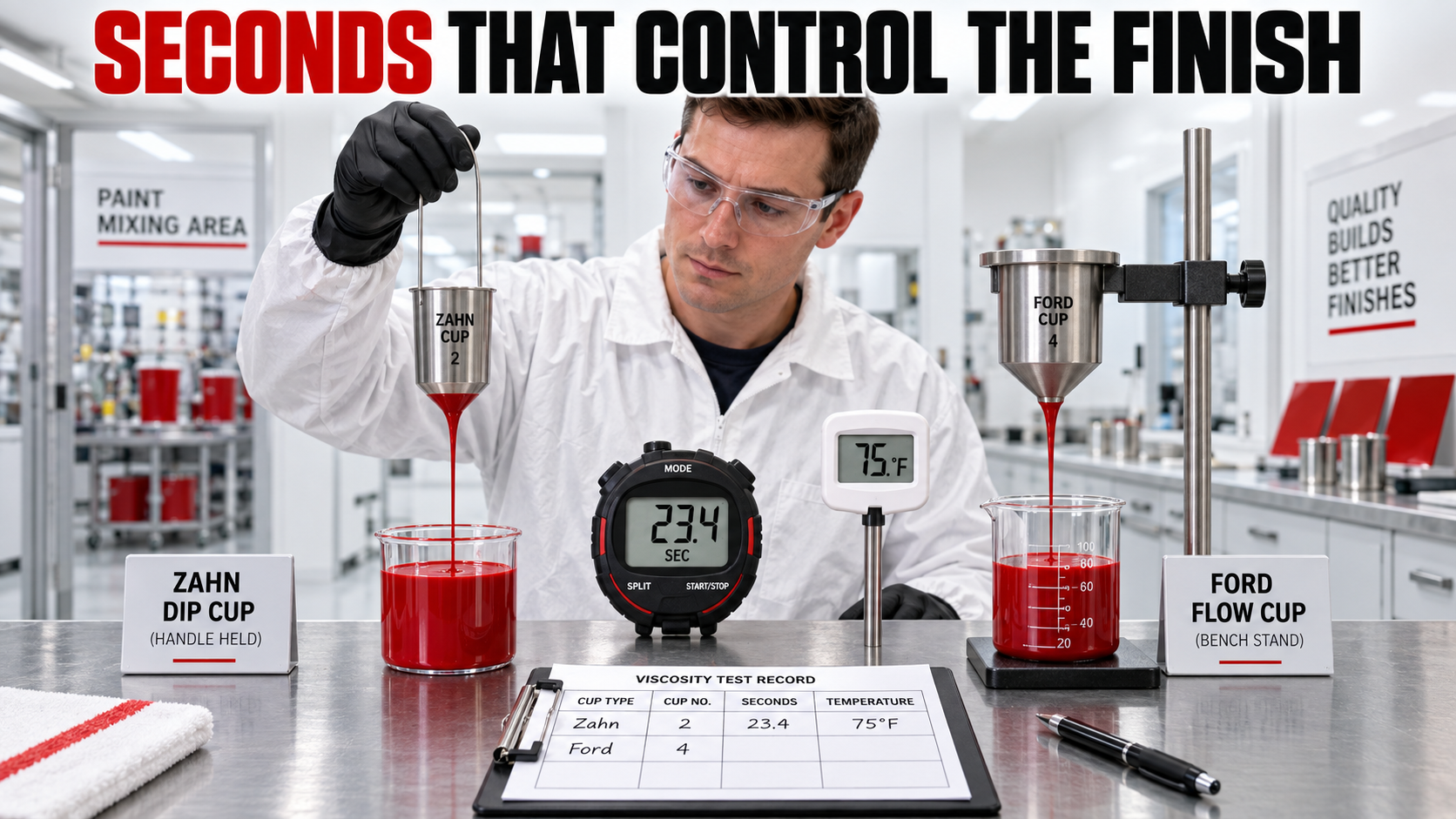 AirSprayTech.com Academy Measuring Coating Viscosity With Zahn and Ford CupsSeconds That Control the Finish A coating can look perfectly normal in the mixing container and still be too thick or too thin for the application equipment. The spray gun will eventually tell you something is wrong—but by then, the evidence may already be hanging on the part in the form of orange peel, dry spray, runs, poor atomization, or uneven film build. A viscosity cup gives you a better option. It provides a quick, repeatable way to measure how readily a liquid coating flows under controlled conditions. The test appears simple: fill or immerse the cup, start a stopwatch, and record the number of seconds required for the stream to break. But getting a useful result requires more than a cup and a good thumb. Cup type, cup number, coating temperature, mixing procedure, timing method, cleanliness, and operator technique must all be controlled. A viscosity reading is incomplete unless it identifies the cup type, cup number, temperature, and measured time. What Is Coating Viscosity?Viscosity is a liquid’s resistance to flow. A high-viscosity coating flows more slowly and is commonly described as thicker. A low-viscosity coating flows more readily and is commonly described as thinner. Viscosity affects how the coating moves through pumps, hoses, fluid passages, nozzles, and spray-gun air caps. It also influences atomization, transfer efficiency, film build, leveling, sag resistance, and final appearance. A viscosity cup does not directly measure every property that determines sprayability. It measures the time required for a controlled volume of material to flow through a specified opening. That time becomes a practical shop-floor control value. Start With the Product Data SheetBefore reaching for a viscosity cup, read the coating manufacturer’s Product Data Sheet. Look for:
If the Product Data Sheet specifies “20 to 24 seconds in a Zahn No. 2 cup at 77°F,” that entire instruction matters. A result of “22 seconds” obtained with a different cup or at a different temperature is not the same measurement. Never add an unapproved reducer simply to reach a familiar viscosity. Use only the reducer, amount, and procedure permitted by the coating manufacturer. Zahn and Ford Cups Do Similar Work Differently
A Zahn cup is convenient for quick production checks. A Ford cup is commonly used when a more controlled bench procedure is required. Neither cup is automatically right for every coating or specification. Cup Numbers Are Not InterchangeableZahn and Ford cups are available in different numbered sizes. Each cup number has a particular orifice and useful viscosity range. A larger number does not create a universal viscosity scale, and cups from different families cannot be substituted by matching their numbers. A Zahn No. 2 reading is not the same as a Ford No. 2 reading. Results obtained with different cup designs may not be directly comparable, even when the drain times happen to be identical. Always use the exact cup specified by the coating manufacturer, customer specification, internal procedure, or applicable test method. Equipment Required
Prepare the Coating Before Testing
Measuring With a Zahn CupUse the manufacturer’s instructions and the applicable written test procedure. A typical production-floor method follows these general steps:
Example of a complete result: 23.4 seconds, Zahn No. 2, 75°F, tested after induction. Measuring With a Ford CupA Ford cup measurement is normally performed on a stable, level stand under controlled conditions. Follow the applicable test method and the instrument manufacturer’s instructions.
Temperature Can Change the ResultMost liquid coatings become less viscous as their temperature rises and more viscous as their temperature falls. That means the same batch can produce different cup times at different temperatures without any reducer being added. Consider a coating moved from a cool storage room into a warm mixing room. If the operator tests it immediately, the cup time may be higher than it will be after the material reaches the specified application temperature. Adding reducer too soon could leave the coating excessively thin later in the shift. Measure the coating temperature—not merely the room temperature—and record it with every viscosity result. Why Test Results Become Unreliable
Repeat the MeasurementOne test can be affected by a bubble, hesitation, an uneven lift, or a poorly observed stream break. When process control matters, perform repeat measurements according to the written procedure. If repeated readings differ substantially, do not average the numbers and pretend the problem disappeared. Investigate the sample, temperature, mixing, cup condition, and operator technique. Clean the Cup ImmediatelyDried coating inside the orifice can change the flow time. Clean the cup immediately after testing with a compatible cleaning material and inspect it under good lighting.
A viscosity cup is a measuring instrument, not a disposable mixing tool. Treat the orifice the same way you would treat any other calibrated measuring surface. Verification and CalibrationCups used for production control should be periodically checked using the manufacturer’s recommended procedure and suitable certified viscosity standards. The inspection frequency should reflect usage, cleaning practices, customer requirements, and the importance of the measurement. Record the cup identification number, verification date, reference material, temperature, measured value, acceptable range, result, and person performing the check. Remove a damaged or out-of-tolerance cup from service. Can Cup Seconds Be Converted to Centistokes?Some cup manufacturers provide equations or conversion tables that estimate kinematic viscosity in centistokes from efflux time. Use only the conversion information supplied for the exact cup design and only within its stated measurement range. Do not use a generic internet chart to convert one cup family into another. Cup geometry, orifice dimensions, calibration, temperature, and the material’s flow behavior all affect the result. The Limitation of Flow CupsFlow cups work best with Newtonian and near-Newtonian liquids. Many modern coatings are non-Newtonian, shear-thinning, or thixotropic. Their apparent viscosity can change with agitation, shear, and resting time. A cup reading may still be useful for internal production control when the method is tightly standardized, but it may not fully describe how the coating behaves during pumping or atomization. A rotational viscometer or another controlled-shear instrument may be required when better characterization is needed. ASTM notes that dip cups are convenient and robust but that other laboratory instruments can provide better precision. The right instrument depends on what the measurement is expected to prove. What the Result May Tell the Painter
Record More Than a NumberA useful viscosity record should include:
The record creates traceability. When a finish problem appears later, the quality team can determine whether the coating was prepared and applied within the established process window. The Bottom LineMeasuring coating viscosity is simple enough to perform on the shop floor, but it is precise enough to expose an uncontrolled process. The value of the test does not come from watching liquid drain through a hole. It comes from performing the same test the same way, under the same defined conditions, and acting on the result before the coating reaches the part. Use the specified cup. Control the temperature. Follow the Product Data Sheet. Record the complete result. Then adjust the coating only when the manufacturer’s instructions permit it. Seconds are not just numbers on a stopwatch. They may be the first warning that your finishing process is moving outside its approved operating window. Technical References
Technical notice: This article provides general educational information. Always follow the coating manufacturer’s current Product Data Sheet, Safety Data Sheet, viscosity-cup instructions, customer specification, and applicable test standard.
Copyright © 2026 Azimuth Spray Systems, LLC. All rights reserved. Tags:
coating viscosity, Zahn viscosity cup, Ford viscosity cup, measure paint viscosity, viscosity cup test, paint flow time, coating temperature, spray viscosity, ASTM D4212, ASTM D1200, paint quality control, coating application, viscosity testing, paint mi
|