|
|
|
Grounding and Bonding in Liquid and Powder Finishing | Give Static Electricity a Safe Way Home Last Updated: 09/10/2026 |
|||||||||||||||||||||||||||||||||||||||
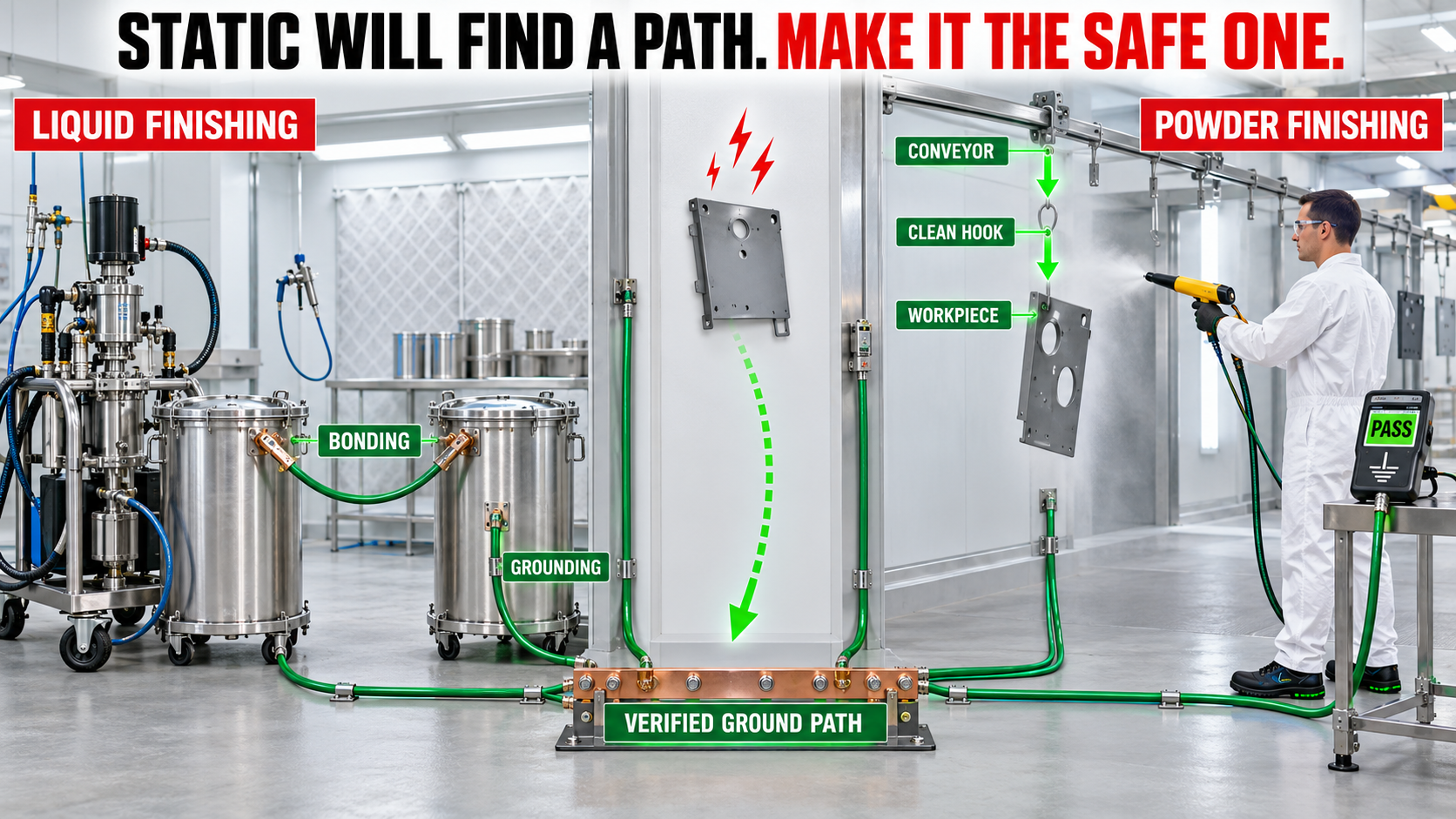 AirSprayTech.com Academy Grounding and Bonding in Liquid and Powder FinishingGive Static Electricity a Safe Way Home Static electricity does not need a visible spark to become a problem. It can build quietly on a spray gun, pump, container, conveyor, powder hose, workpiece, operator, or pile of coating material. When the electrical charge finally finds a path to something at a different potential, the discharge can be sudden. In a finishing area containing flammable vapors or combustible powder, that spark may become an ignition source. In an electrostatic system, poor grounding can also reduce coating attraction, transfer efficiency, wraparound, and finish consistency. Grounding and bonding are related, but they are not identical. A safe installation requires workers to understand what each one does, where continuity can be lost, and how the complete path is verified. Bonding connects conductive objects together. Grounding connects the bonded system to earth. Both help prevent a dangerous difference in electrical potential. What Is Bonding?Bonding creates an electrically conductive connection between two or more conductive objects. The purpose is to keep those objects at substantially the same electrical potential. A common example is transferring a flammable liquid from one metal container into another. A bonding conductor connects the source container to the receiving container so a static charge does not create a significant voltage difference between them. Bonding does not necessarily connect the objects to earth. It connects them to each other. What Is Grounding?Grounding provides an electrically conductive path from equipment, containers, workpieces, or other conductive objects to an approved earth-grounding point. The path allows accumulated electrical charge to dissipate instead of remaining on the object until it discharges through a person, another piece of equipment, or a spark gap. A ground path must be continuous. A clamp attached to a painted surface, a dirty conveyor hook, a broken wire, an insulated caster, or a plastic pail liner may leave the equipment looking grounded when it is not. Grounding Versus Bonding
Where Static Charge Comes FromStatic charge can be generated when materials move, separate, rub, flow, or are atomized. Finishing operations provide many opportunities:
Electrostatic systems intentionally charge the coating to improve attraction to a grounded workpiece. That controlled process works properly only when every required component has the electrical condition intended by the equipment manufacturer. Why Grounding Matters Even Without ElectrostaticsStatic-electricity control is not limited to electrostatic spray guns. Conventional air spray, HVLP, airless, air-assisted airless, material transfer, mixing, flushing, and container filling can all generate or accumulate static charge. A non-electrostatic gun does not intentionally charge the coating, but movement of material and air can still create static electricity. Pumps, containers, conductive hoses, waste pails, and receiving containers must be grounded or bonded when required by the equipment instructions, chemical classification, and applicable codes. Liquid Finishing SystemsDepending on the process and manufacturer’s instructions, grounding and bonding may be required for:
Pumps and Fluid SourcesA pump may have a grounding terminal, grounding lug, wire, and clamp specified by its manufacturer. The clamp must be connected to an approved grounding point—not merely to a nearby object that appears metallic. Paint, corrosion, thread sealant, loose fasteners, insulated mounting pads, and contaminated clamps can interrupt the path. Grounding continuity must be verified rather than assumed. HosesSome spray and electrostatic systems depend on approved conductive or grounded hoses as part of the grounding path. A hose that looks correct may not have the electrical construction or resistance required by the equipment manufacturer. Use the hose type, maximum combined length, fittings, and grounding method specified by the equipment manufacturer. Inspect hoses for cuts, broken conductors, damaged fittings, bulges, coating buildup, and unauthorized repairs. Containers and FlushingWhen transferring flammable liquids between conductive containers, bond the containers together and ground the system as required. Maintain metal-to-metal contact or use approved bonding conductors and clamps. During flushing, use an approved conductive receiving container that is properly grounded. Maintain the grounding path while triggering the gun according to the manufacturer’s flushing procedure. A metal pail is not grounded simply because it is made of metal. If it sits on cardboard, plastic, an insulated cart, or a heavily coated floor, the electrical path may be broken. Electrostatic Liquid FinishingAn electrostatic spray gun creates an electrical charge on the coating. The charged droplets are attracted to a properly grounded workpiece. This can improve transfer efficiency and wraparound when the entire system is correctly designed and maintained. Poor grounding can cause:
The gun, fluid supply, workpiece, operator, conductive objects, containers, booth, and other equipment must be treated exactly as required by the electrostatic-system manufacturer. Waterborne electrostatic systems may use voltage-isolation equipment and require procedures different from solvent-based systems. Do not assume that one electrostatic installation represents all others. Powder-Coating SystemsPowder coating depends heavily on proper grounding. Charged powder must be attracted to the workpiece, and unused charge must have a controlled path away from conductive equipment and personnel. Grounding considerations may include:
The Workpiece Ground PathThe part is often grounded through a chain of contact points: Part → Hook → Rack → Conveyor → Grounding System Every connection matters. A beautifully grounded conveyor does little good if cured powder has insulated the hook from the part. Contact points must be designed, cleaned, inspected, and replaced often enough to maintain the resistance-to-ground limit required by the applicable standard and equipment manufacturer. Grounding and Faraday-Cage AreasPoor grounding is sometimes blamed for every recess-coating problem, but Faraday-cage behavior can occur even when grounding is acceptable. Deep recesses, corners, gun position, powder flow, voltage, current limiting, part geometry, and operator technique also matter. Verify grounding first, then evaluate application settings and gun movement. Do not increase voltage automatically. More voltage can make penetration into a recessed area worse under some conditions. Grounding the OperatorIn electrostatic liquid and powder applications, the operator may become charged if insulated from ground. The approved grounding method may involve conductive footwear, grounded floor systems, conductive gloves, grounding straps, or equipment-specific provisions. Conditions that can interrupt operator grounding include:
Do not cut holes in gloves or modify PPE unless that method is specifically approved by the equipment manufacturer and the employer’s safety program. Chemical protection and electrical grounding must both be maintained. Plastic Creates Special ProblemsPlastic containers, pail liners, hoses, duct components, part masks, protective films, and other nonconductive materials can accumulate static charge or interrupt a grounding path. Attaching a grounding clamp to plastic does not make the plastic conductive. Grounding a nearby metal frame may not remove charge from an insulated plastic surface. Use only materials and configurations approved for the process. Evaluate nonconductive items during the design review rather than after a static-discharge event. A Ground Clamp Must Reach Bare Conductive MetalGround clamps should be attached to clean, unpainted conductive surfaces or approved grounding terminals. Clamping onto paint, powder coating, corrosion, tape, sealant, or dirt can create electrical resistance or complete isolation. Inspect grounding clamps for:
How Grounding Is TestedGrounding should be tested with the instrument and procedure required by the equipment manufacturer, facility electrical-safety program, and applicable standard. Depending on the system, this may require a resistance-to-ground meter, megohmmeter, approved electrostatic test instrument, or continuity-testing device. An ordinary multimeter may not be suitable for every electrostatic grounding test. It may use the wrong test voltage, lack the required range, or fail to evaluate the system under the conditions specified by the manufacturer. A complete grounding record should identify:
Do not perform electrical-resistance testing in a potentially hazardous atmosphere unless the instrument and procedure are specifically approved for that location and condition. Shut down the process and follow the manufacturer’s safe test procedure. What Resistance Is Acceptable?There is no single resistance value that should be applied blindly to every component in every finishing system. Limits can differ for workpieces, guns, hoses, operators, flooring, containers, and specialized electrostatic equipment. Some equipment manufacturers specify a maximum resistance-to-ground value, such as one megohm, for particular objects or systems. That number should not be copied into a general shop procedure unless it applies to the exact equipment and installation being tested. Use the most restrictive applicable requirement from:
Do Not Install an Independent Ground Rod Without Engineering ReviewDriving a separate rod into the floor or soil may appear to create a convenient ground, but separately grounded systems can develop differences in electrical potential. Grounding and bonding must be coordinated with the facility electrical-grounding system. Grounding-system design, permanent electrical connections, hazardous-location wiring, and modifications should be handled by qualified personnel and reviewed against applicable codes. Common Grounding and Bonding Failures
Daily Operator InspectionBefore spraying begins, the operator should check the items assigned by the facility procedure:
Periodic Grounding AuditA documented audit should trace the entire path rather than testing only the easiest connection:
The Bottom LineGrounding and bonding are not decorations added to make a finishing system look complete. They are working parts of the fire-prevention, shock-prevention, electrostatic-performance, and process-control system. Bonding keeps conductive objects at substantially the same electrical potential. Grounding provides the path to earth. Both depend on clean contact points, approved conductors, correct equipment, qualified installation, regular inspection, and documented testing. If the system depends on a ground path, do not assume that path exists because a wire is visible. Test it. Record it. Maintain it. Static electricity will look for a path. Make sure the safe path is already there. Safety References
Safety notice: This article provides general educational information and is not an electrical design, code interpretation, or site-specific safety plan. Grounding, bonding, hazardous-location electrical work, electrostatic equipment, and resistance testing must comply with current manufacturer instructions, OSHA requirements, NFPA standards, the National Electrical Code, local codes, insurance requirements, and the authority having jurisdiction.
Copyright © 2026 Azimuth Spray Systems, LLC. All rights reserved. Tags:
grounding and bonding, spray booth grounding, liquid finishing safety, powder coating grounding, electrostatic spray safety, static electricity control, paint equipment grounding, container bonding, conductive spray hoses, powder coating hooks, workpiece
|
|||||||||||||||||||||||||||||||||||||||