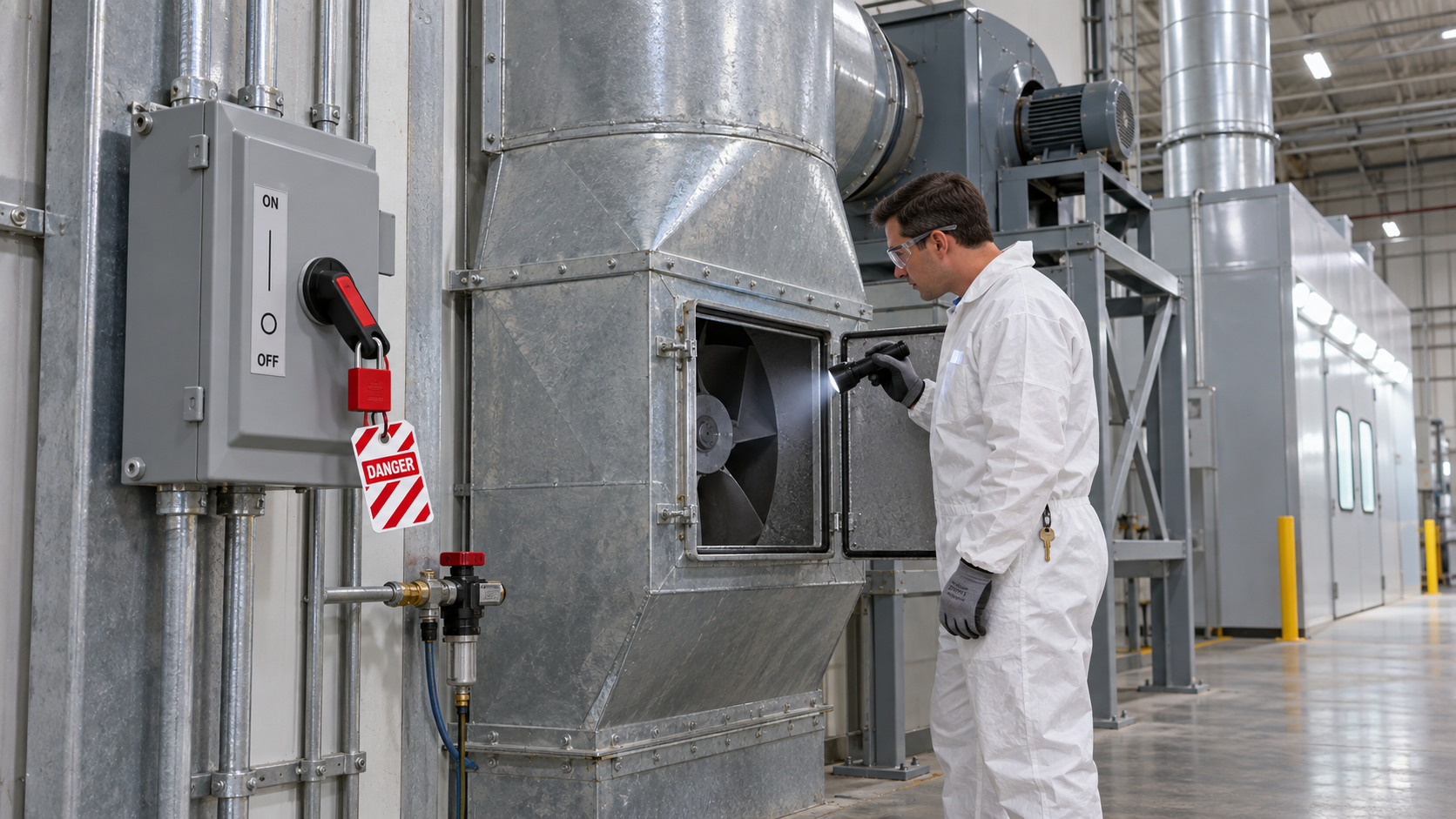
 Turning It Off Is Not the Same as Making It Safe
A spray booth fan stops turning. A conveyor comes to a halt. A pump becomes quiet. The control panel goes dark.
It may look safe—but hazardous energy can still be waiting inside the equipment.
A maintenance technician reaches into a fan housing. Someone clears a jammed conveyor. An employee opens a pressurized fluid filter. Another worker, unaware that maintenance is underway, presses the start button.
That is the danger lockout/tagout is designed to prevent.
Lockout/tagout—commonly abbreviated LOTO—is the process used to control hazardous energy during servicing and maintenance. It prevents unexpected startup, equipment movement, electrical shock, pressure release, heat exposure, and other potentially serious events.
The stop button controls the machine. Lockout/tagout controls the energy.
What Is Hazardous Energy?
Hazardous energy is any form of energy capable of injuring an employee during maintenance or servicing.
In a professional finishing operation, hazardous energy may include:
- Electrical energy
- Pneumatic pressure
- Hydraulic pressure
- Mechanical movement
- Stored spring tension
- Gravity
- Thermal energy
- Pressurized coating or solvent
- Steam or heated fluids
- Electrostatic high voltage
- Stored electrical energy in capacitors
- Chemical energy
A single machine may contain several types of energy. Disconnecting the electrical supply may stop the motor but leave pressurized air, hydraulic pressure, trapped coating, elevated parts, hot surfaces, or charged electrical components.
Where Lockout/Tagout Appears in a Finishing Operation
Lockout/tagout may be required when maintaining or servicing:
- Spray-booth exhaust and makeup-air fans
- Air-handling units
- Booth heaters and burners
- Curing ovens
- Conveyors and part-handling systems
- Reciprocators and robotic applicators
- Airless and air-assisted airless pumps
- Pneumatic piston pumps
- Diaphragm pumps
- Pressure tanks and pressure pots
- Mixers and agitators
- Plural-component proportioners
- Paint-circulation systems
- Powder-coating booths and recovery systems
- Electrostatic spray equipment
- Dust collectors
- Compressed-air systems
- Washers and pretreatment systems
- Lifts, hoists, and elevators
The specific lockout procedure must address the actual equipment and every energy source connected to it.
When Is Lockout/Tagout Required?
OSHA’s control-of-hazardous-energy standard generally applies when servicing or maintenance exposes an employee to unexpected energization, startup, or the release of stored energy.
This may include:
- Removing guards or access panels
- Entering a fan, duct, oven, booth pit, or machine enclosure
- Clearing conveyor or equipment jams
- Replacing belts, bearings, filters, motors, or fan components
- Cleaning internal machine parts
- Repairing pumps, valves, regulators, or fluid lines
- Working near moving parts
- Opening equipment containing trapped pressure
- Performing electrical troubleshooting or repair
- Working where automatic equipment may cycle unexpectedly
If an employee must place any part of the body into a danger zone, the equipment must be evaluated for lockout/tagout.
A Push Button Is Not an Energy-Isolating Device
Stop buttons, selector switches, touchscreens, programmable controllers, emergency-stop buttons, and remote controls are operating controls. They are not normally energy-isolating devices.
An energy-isolating device physically prevents energy from being transmitted or released.
Examples include:
- Electrical disconnect switches
- Circuit breakers designed for isolation and lockout
- Manually operated line valves
- Disconnect blocks
- Mechanical blocking devices
- Blank flanges
- Other devices that physically prevent energy transmission
Pressing “Stop” may halt normal operation, but the equipment may restart after a control failure, software command, sensor signal, power restoration, or another person’s action.
Lockout and Tagout Are Not Identical
Lockout uses a lock and an approved lockout device to hold an energy-isolating device in a safe position.
Tagout uses a warning tag to identify that the equipment must not be operated.
A tag provides information—but it does not physically prevent someone from operating the energy-isolating device.
When an energy-isolating device is capable of being locked out, OSHA generally requires lockout unless the employer can demonstrate that a tagout system provides full employee protection equivalent to lockout.
If the device can be locked, lock it.
The Three Types of Employees
Authorized Employees
An authorized employee applies locks and tags to perform servicing or maintenance. This person must understand the equipment, hazardous-energy sources, isolation points, and required procedure.
Affected Employees
An affected employee normally operates or works around equipment being locked out. Affected employees must understand why the equipment is unavailable and must not attempt to operate or restart it.
Other Employees
Other employees who work in the area must understand the meaning of locks and tags and the prohibition against tampering with them.
Only trained and authorized employees should perform lockout/tagout.
The Basic Lockout/Tagout Sequence
Every machine requires a procedure appropriate to its energy sources and isolation points. The following sequence describes the general process.
Step 1: Prepare for Shutdown
Before shutting down the equipment, the authorized employee must identify:
- Every hazardous-energy source
- The type and magnitude of the energy
- The hazards involved
- Every energy-isolating device
- The method required to control each source
- Stored-energy hazards
- The correct verification procedure
Do not begin until the entire energy path is understood.
Step 2: Notify Affected Employees
Tell affected employees that the equipment will be shut down and locked out. Explain which equipment is affected and why it will be unavailable.
Step 3: Shut Down the Equipment Normally
Use the normal operating controls to stop the equipment. A controlled shutdown can prevent additional hazards, equipment damage, or sudden movement.
Step 4: Isolate Every Energy Source
Operate the disconnects, valves, breakers, blocks, or other energy-isolating devices needed to separate the equipment from its energy sources.
Isolating the electrical supply does not automatically isolate pneumatic, hydraulic, thermal, gravitational, or chemical energy.
Step 5: Apply Locks and Tags
Each authorized employee applies a personally assigned lock to the appropriate energy-isolating device or group lockout system.
The tag should identify the employee and communicate that the equipment must not be operated.
Locks used for energy control should be standardized, identifiable, durable, and used only for lockout/tagout.
Step 6: Control Stored Energy
After isolation, stored or residual energy must be relieved, disconnected, restrained, blocked, dissipated, or otherwise rendered safe.
This may require:
- Bleeding compressed-air pressure
- Relieving hydraulic pressure
- Triggering a spray gun into an approved grounded container
- Draining trapped coating or solvent
- Discharging electrical capacitors
- Waiting for rotating equipment to stop
- Blocking raised equipment
- Releasing spring tension
- Allowing ovens or heated parts to cool
- Verifying that electrostatic charges have dissipated
If stored energy can accumulate again, it must be monitored continuously or checked regularly until servicing is complete.
Step 7: Verify Isolation
Before work begins, verify that the equipment is actually isolated and de-energized.
Depending on the equipment, verification may include:
- Trying the normal start controls
- Testing electrical conductors with an appropriate meter
- Checking pressure gauges
- Operating bleed or relief valves
- Confirming that moving parts cannot cycle
- Inspecting blocks and restraints
- Testing for residual electrostatic energy
After a start attempt, return every control to its neutral or off position.
Never assume isolation. Prove it.
Special Hazards in Finishing Operations
Spray-Booth Fans
An exhaust fan may continue rotating after electrical power is disconnected. Air movement, belt tension, and heavy fan blades can create mechanical hazards.
Lock out the electrical disconnect, wait for the fan to stop completely, and control any remaining movement before entering the fan housing or ductwork.
Compressed-Air Systems
Closing the main air valve is only the beginning. Pressure may remain trapped in hoses, regulators, cylinders, pumps, pressure pots, and actuators.
Close and lock the correct isolating valve, bleed downstream pressure, and verify that the pressure cannot rebuild.
High-Pressure Paint Pumps
Airless and air-assisted airless systems can retain dangerous fluid pressure after the pump stops. High-pressure coating can penetrate the skin and cause a serious injection injury.
Follow the equipment manufacturer’s pressure-relief procedure before servicing a pump, hose, spray gun, tip, filter, valve, or fluid connection.
A gauge reading of zero should be considered along with the complete manufacturer-specified verification procedure.
Pressure Pots and Tanks
A pressure pot can contain compressed air even after the supply valve is closed.
Before loosening lid clamps, regulators, hoses, or fittings:
- Isolate the air supply.
- Lock the air-isolating device when required.
- Relieve vessel pressure completely.
- Verify the gauge reads zero.
- Confirm that the pressure-relief path is open.
- Follow the manufacturer’s opening procedure.
Never attempt to force open a pressurized vessel.
Mixers and Agitators
A mixer can start unexpectedly through a switch, control signal, timer, air valve, or restored power.
Lock out the power source before reaching into a vessel, touching the shaft or blade, or removing a guard.
Conveyors
Conveyors may move because of electrical power, gravity, accumulated product, chain tension, pneumatic actuators, or stored mechanical energy.
Lock out every relevant energy source and block movement before clearing jams or working near chains, sprockets, hooks, drives, take-ups, or pinch points.
Curing Ovens
Ovens may contain electrical energy, natural gas, heated air, rotating fans, conveyors, hot surfaces, and automatic controls.
Lockout planning must address more than the burner. Employees may need protection from heat, fan movement, fuel supply, conveyor movement, and confined-space hazards.
Electrostatic Equipment
Electrostatic spray systems may retain electrical energy after the high-voltage supply is turned off.
Follow the manufacturer’s shutdown, discharge, grounding, and verification procedures before servicing guns, cables, controls, bells, discs, reciprocators, or associated equipment.
Powder-Coating Systems
Powder systems may combine electrical, pneumatic, mechanical, electrostatic, and combustible-dust hazards.
Lockout may be required for:
- Booth exhaust fans
- Cartridge-cleaning systems
- Automatic gun movers
- Powder pumps
- Recovery systems
- Sieves and feed centers
- Transfer blowers
- Fire-detection and suppression interfaces
Do not enter or reach into powder-recovery equipment until every hazardous-energy source has been identified and controlled.
Testing or Positioning May Require Temporary Energization
Some maintenance tasks may require temporary energization for testing, positioning, or troubleshooting.
When this is necessary, follow the employer’s approved procedure:
- Clear tools and materials from the equipment.
- Remove employees from danger zones.
- Remove locks and tags according to the established procedure.
- Energize the equipment only for the required test or positioning.
- De-energize the equipment again.
- Reapply all energy-control measures.
- Verify isolation before maintenance resumes.
Temporary energization should never become a shortcut around lockout/tagout.
Group Lockout/Tagout
When several employees work on the same equipment, each authorized employee must receive protection equivalent to personal lockout.
A group lockbox, hasp, or other approved group system may be used. Each authorized employee should apply and remove a personal lock according to the company’s procedure.
One person’s lock should never be treated as protection for an entire crew unless the group procedure provides each worker with the required personal control.
Shift and Personnel Changes
Maintenance may continue through a shift change. The written procedure must ensure continuous protection while responsibility transfers from outgoing employees to incoming employees.
The equipment must never be left between shifts without clearly assigned locks, control, and responsibility.
Outside Contractors
When outside contractors perform maintenance, the facility and contractor must inform each other about their respective energy-control procedures.
Facility employees must understand the restrictions of the contractor’s program, and contract employees must understand the facility’s requirements.
Do not assume that the contractor’s lockout system is identical to the facility’s system.
Removing Another Employee’s Lock
Normally, the employee who applied a personal lock is the person who removes it.
If that employee is unavailable, the lock may be removed only under a specific employer-developed procedure that provides protection equivalent to personal removal.
The procedure should include verification that the employee is not at the facility, reasonable efforts to contact the employee, and confirmation that the employee knows the lock was removed before resuming work.
Cutting off a lock simply because production needs the machine is not an acceptable procedure.
The Cord-and-Plug Exception Is Limited
Certain cord-and-plug-connected equipment may fall outside the general lockout requirements when unplugging controls the hazard and the plug remains under the exclusive control of the employee performing the service.
If the employee cannot maintain exclusive control of the plug, another employee could reconnect it, or the equipment contains additional hazardous energy, unplugging alone may not provide adequate protection.
The Minor-Servicing Exception Is Narrow
Not every small adjustment is automatically exempt from lockout/tagout.
For OSHA’s minor-servicing exception to apply, the activity must occur during normal production and be:
- Routine
- Repetitive
- Integral to production
Alternative measures must also provide effective protection.
If every condition is not satisfied, the exception does not apply. Calling a task “minor” does not make it exempt.
Returning Equipment to Service
After maintenance is completed:
- Inspect the work area.
- Remove tools, spare parts, and temporary materials.
- Reinstall guards and safety devices.
- Confirm that employees are safely positioned.
- Verify that operating controls are in the correct position.
- Each authorized employee removes their personal lock and tag.
- Remove blocks or restraints according to the procedure.
- Restore energy in a controlled sequence.
- Notify affected employees that the equipment is returning to service.
- Observe the startup for abnormal operation.
Removing the last lock is not permission for an uncontrolled restart.
Training and Periodic Inspection
Authorized employees must be trained to recognize hazardous-energy sources and understand the methods needed to isolate and control them.
Affected and other employees must understand the purpose of the program and the rule against restarting or tampering with locked-out equipment.
Retraining is required when job assignments, equipment, processes, or energy-control procedures change—or when an inspection reveals that employees are not following or understanding the procedure.
OSHA also requires the employer to conduct and certify a periodic inspection of each energy-control procedure at least annually. The inspection must identify and correct deviations or weaknesses.
A Practical Finishing-Equipment Lockout Checklist
Before beginning maintenance, confirm:
- The equipment-specific procedure has been reviewed.
- Every hazardous-energy source has been identified.
- Affected employees have been notified.
- The equipment has been shut down normally.
- Every energy source has been isolated.
- Personal locks and tags have been applied.
- Stored pressure has been relieved.
- Moving parts have stopped.
- Raised parts have been blocked.
- Hot surfaces have cooled or been controlled.
- Electrical and electrostatic energy has been discharged.
- Isolation has been tested and verified.
- Controls have been returned to neutral after the test.
- Each employee is protected by the approved lockout system.
The Bottom Line
The equipment does not know that someone is cleaning it, repairing it, or reaching inside it.
A stopped machine may still contain electricity, air pressure, hydraulic force, trapped coating, heat, gravity, spring tension, or stored electrical charge.
Identify every energy source. Isolate it. Lock it. Release stored energy. Then verify that the equipment is safe before maintenance begins.
The machine is not safe because it stopped. It is safe only after every hazardous-energy source has been controlled and verified.
This article provides general educational information. It is not a substitute for an employer’s equipment-specific energy-control procedures, employee training, manufacturer instructions, a workplace hazard assessment, or applicable federal, state, and local regulations.
Authoritative Resources
© 2026 Azimuth Spray Systems, LLC. All rights reserved.