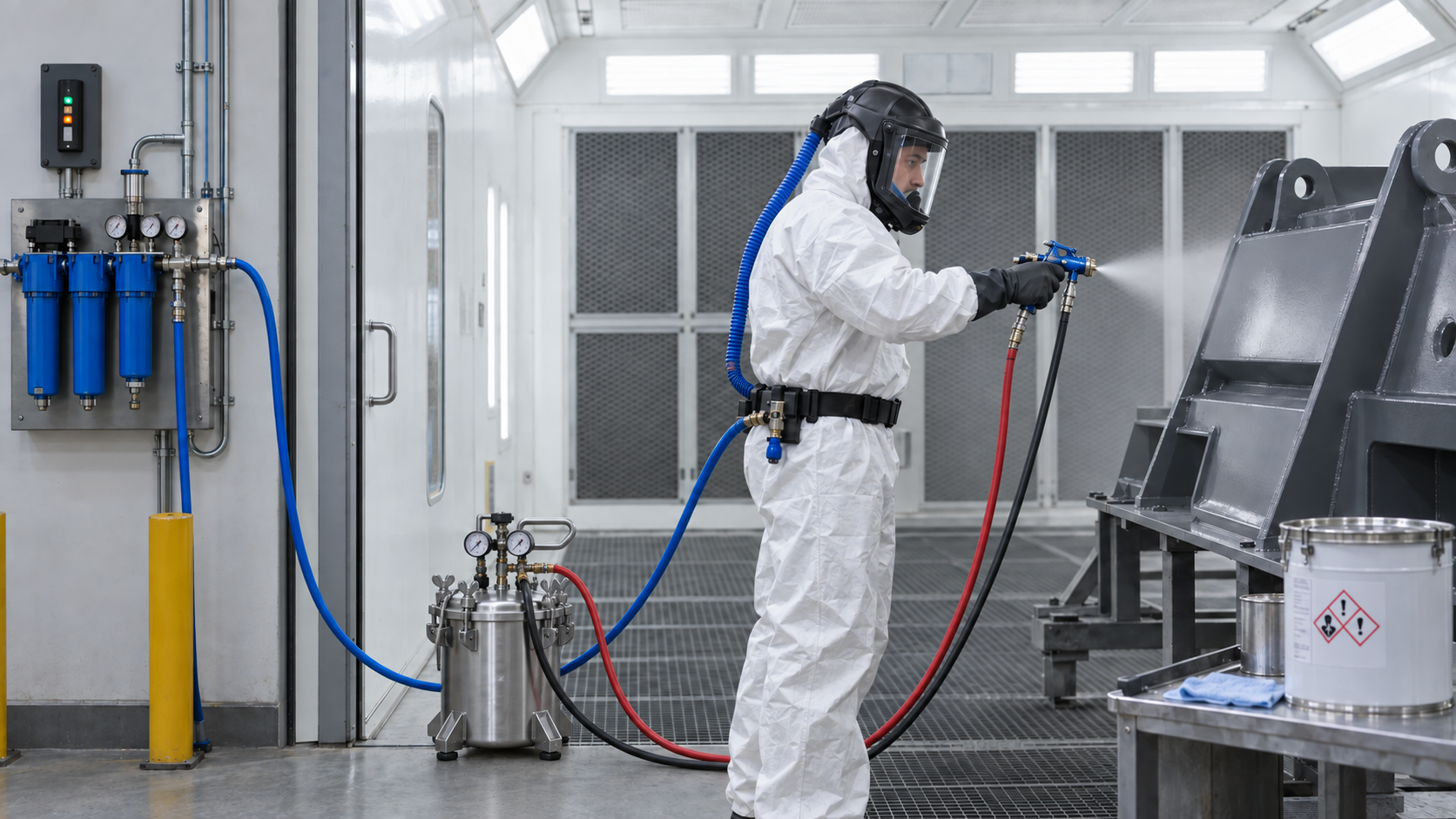
 What You Cannot Smell Can Still Hurt You
Isocyanates are among the most serious respiratory hazards found in professional spray finishing. They may be present in two-component polyurethane coatings, primers, clearcoats, truck and automotive finishes, industrial coatings, foam products, adhesives, and certain sealants.
When these materials are sprayed, the worker may be exposed to airborne isocyanate vapor and a fine mist of coating particles. That combination can enter the breathing zone quickly, especially inside a spray booth, enclosure, tank, or other confined work area.
The danger is not always obvious. A worker cannot depend on odor, throat irritation, or visible overspray to determine whether the air is safe. By the time a worker notices a problem, significant exposure may already have occurred.
That is why supplied-air respiratory protection is frequently selected for spraying coatings containing isocyanates.
What Are Isocyanates?
Isocyanates are reactive chemicals used to create durable polyurethane products. They help coatings produce the hardness,, gloss, chemical resistance, weather resistance, and long service life required in many professional finishing applications.
Common isocyanates and related compounds include:
- Toluene diisocyanate, commonly identified as TDI
- Methylene diphenyl diisocyanate, commonly identified as MDI
- Hexamethylene diisocyanate, commonly identified as HDI
- Isophorone diisocyanate, commonly identified as IPDI
- Isocyanate prepolymers and polyisocyanates
In many two-component coating systems, the isocyanate-containing component may be called the activator, hardener, catalyst, or Part B. The product label and Safety Data Sheet should be reviewed instead of relying solely on the name used in the shop.
Why Isocyanate Exposure Is So Serious
Isocyanates can irritate the eyes, nose, throat, skin, and lungs. Exposure may cause coughing, chest tightness, wheezing, shortness of breath, or flu-like symptoms.
One of the greatest concerns is respiratory sensitization. A sensitized worker may develop an asthma-like reaction after exposure to very small amounts of isocyanate. Sensitization can develop after repeated exposure, but a serious reaction may also occur without a long history of obvious symptoms.
Once sensitized, a worker may react to concentrations that do not affect other employees. The condition can become permanent and may prevent the person from working around isocyanate-containing products in the future.
Symptoms may occur during the work shift or several hours after the employee has left the workplace. This delay can make it difficult to connect the symptoms with the coating operation.
Spraying Creates a Different Exposure
Brushing or rolling a coating and atomizing it through a spray gun are not the same exposure situation.
A spray gun breaks liquid coating into a cloud of small droplets. The smaller droplets may remain suspended in the air and can travel through the worker’s breathing zone. Solvent vapor may also be released during mixing, spraying, flash-off, equipment cleaning, and curing.
The respiratory hazard may therefore include:
- Isocyanate-containing coating mist
- Isocyanate vapor
- Organic solvent vapor
- Pigments and other coating particles
- Cleaning-solvent vapor
- Other hazardous coating ingredients
A respirator must be selected for the complete mixture of contaminants—not for only one ingredient.
Why an Ordinary Dust Mask Is Not Enough
A filtering facepiece respirator, such as an N95, is designed for certain airborne particles. It does not protect the wearer from organic vapors or gases.
A dust mask should never be treated as adequate respiratory protection for spraying an isocyanate-containing coating unless a qualified hazard assessment specifically supports its use—which would be highly unusual for an active spray application.
Even a reusable half-mask equipped with organic-vapor cartridges and particulate filters may not be the correct choice. The employer must know the contaminants, exposure concentrations, respirator limitations, required protection factor, and cartridge service life before selecting an air-purifying respirator.
Why Supplied Air Is Frequently Selected
An air-purifying respirator depends on filters or cartridges to remove contaminants from the surrounding workplace air. A supplied-air respirator provides breathing air from a separate, uncontaminated source.
Supplied air is frequently selected for isocyanate spray operations because:
- Isocyanates may have poor odor-warning properties.
- The exposure can include both vapor and coating mist.
- Airborne concentrations may vary substantially during spraying.
- The concentration may not be fully characterized.
- Cartridge service life may be difficult to establish.
- A spray booth or enclosure can concentrate airborne contaminants.
- A full-face supplied-air system can also help protect the eyes and face.
The coating manufacturer’s Safety Data Sheet, workplace exposure assessment, respirator manufacturer’s instructions, and applicable regulations must all be considered. If the hazard cannot be identified or reasonably estimated, OSHA requires the atmosphere to be treated as immediately dangerous to life or health until it is properly evaluated.
Not Every Air Hose Provides Breathing Air
A supplied-air respirator cannot be connected casually to an ordinary shop-air line.
Compressed air used for breathing must meet applicable OSHA breathing-air quality requirements. The system must be designed, located, maintained, and monitored so that oil mist, carbon monoxide, exhaust fumes, condensed moisture, and other contaminants do not enter the worker’s breathing air.
A proper breathing-air system may include:
- A compressor or air source suitable for breathing-air service
- Properly located air intake
- Breathing-air filtration and moisture control
- Carbon-monoxide monitoring or approved safeguards
- Required alarms
- Pressure regulation
- Correct breathing-air hose
- Approved respirator couplings
- A NIOSH-approved supplied-air respirator assembly
The couplings used for breathing air must be incompatible with connections for nonrespirable gases or other workplace systems. This helps prevent a respirator from being accidentally connected to the wrong source.
Never use pure oxygen in a supplied-air respirator unless the entire system is specifically designed and approved for that purpose. Oxygen must not be substituted for compressed breathing air.
The Respirator Must Be NIOSH Approved
Workplace respirators must be NIOSH Approved® and used according to their approval and the manufacturer’s instructions.
A respirator is approved as a complete assembly. The facepiece, hood, regulator, hose, fittings, and air-supply components must be compatible with the approved system. Mixing components from different manufacturers can invalidate the approval and create an unsafe condition.
Do not modify hoses, substitute fittings, drill components, or make improvised repairs. Use only parts and configurations approved by the respirator manufacturer.
Tight-Fitting and Loose-Fitting Systems
Supplied-air respirators may use a tight-fitting facepiece or a loose-fitting hood or helmet.
A tight-fitting facepiece must seal against the worker’s face. Employees using tight-fitting respirators must be medically evaluated, fit tested, and free of facial hair or anything else that interferes with the sealing surface.
A loose-fitting supplied-air hood does not depend on a face seal in the same way. However, it must still be properly selected, inspected, maintained, and operated at the airflow specified by the manufacturer.
The assigned protection factor differs among respirator types and operating modes. A qualified program administrator must determine whether the selected respirator provides enough protection for the measured or reasonably estimated exposure.
Supplied Air Does Not Automatically Make an IDLH Atmosphere Safe
A routine supplied-air respirator should not automatically be assumed suitable for entry into an immediately dangerous to life or health atmosphere.
OSHA requires specific respiratory protection for IDLH conditions, generally involving a full-facepiece pressure-demand self-contained breathing apparatus or a full-facepiece pressure-demand supplied-air respirator with an auxiliary self-contained escape-air supply.
Entry into an IDLH atmosphere also requires standby personnel, communications, emergency procedures, and other protections. A spray painter should never enter an uncharacterized tank, vessel, enclosed space, or poorly ventilated area simply because a supplied-air hood is available.
A Supplied-Air Respirator Requires a Complete Program
Purchasing a supplied-air unit does not by itself create a compliant respiratory-protection program.
When respirators are required, the employer must establish a written respiratory-protection program addressing:
- Workplace respiratory-hazard evaluation
- Respirator selection
- Medical evaluations
- Fit testing for tight-fitting facepieces
- Correct use of respirators
- Cleaning, inspection, maintenance, and storage
- Breathing-air quality and system safeguards
- Employee training
- Emergency procedures
- Regular program evaluation
The employer must appoint a qualified respiratory-protection program administrator to oversee the program.
Medical Evaluation Comes Before Use
Respirators can place physical demands on the wearer. The burden may increase when the employee is working in heat, wearing protective clothing, climbing, bending, or performing strenuous spray work.
Before an employee is fit tested or required to use a respirator, the employee must receive the required confidential medical evaluation from a physician or other licensed healthcare professional.
Employees should promptly report chest tightness, wheezing, shortness of breath, persistent coughing, dizziness, unusual fatigue, or other symptoms associated with respirator use or isocyanate exposure.
Anyone experiencing severe breathing difficulty or another medical emergency should leave the exposure area immediately and obtain emergency medical assistance.
Fit Testing and User Seal Checks
Employees wearing a tight-fitting supplied-air facepiece must pass a fit test before initial use, at least annually, and whenever a different make, model, style, or size is used.
Additional fit testing may be required following significant weight change, dental work, facial surgery, scarring, or another physical change that could affect the seal.
The wearer must also perform a user seal check every time the respirator is put on. A daily seal check does not replace the required fit test.
Do Not Forget Skin and Eye Exposure
Inhalation is not the only concern. Isocyanates may also contact the skin and eyes. Skin exposure may contribute to irritation and sensitization.
Depending on the product and task, additional protective equipment may include:
- Chemical-resistant gloves
- Protective coveralls
- Head and neck protection
- Eye and face protection
- Chemical-resistant footwear
Protective clothing and gloves must be selected for the chemicals being used. A glove that resists one solvent or coating ingredient may not resist another.
Mixing, Cleanup, and Booth Entry Still Count
Exposure does not necessarily end when the trigger is released.
Isocyanate-containing mist and vapor may remain in the booth during flash-off and curing. Exposure may also occur while:
- Mixing coating components
- Pouring activators or hardeners
- Cleaning spray guns
- Flushing fluid lines
- Changing booth filters
- Handling contaminated masking materials
- Entering the booth before contaminants have cleared
- Managing spills or waste
The hazard assessment must cover the entire finishing process—not only active spraying.
A Practical Pre-Spray Checklist
Before spraying an isocyanate-containing coating, confirm:
- The coating and activator Safety Data Sheets have been reviewed.
- The respiratory hazards have been evaluated.
- Spray-booth ventilation is operating correctly.
- The selected respirator is appropriate for the exposure.
- The supplied-air system is NIOSH approved as a complete assembly.
- The breathing-air source meets applicable quality requirements.
- The breathing-air intake is protected from exhaust and contamination.
- Hoses, fittings, regulators, alarms, and filters have been inspected.
- The employee has received medical clearance.
- Any required fit test is current.
- The employee has been trained to use the equipment.
- Required protective clothing, gloves, and eye protection are available.
- Emergency and equipment-failure procedures are understood.
The Bottom Line
Isocyanate-containing coatings can produce outstanding finishes—but they demand serious respiratory protection.
Do not select a respirator because it is familiar, inexpensive, or already hanging beside the booth. Start with the product, the application method, the exposure assessment, and the conditions inside the work area.
When supplied-air protection is required, every part of the system matters: the breathing-air source, filtration, monitoring, hoses, fittings, facepiece or hood, employee training, medical evaluation, and maintenance program.
The coating may be designed to last for years. An unprotected exposure can last even longer.
This article provides general educational information. It is not a substitute for a workplace-specific hazard assessment, professional industrial-hygiene advice, medical advice, the coating Safety Data Sheet, respirator manufacturer instructions, or applicable federal, state, and local regulations.
Authoritative Resources
© 2026 Azimuth Spray Systems, LLC. All rights reserved.