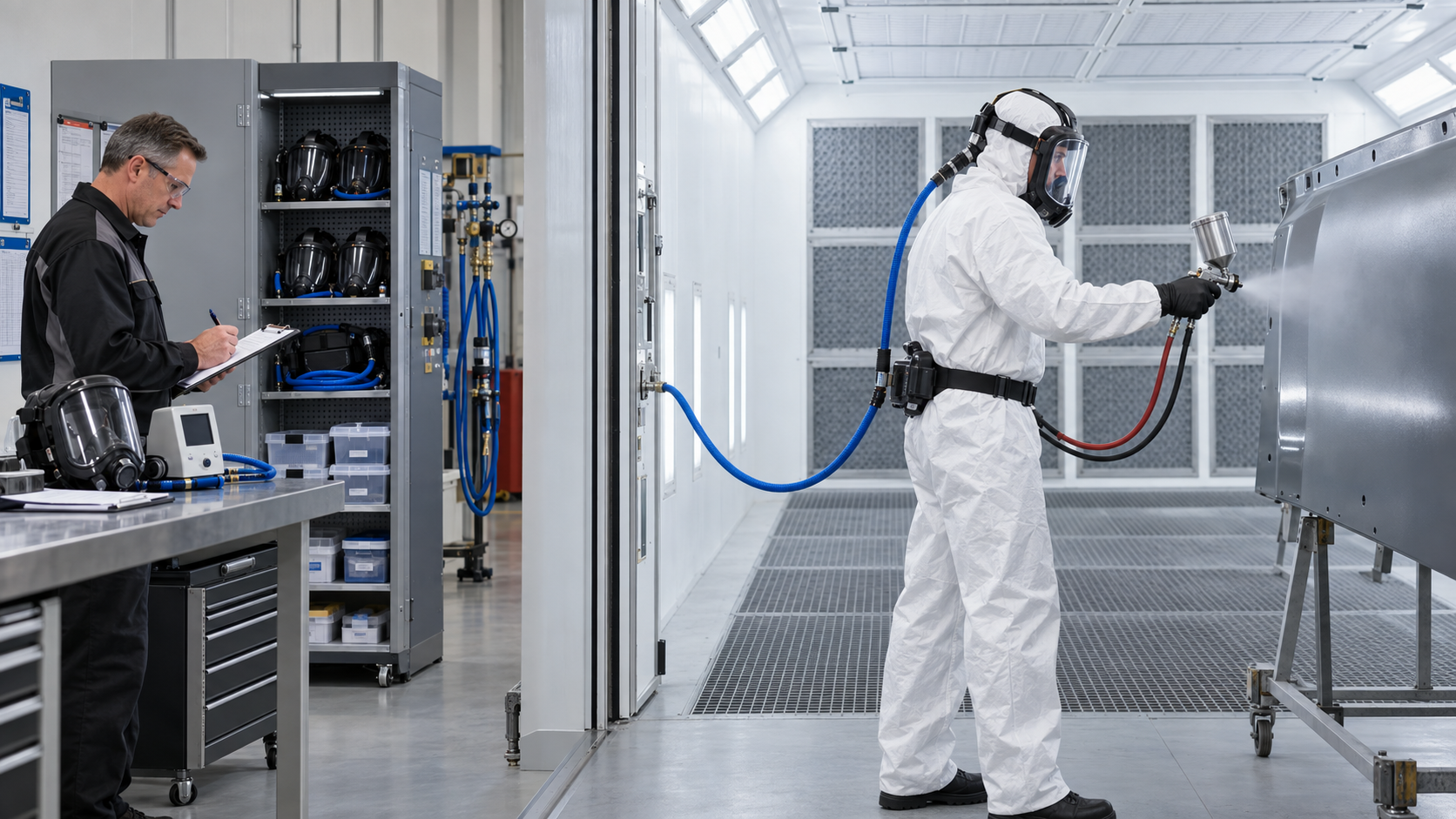
 The Respirator Is Not the Program
Respiratory-Protection Program Basics for Professional Finishing Operations
Walk into almost any paint shop and you will find respirators hanging near the spray booth. That may look like respiratory protection, but it is not necessarily a respiratory-protection program.
A respirator is a piece of equipment. A respiratory-protection program is the complete system that determines:
-
What contaminants are present
-
How much exposure workers may receive
-
Whether respiratory protection is required
-
Which respirator is appropriate
-
Whether the employee is medically able to wear it
-
Whether the respirator fits
-
How it will be inspected, cleaned, stored, and maintained
-
When filters and cartridges must be replaced
-
Whether the program is working
If employees are required to wear respirators, the employer generally must establish and maintain a written respiratory-protection program that meets OSHA requirements.
Start With the Hazard—not the Respirator
Selecting respiratory protection should never begin with, “Which cartridge do we have on the shelf?”
It begins by identifying the respiratory hazards.
A professional finishing operation may expose employees to:
-
Paint and coating overspray
-
Organic solvent vapors
-
Isocyanates
-
Powder-coating particles
-
Sanding dust
-
Abrasive-blasting dust
-
Welding fumes
-
Metal-containing pigments
-
Cleaning chemicals
-
Stripping compounds
-
Combustion gases
-
Contaminated booth exhaust
-
Oxygen-deficient atmospheres
Review the coating manufacturer’s Safety Data Sheet, especially the sections covering exposure controls, personal protection, physical properties, and toxicological information. However, an SDS alone may not answer every respirator-selection question.
Employers may also need exposure monitoring, air sampling, task observations, process information, and professional industrial-hygiene assistance.
If the contaminant or exposure level cannot be reasonably identified, the atmosphere must be treated as immediately dangerous to life or health—commonly called IDLH—until it is properly evaluated.
Control the Contaminant First
Respirators are an important last line of defense, but they should not replace effective engineering and work-practice controls.
Before depending on a respirator, consider whether exposure can be reduced through:
-
Proper spray-booth ventilation
-
Local exhaust ventilation
-
Enclosed mixing and cleaning stations
-
Automated material handling
-
Correct spray pressure and gun setup
-
High-transfer-efficiency application equipment
-
Less hazardous coating or cleaning products
-
Preventive booth and filter maintenance
-
Improved housekeeping
-
Restricted access to spray areas
-
Employee positioning and work practices
A respirator protects the person wearing it. Good ventilation and process control help protect the entire work area.
The Written Respiratory-Protection Program
When respirators are required, the employer must develop a written program with procedures specific to the workplace.
The program should address:
-
Respirator selection
-
Medical evaluations
-
Fit testing
-
Proper respirator use
-
Procedures for IDLH atmospheres, when applicable
-
Cleaning, inspection, storage, repair, and replacement
-
Breathing-air quality for supplied-air respirators
-
Employee training
-
Program evaluation
-
Recordkeeping
The employer must appoint a qualified program administrator who understands respiratory hazards and can properly manage the program.
The written program should describe what the company actually does—not what someone copied from a generic safety manual.
Select the Correct Respirator
There is no universal “paint respirator.”
The correct selection depends on:
-
The contaminant
-
Its physical form: particle, mist, vapor, gas, or combination
-
Its concentration
-
Occupational exposure limits
-
The work being performed
-
The respirator’s assigned protection factor
-
The oxygen level
-
Whether the atmosphere is IDLH
-
The manufacturer’s limitations
-
Other required personal protective equipment
Workplace respirators must be NIOSH Approved® and used according to their approval and manufacturer instructions.
Air-Purifying Respirators
Air-purifying respirators remove contaminants from the surrounding air using filters, cartridges, or canisters. They do not provide oxygen.
Common examples include:
-
Filtering facepiece respirators
-
Reusable half-mask respirators
-
Full-facepiece respirators
-
Powered air-purifying respirators
An N95-style particulate respirator may reduce exposure to certain particles, but it does not protect against organic vapors. A particulate filter should not be mistaken for a vapor cartridge.
Combination cartridges may be required when the atmosphere contains both coating mist and organic vapor. The selection must match every relevant hazard.
Atmosphere-Supplying Respirators
Atmosphere-supplying respirators provide breathing air from a source separate from the contaminated work area.
These include:
-
Supplied-air respirators
-
Self-contained breathing apparatus
-
Combination supplied-air and self-contained systems
Supplied-air respiratory protection may be required when air-purifying cartridges are unsuitable, the contaminant has poor warning properties, concentrations are excessive or uncertain, oxygen is deficient, or the coating manufacturer and hazard assessment call for supplied air.
Two-component coatings containing isocyanates demand particular attention. Never assume that an ordinary organic-vapor cartridge is acceptable simply because the product is called “paint.” Follow the SDS, respirator manufacturer’s instructions, exposure assessment, and applicable regulations.
Breathing air must meet OSHA quality requirements. Never connect a supplied-air respirator directly to an ordinary shop-air system without confirming that the system is properly designed, monitored, and approved for breathing air.
Medical Evaluation Comes Before Use
Wearing a respirator can place additional stress on the heart and lungs. Heat, physical exertion, restrictive clothing, and the weight or breathing resistance of the respirator can increase that burden.
Before an employee is fit tested or required to wear a respirator, the employer must provide a confidential medical evaluation performed or reviewed by a physician or other licensed healthcare professional.
Additional evaluation may be needed when:
-
The employee reports symptoms
-
A supervisor or program administrator identifies a concern
-
The healthcare professional recommends reevaluation
-
Workplace conditions increase the physical burden
-
Fit-testing or program observations indicate a possible problem
The employer should receive the healthcare professional’s written recommendation regarding the employee’s ability to use a respirator—not the employee’s confidential medical details.
Fit Testing Is Not a Seal Check
Every employee using a tight-fitting respirator must be fit tested with the same make, model, style, and size that will be worn on the job.
Fit testing is required:
-
Before initial use
-
At least annually
-
Whenever a different facepiece is used
-
When physical changes could affect the seal
Such changes may include significant weight change, dental work, facial surgery, or scarring.
A fit test may be qualitative, using the wearer’s response to a test agent, or quantitative, using an instrument to measure leakage. The permitted method depends partly on the respirator and the required protection level.
A user seal check is different. The wearer performs a seal check every time the tight-fitting respirator is put on. Passing today’s seal check does not replace the annual fit test.
Facial Hair Can Break the Seal
Facial hair cannot interfere with the sealing surface of a tight-fitting respirator or the operation of its valves.
A beard, heavy stubble, or hair crossing the sealing area can create leakage. Tightening the straps harder does not solve the problem and may distort the facepiece.
Other items can also interfere with the seal, including:
-
Eyeglass temples
-
Head coverings
-
Hood material
-
Jewelry
-
Facial piercings
-
Improperly positioned straps
When an employee cannot use a tight-fitting facepiece, the employer may need to evaluate an appropriate loose-fitting powered or supplied-air alternative.
Cartridge Change Schedules Matter
“Change it when you smell paint” is not an acceptable cartridge-change schedule.
Odor is not a dependable warning system. Some chemicals have poor warning properties, workers have different abilities to detect odors, and odor fatigue can reduce awareness.
For gas- and vapor-removing cartridges, the employer must use either:
-
An approved end-of-service-life indicator, or
-
A written change schedule based on objective information
The schedule may consider:
-
Contaminant identity and concentration
-
Temperature
-
Humidity
-
Breathing rate
-
Length of the work shift
-
Cartridge capacity
-
Manufacturer service-life data
-
Exposure modeling
-
Workplace air-monitoring results
Particulate filters also require replacement according to the manufacturer’s instructions and workplace conditions. A damaged, dirty, wet, clogged, or difficult-to-breathe-through filter should be removed from service.
Cleaning, Inspection, and Storage
A respirator tossed onto a mixing-room bench is not ready for dependable service.
Respirators should be:
-
Inspected before use
-
Cleaned and disinfected at the required frequency
-
Stored away from contamination, sunlight, heat, and damaging chemicals
-
Protected from deformation
-
Maintained with approved replacement parts
-
Removed from service when defective
Inspection should include the facepiece, straps, valves, gaskets, cartridge connections, hoses, regulators, and other components.
Never drill, tape, glue, or improvise repairs. Mixing components from different manufacturers may void the respirator’s NIOSH approval.
Train the Person Behind the Mask
Employees need to understand more than how to fasten the straps.
Training should explain:
-
Why the respirator is necessary
-
What hazards are present
-
The respirator’s capabilities and limitations
-
How improper fit or use reduces protection
-
How to inspect and put on the respirator
-
How to perform a user seal check
-
How to recognize cartridge or respirator problems
-
Emergency procedures
-
Cleaning and storage requirements
-
Signs and symptoms that may limit safe use
Training must occur before use and be repeated at least annually or whenever changes, mistakes, or employee understanding indicate retraining is necessary.
Employees must be able to demonstrate that they understand the information.
Evaluate the Program
A written program is not a “write it once and file it” document.
The program administrator should regularly observe work practices and speak with respirator users. The evaluation should determine whether:
-
The respirator is appropriate for the actual task
-
Employees are wearing it correctly
-
Facepieces remain comfortable and properly fitted
-
Cartridges and filters are replaced on schedule
-
Equipment is being cleaned and stored correctly
-
Workplace conditions have changed
-
Employees experience breathing difficulty, dizziness, irritation, odor breakthrough, or other symptoms
Problems should be investigated and corrected promptly.
What About Voluntary Respirator Use?
An employee may want to wear a respirator even when the employer has determined that respiratory protection is not required.
OSHA permits voluntary use under certain conditions, but the employer must ensure that the respirator itself does not create a hazard. Employees allowed voluntary use must receive the information contained in Appendix D of OSHA’s respiratory-protection standard.
Additional program elements may apply when voluntarily using reusable elastomeric respirators. Voluntary use of filtering facepieces has fewer requirements, but it is not a substitute for a proper hazard assessment.
If respiratory protection is actually necessary, calling its use “voluntary” does not remove the employer’s responsibilities.
A Practical Program Checklist
Before sending an employee into a finishing area, confirm:
-
The respiratory hazards have been identified and evaluated.
-
Engineering and work-practice controls are operating.
-
A qualified program administrator has been appointed.
-
The written program reflects actual workplace conditions.
-
The selected respirator is NIOSH Approved and suitable for the hazard.
-
The employee has completed the required medical evaluation.
-
Tight-fitting respirators have been properly fit tested.
-
The employee is clean-shaven where the facepiece seals.
-
The employee knows how to perform a user seal check.
-
Filters and cartridges are covered by a replacement schedule.
-
The respirator is inspected, clean, and properly stored.
-
The employee has received and understood training.
-
Supplied breathing air meets applicable quality requirements.
-
The program is being evaluated and corrected when necessary.
The Bottom Line
A respirator cannot protect a worker if it is the wrong type, does not fit, has an exhausted cartridge, receives contaminated breathing air, or is worn by someone who has not been medically cleared and trained.
Respiratory protection is not simply about handing someone a mask.
It is about understanding the hazard, controlling exposure, selecting the right equipment, proving that it fits, maintaining it properly, and making sure the employee knows exactly how and when to use it.
Protect the lungs behind the spray gun—build the program before the worker enters the booth.
This article provides general educational information and is not a substitute for a workplace-specific hazard assessment, professional industrial-hygiene advice, product Safety Data Sheets, manufacturer instructions, or applicable federal, state, and local regulations.
Authoritative Resources
|