Knowledge Base:  
Corrosion Protection for Industrial Coating Contractors - Article 01: Understanding Corrosion
Last Updated: 09/17/2026

Corrosion Protection for Industrial Coating Contractors

Article 1: Understanding Corrosion

Why Steel Corrodes and Why the Coating Contractor Matters

Before you can protect steel from corrosion, you need to understand what corrosion is, what allows it to continue, and why a coating defect can become an active corrosion site.

Big Idea: Corrosion is an electrochemical process. Protective coatings control corrosion by separating the metal from the environment needed to sustain that process.

Corrosion Is More Than Rust

When most people hear the word corrosion, they picture orange rust on a piece of steel. Rust is one visible product of corrosion, but the corrosion process begins before that orange material appears.

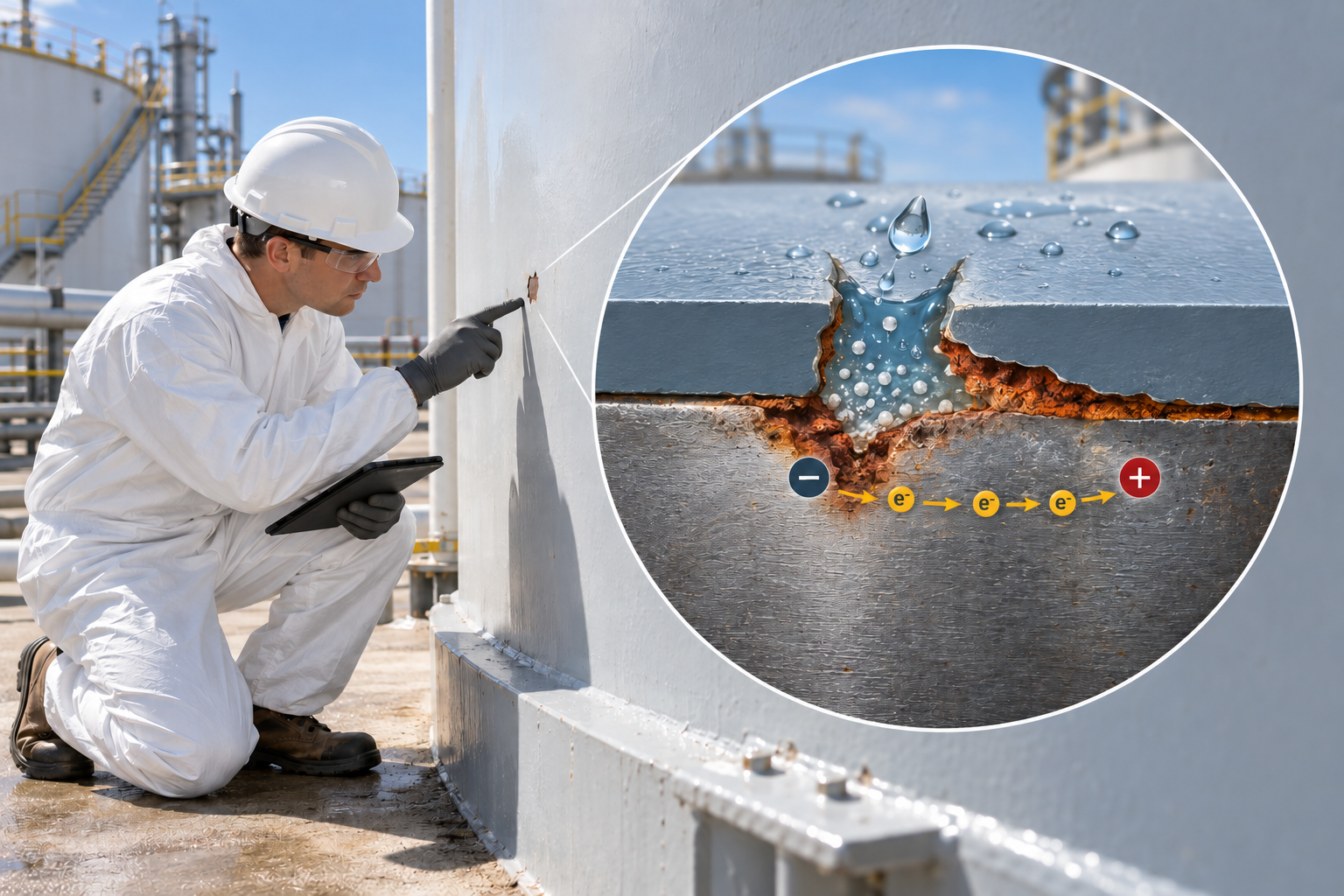
Corrosion is the deterioration of a material through a chemical or electrochemical reaction with its environment. For steel, corrosion occurs when iron atoms lose electrons and begin changing into corrosion products.

The important word for the industrial coating contractor is electrochemical. Corrosion involves both a chemical reaction and the movement of electrical charge. If the conditions required for that reaction remain present, the metal can continue to deteriorate.

A coating contractor does not need to become a corrosion engineer to perform quality work. However, understanding the basic process makes it easier to recognize contamination, surface-preparation problems, coating defects, environmental risks, and conditions that should be reported before work continues.


Steel Wants to Return to a More Stable Condition

Manufacturing steel requires energy. Iron ore is processed, refined, and converted into metallic iron and steel. That finished steel contains stored energy and is less stable than the naturally occurring compounds from which it was produced.

When unprotected steel is exposed to moisture and oxygen, it begins moving back toward a more stable condition. The resulting compounds include iron oxides and iron hydroxides that we commonly call rust.

That is why corrosion protection is an ongoing battle. Steel does not need encouragement to corrode. It needs a properly designed and maintained system to prevent or control the reactions that cause corrosion.


The Four Parts of a Corrosion Cell

An active electrochemical corrosion cell requires four basic parts:

1. The Anode

The anode is the location where metal loss occurs. Iron atoms at the anodic area give up electrons and enter the surrounding electrolyte as electrically charged ions.

This is the part of the corrosion cell where the steel is actually being consumed.

2. The Cathode

The cathode is the location where another electrochemical reaction uses the electrons released at the anode. The cathodic area is protected from metal loss while the corrosion cell is operating.

Anodic and cathodic areas can exist on the same piece of steel. They may be separated by only a very small distance.

3. The Electrolyte

The electrolyte is a conductive liquid or moist material that allows ions to move between the anodic and cathodic areas.

Water is a common electrolyte. Soil moisture, seawater, condensation, process water, wastewater, and water containing dissolved salts can all support corrosion.

Pure water is not as conductive as water containing dissolved materials. Salts, acids, alkalis, and other contaminants can make moisture more conductive and increase corrosion activity.

4. The Metallic Path

The metallic path allows electrons to travel from the anodic area to the cathodic area. The steel structure itself commonly provides this path.

If all four parts are present and electrically connected, the corrosion cell can operate.

Field Rule: Corrosion can be controlled by eliminating, isolating, or changing one or more parts of the corrosion cell.


What Happens at the Anode?

At the anode, iron atoms lose electrons. After losing electrons, the iron atoms become positively charged iron ions and leave the steel surface.

The released electrons remain in the metal and travel through the metallic path toward a cathodic area. At the cathode, those electrons participate in another reaction, often involving oxygen and water.

The iron ions can react with oxygen, water, and other materials in the environment to form corrosion products. These products may appear as loose rust, tightly adhering oxide, tubercles, staining, scale, or deposits beneath a coating.

The visible rust is evidence of the process. The important damage is the metal that has already been lost.


Why Corrosion Does Not Occur Uniformly

A steel surface may look uniform, but small differences can create separate anodic and cathodic areas. These differences can include:

  • Variations in oxygen concentration
  • Different moisture levels
  • Deposits that trap water or contaminants
  • Differences in temperature
  • Welds and heat-affected zones
  • Different metals in electrical contact
  • Scratches, holidays, and damaged coating
  • Mill scale or partially removed corrosion products
  • Soluble salts remaining on the surface
  • Crevices, lap joints, bolts, and restricted areas

These differences help explain why one small area may experience deep pitting while the surrounding steel shows much less damage.


Conditions That Can Increase Corrosion

Moisture

Water provides the electrolyte needed for many corrosion reactions. Rain, condensation, humidity, wash water, immersion, leaking process equipment, and moisture in soil can all contribute.

Oxygen

Oxygen commonly participates in the cathodic reaction. Differences in oxygen availability can also create corrosion cells. Areas beneath deposits or inside crevices may behave differently from freely exposed areas.

Salts

Chlorides and other soluble salts can attract moisture, increase conductivity, and remain active beneath a coating. Steel can look visually clean while still carrying harmful invisible contamination.

Temperature

Higher temperatures often accelerate chemical and electrochemical reactions. Temperature also affects condensation, coating cure, service exposure, and the movement of moisture through a coating film.

Acids and Alkalis

Chemical exposure can change the corrosion rate and attack both the substrate and the protective coating. The coating system must be selected for the actual service environment.

Electrical Contact Between Different Metals

When dissimilar metals are electrically connected in the presence of an electrolyte, one metal may become more anodic and corrode preferentially. This is known as galvanic corrosion.


How Protective Coatings Control Corrosion

A protective coating primarily controls corrosion by separating the steel from water, oxygen, salts, chemicals, and other parts of the service environment.

A coating does not need to stop every individual molecule from moving through the film. It must reduce the movement of moisture, oxygen, ions, and contaminants enough to prevent a damaging corrosion cell from developing at the steel surface.

Different coatings provide protection in different ways. Some primarily act as barriers. Some contain inhibitive pigments. Zinc-rich primers can provide galvanic protection when properly formulated, applied, and electrically connected to the steel.

Regardless of the protective mechanism, the coating system must be properly selected, applied to a properly prepared surface, cured under acceptable conditions, and inspected for defects.


What Happens When the Coating Is Damaged?

A scratch, pinhole, missed area, holiday, thin spot, damaged edge, or area of coating disbondment can expose steel to the environment.

Once water and contaminants reach the exposed steel, a corrosion cell can develop. Corrosion products may build beneath the edge of the coating. Because many corrosion products occupy more volume than the original metal, they can create pressure that lifts or separates the surrounding coating.

The defect can then grow beyond the original point of damage. What began as a small holiday may become blistering, underfilm corrosion, rust creepage, flaking, or widespread disbondment.

This is why small application defects matter. A defect that looks minor during application can become the starting point for a much larger failure in service.


Where Cathodic Protection Fits

Cathodic protection controls corrosion by changing the electrochemical behavior of the protected structure. The system supplies protective current so that exposed areas of the structure behave as cathodic rather than anodic sites.

Cathodic protection is commonly used on buried pipelines, tank bottoms, marine structures, submerged equipment, water systems, and other assets exposed to conductive environments.

The coating and cathodic-protection system are intended to work together. A sound coating reduces the amount of bare steel exposed to the environment. That reduces the protective current required from the cathodic-protection system.

As coating damage increases, current demand can increase. Disbonded coatings and other materials can also shield the steel and prevent protective current from reaching the area where it is needed.

Remember: Cathodic protection does not make poor surface preparation or poor coating application acceptable. The coating remains the primary corrosion barrier.


Why This Matters to the Coating Contractor

The coating contractor controls or influences many of the conditions that determine whether a corrosion-protection system succeeds.

  • Was the surface inspected before work began?
  • Were oil, grease, salts, dirt, and other contaminants removed?
  • Was the required degree of surface cleanliness achieved?
  • Was the surface profile within the specified range?
  • Were environmental conditions acceptable?
  • Were the coating materials properly stored, mixed, and applied?
  • Did edges, welds, bolts, pits, and difficult areas receive adequate coverage?
  • Was the required dry-film thickness achieved?
  • Were holidays and other defects found and repaired?
  • Were cathodic-protection components protected from damage?
  • Was the completed work properly documented?

These are not separate concerns. They are connected parts of the corrosion-protection system.


A Simple Field Example

Consider a steel tank located outdoors near a coastal environment. Salt deposits settle on the surface. Moisture from humidity and condensation dissolves those salts and creates a conductive electrolyte.

If the tank coating is continuous and well adhered, it separates the steel from much of that environment. If the coating contains a holiday at a weld, moisture and dissolved salts can reach the steel.

The exposed area can become anodic. Metal loss begins. Corrosion products form and spread beneath the coating. The surrounding film may blister or disbond. Additional steel becomes exposed, and the damaged area grows.

A small defect that could have been located and repaired during inspection may eventually require a much larger maintenance repair.


Warning Signs Contractors Should Recognize

Conditions that may indicate active corrosion or an increased corrosion risk include:

  • Rust staining emerging from coating defects
  • Blistering or loss of coating adhesion
  • Rust creepage from scratches, welds, edges, or holidays
  • Deep pits hidden beneath corrosion products
  • Moisture trapped beneath deposits, insulation, or disbonded coating
  • White, green, or other colored corrosion products on nonferrous metals
  • Accelerated attack near connections between dissimilar metals
  • Recurring failure in the same location
  • Unexpected coating failure around cathodic-protection components
  • Evidence of chemical exposure not addressed by the existing coating system

Recognizing a warning sign does not mean the contractor should independently redesign the corrosion-control system. It means the condition should be documented and reported to the responsible owner, inspector, engineer, coating manufacturer, or corrosion specialist.


The Contractor's First Corrosion-Control Checklist

Before surface preparation begins, ask:

  • What material is being coated?
  • What type of environment will the structure face?
  • Will the structure be atmospheric, buried, submerged, or immersed?
  • Are chemicals, salts, heat, abrasion, or moisture present?
  • Is there visible corrosion, pitting, section loss, or coating disbondment?
  • Are soluble-salt or other contamination tests required?
  • Is a cathodic-protection system present?
  • Are there anodes, cables, test stations, isolation joints, or electrical connections that must be protected?
  • Does the specification match the actual field condition?
  • Who has authority to resolve unexpected conditions?

Asking these questions early can prevent costly disagreements, coating failures, and repair work later.


Key Takeaways

  • Corrosion is an electrochemical process that causes material deterioration.
  • An active corrosion cell requires an anode, a cathode, an electrolyte, and a metallic path.
  • Metal loss occurs at the anodic area.
  • Moisture, oxygen, salts, chemicals, temperature, and dissimilar metals can influence corrosion.
  • Protective coatings control corrosion primarily by separating the steel from its environment.
  • Small coating defects can become active corrosion sites and grow into larger failures.
  • Cathodic protection and protective coatings are complementary corrosion-control methods.
  • The contractor's surface preparation, application, inspection, and documentation directly affect long-term performance.

Bottom Line: A coating contractor is not simply covering steel. The contractor is interrupting a corrosion process that will restart anywhere the protective system is incomplete.


Knowledge Check

  1. What are the four parts required for an active electrochemical corrosion cell?
  2. At which part of the corrosion cell does metal loss occur?
  3. Why can soluble salts increase corrosion activity?
  4. How does a protective coating help control corrosion?
  5. Why can a small coating holiday become a larger coating failure?
  6. How do protective coatings and cathodic protection work together?
View Knowledge Check Answers

1. An anode, a cathode, an electrolyte, and a metallic path.

2. Metal loss occurs at the anode.

3. Soluble salts can attract moisture and increase the electrical conductivity of the electrolyte.

4. A protective coating separates the steel from water, oxygen, salts, chemicals, and other parts of the corrosive environment.

5. Moisture and contaminants can reach the exposed steel, allowing corrosion products to form beneath the surrounding coating and cause additional disbondment.

6. The coating reduces the amount of steel exposed to the environment, while cathodic protection helps control corrosion at holidays, scratches, and other exposed areas.


Coming Next

Article 2: Common Forms of Corrosion

The next article examines general corrosion, pitting, crevice corrosion, galvanic corrosion, underfilm corrosion, and other forms of attack industrial coating contractors may encounter in the field.
Corrosion Protection for Industrial Coating Contractors Certificate Program


Was this article helpful?

Comments:
 

Related Articles
 > Academy Series | Five Professional Finishing Certificate Programs
 > The Language of Finishing: A Paint and Coatings Industry Glossary
 > The Language of Finishing: Paint and Coatings Glossary A–B
 > The Language of Finishing: Paint and Coatings Glossary C–D
 > The Language of Finishing: Paint and Coatings Glossary E–F
 > The Language of Finishing: Paint and Coatings Glossary G–H
 > The Language of Finishing: Paint and Coatings Glossary I–K
 > The Language of Finishing: Paint and Coatings Glossary L–M
 > The Language of Finishing: Paint and Coatings Glossary N–O
 > The Language of Finishing: Paint and Coatings Glossary P–Q
 > The Language of Finishing: Paint and Coatings Glossary R
 > The Language of Finishing: Paint and Coatings Glossary S
 > The Language of Finishing: Paint and Coatings Glossary T
 > The Language of Finishing: Paint and Coatings Glossary U–V
 > The Language of Finishing: Paint and Coatings Glossary W–Z
 > The Language of Finishing: Coatings Standards and Acronyms
 > Airless Spraying - From Pump to Pattern
 > Airless Spraying—From Pump to Pattern | Article 01 of 18 How Airless Spray Equipment Works
 > Airless Spraying—From Pump to Pattern | Article 02 of 18 How to Read an Airless Spray Tip Number
 > Airless Spraying—From Pump to Pattern | Article 03 of 18 How to Choose the Correct Airless Tip Size
 > Airless Spraying—From Pump to Pattern | Article 04 of 18 Understanding Airless Fan Width and Orifice Size
 > Airless Spraying—From Pump to Pattern | Article 05 of 18 The Right Way to Set Airless Spray Pressure
 > Airless Spraying—From Pump to Pattern | Article 06 of 18 The Perfect Airless Spray Pattern
 > Airless Spraying—From Pump to Pattern | Article 07 of 18 Why an Airless Spray Pattern Develops Tails
 > Airless Spraying—From Pump to Pattern | Article 08 of 18 How Tip Wear Wastes Paint and Changes the Pattern
 > Airless Spraying—From Pump to Pattern | Article 09 of 18 Matching the Tip to the Sprayer’s Capacity
 > Airless Spraying—From Pump to Pattern | Article 10 of 18 How Airless Hose Size and Length Affect Performance
 > Airless Spraying—From Pump to Pattern | Article 11 of 18 How to Prime and Start an Airless Sprayer
 > Airless Spraying—From Pump to Pattern | Article 12 of 18 Professional Airless Spray-Gun Technique
 > Airless Spraying—From Pump to Pattern | Article 13 of 18 How to Shut Down, Flush, and Store an Airless Sprayer
 > Airless Spraying—From Pump to Pattern | Article 14 of 18 Airless Troubleshooting: When the Pump Will Not Prime
 > Airless Spraying—From Pump to Pattern | Article 15 of 18 Airless Troubleshooting: Surging, Pulsing, and Pressure Loss
 > Airless Spraying—From Pump to Pattern | Article 16 of 18 Electric, Gas, or Pneumatic Airless Equipment
 > Airless Spraying—From Pump to Pattern | Article 17 of 18 Choosing the Right Airless Sprayer for the Work
 > Airless Spraying—From Pump to Pattern | Article 18 of 18 Airless Safety: Understanding Injection-Injury Hazards
 > Airless Spraying-From Pump to Pattern Certificate of Completion
 > Airless Spraying—From Pump to Pattern | Final Assessment
 > Powder Coating - From Particle To Performance
 > Powder Coating—From Particle to Performance | Article 01 of 32 | The History of Powder Coating
 > Powder Coating—From Particle to Performance | Article 02 of 32 | What Powder Coating Is—and What It Is Not
 > Powder Coating—From Particle to Performance | Article 03 of 32 | What Is Inside a Powder Coating?
 > Powder Coating—From Particle to Performance | Article 04 of 32 | How Powder Coating Is Manufactured
 > Powder Coating—From Particle to Performance | Article 05 of 32 | Thermoset Versus Thermoplastic Powder Coatings
 > Powder Coating—From Particle to Performance | Article 06 of 32 | Epoxy, Polyester, and Epoxy-Polyester Hybrid Powders
 > Powder Coating—From Particle to Performance | Article 07 of 32 | Polyurethane, Acrylic, Fluoropolymer, and Specialty Powders
 > Powder Coating—From Particle to Performance | Article 08 of 32 | Selecting the Right Powder for the Application
 > Powder Coating—From Particle to Performance | Article 09 of 32 | Why Surface Preparation Determines Coating Performance
 > Powder Coating—From Particle to Performance | Article 10 of 32 | Preparing Steel, Aluminum, and Galvanized Surfaces
 > Powder Coating—From Particle to Performance | Article 11 of 32 | Mechanical Surface Preparation for Powder Coating
 > Powder Coating—From Particle to Performance | Article 12 of 32 | Chemical Pretreatment, Rinsing, and Dry-Off
 > Powder Coating—From Particle to Performance | Article 13 of 32 | How Electrostatic Powder Coating Works
 > Powder Coating—From Particle to Performance | Article 14 of 32 | Corona-Charging Powder Guns
 > Powder Coating—From Particle to Performance | Article 15 of 32 | Tribostatic Powder Application
 > Powder Coating—From Particle to Performance | Article 16 of 32 | Fluidized-Bed Powder Coating
 > Powder Coating—From Particle to Performance | Article 17 of 32: Anatomy of a Manual Powder-Coating System
 > Powder Coating—From Particle to Performance | Article 18 of 32: Anatomy of an Automatic Powder-Coating System
 > Powder Coating—From Particle to Performance | Article 20 of 32: Powder Feed, Recovery, Reclaim, and Color Change
 > Powder Coating—From Particle to Performance | Article 21 of 32: Compressed-Air Quality for Powder-Coating Equipment
 > Powder Coating—From Particle to Performance | Article 22 of 32: How to Set Up and Start a Powder-Coating System
 > Powder Coating—From Particle to Performance | Article 23 of 32: Setting Powder Flow, Pattern Air, kV, and Current
 > Powder Coating—From Particle to Performance | Article 24 of 32: Professional Manual Powder-Gun Technique
 > Powder Coating—From Particle to Performance | Article 25 of 32: Setting Up Automatic Guns and Reciprocators
 > Powder Coating—From Particle to Performance | Article 26 of 32: Faraday-Cage Effect, Back Ionization, and Poor Coverage
 > Powder Coating—From Particle to Performance | Article 27 of 32: Curing Powder Coating—Time at Metal Temperature
 > Powder Coating—From Particle to Performance | Article 29 of 32: Measuring Powder-Coating Film Thickness
 > Powder Coating—From Particle to Performance | Article 30 of 32: Testing Adhesion, Cure, Gloss, Color, and Appearance
 > Powder Coating—From Particle to Performance | Article 31 of 32: Powder-Coating Defects and Corrective Action
 > Powder Coating—From Particle to Performance | Article 32 of 32: Powder-Coating Safety, Housekeeping, and Preventive Maintenance
 > Powder Coating—From Particle to Performance | Final Course Assessment
 > Powder Coating—From Particle to Performance | Certificate of Completion
 > Finishing Quality - From Spec to Sign-Off | AirSprayTech Academy
 > Finishing Quality—From Spec to Sign-Off | Article 01 of 28: Quality Begins with the Specification
 > Finishing Quality—From Spec to Sign-Off | Article 02 of 28: From Specification to Control Plan
 > Finishing Quality—From Spec to Sign-Off | Article 03 of 28: Document Control and Traceability
 > Finishing Quality—From Spec to Sign-Off | Article 04 of 28: Incoming Materials and Receiving Inspection
 > Finishing Quality—From Spec to Sign-Off | Article 05 of 28: Incoming Process Water Quality
 > Finishing Quality—From Spec to Sign-Off | Article 06 of 28: Process Water Treatment Systems
 > Finishing Quality—From Spec to Sign-Off | Article 07 of 28 Treating and Releasing Finishing Wastewater
 > Finishing Quality—From Spec to Sign-Off | Article 08 of 28: Surface Cleaning and Contamination Control
 > Finishing Quality—From Spec to Sign-Off | Article 09 of 28 Surface Pretreatment and Conversion Coating Control
 > Finishing Quality—From Spec to Sign-Off | Article 10 of 28 Coating Material Storage, Mixing, and Conditioning
 > Finishing Quality—From Spec to Sign-Off | Article 11 of 28 Compressed-Air Quality and System Control
 > Finishing Quality—From Spec to Sign-Off | Article 12 of 28 Temperature, Humidity, and Environmental Control
 > Finishing Quality—From Spec to Sign-Off | Article 13 of 28 Application Equipment Setup and Process Verification
 > Finishing Quality—From Spec to Sign-Off | Article 14 of 28 Wet-Film Thickness and Application Control
 > Finishing Quality—From Spec to Sign-Off | Article 15 of 28 Dry-Film Thickness Measurement and Control
 > Finishing Quality—From Spec to Sign-Off | Article 16 of 28 Cure Verification and Oven Performance
 > Finishing Quality—From Spec to Sign-Off | Article 17 of 28 Appearance, Color, Gloss, and Texture Inspection
 > Finishing Quality—From Spec to Sign-Off | Article 18 of 28 Coating Adhesion Testing and Interpretation
 > Finishing Quality—From Spec to Sign-Off | Article 19 of 28 Hardness, Impact, Flexibility, and Abrasion Testing
 > Finishing Quality—From Spec to Sign-Off | Article 20 of 28 Corrosion, Chemical, and Environmental Exposure Testing
 > Finishing Quality—From Spec to Sign-Off | Article 21 of 28 Holiday, Porosity, and Coating-Continuity Testing
 > Finishing Quality—From Spec to Sign-Off | Article 22 of 28 Building and Controlling the In-House Finishing Laboratory
 > Finishing Quality—From Spec to Sign-Off | Article 23 of 28 Sampling Plans and Inspection Frequency
 > Finishing Quality—From Spec to Sign-Off | Article 24 of 28 Building the Finishing Process Data Highway
 > Finishing Quality—From Spec to Sign-Off | Article 25 of 28 Nonconformance, Root Cause, and Corrective Action
 > Finishing Quality—From Spec to Sign-Off | Article 26 of 28 Final Product Audit, Acceptance, and Release
 > Finishing Quality—From Spec to Sign-Off | Article 27 of 28 Build a Quality Team That Includes the People Doing the Work
 > Finishing Quality—From Spec to Sign-Off | Article 28 of 28 Your Vendors Are Part of the Quality Team
 > Finishing Quality—From Spec to Sign-Off | Final Assessment
 > Finishing Quality—From Spec to Sign-Off | Certificate Request
 > Paint Shop Planning - From Floor Plan to First Spray
 > Paint Shop Planning—From Floor Plan to First Spray | Article 02 of 28 | Build a Project Team Before You Build the Shop
 > Paint Shop Planning—From Floor Plan to First Spray | Article 03 of 28 | Meet the Authority Having Jurisdiction Early
 > Paint Shop Planning—From Floor Plan to First Spray | Article 04 of 28 | Creating the Owner’s Project Requirements
 > Paint Shop Planning—From Floor Plan to First Spray | Article 05 of 28 | Understanding NFPA 33 and Spray-Application Fire Protection
 > Paint Shop Planning—From Floor Plan to First Spray | Article 06 of 28 | Understanding the NEC in a Paint Shop
 > Paint Shop Planning—From Floor Plan to First Spray | Article 07 of 28 | Flammable and Combustible Liquid Storage
 > Paint Shop Planning—From Floor Plan to First Spray | Article 08 of 28 | Building, Fire, and Mechanical Codes
 > Paint Shop Planning—From Floor Plan to First Spray | Article 09 of 28 | Environmental Permits and Emissions Planning
 > Paint Shop Planning—From Floor Plan to First Spray | Article 10 of 28 | Planning the Shop Layout and Product Flow
 > Paint Shop Planning—From Floor Plan to First Spray | Article 11 of 28 | Spray-Booth and Preparation-Station Selection
 > Paint Shop Planning—From Floor Plan to First Spray | Article 12 of 28 | Air-Makeup and Exhaust-System Planning
 > Paint Shop Planning—From Floor Plan to First Spray | Article 13 of 28 | Planning the Compressed-Air System
 > Paint Shop Planning—From Floor Plan to First Spray | Article 14 of 28 | Electrical Service, Controls, and Hazardous Locations
 > Paint Shop Planning—From Floor Plan to First Spray | Article 15 of 28 | Natural Gas, Heating, and Curing Requirements
 > Paint Shop Planning—From Floor Plan to First Spray | Article 16 of 28 | Fire Suppression, Detection, and Emergency Systems
 > Paint Shop Planning—From Floor Plan to First Spray | Article 17 of 28 | Writing an Equipment Specification Vendors Can Quote
 > Paint Shop Planning—From Floor Plan to First Spray | Article 18 of 28 | How to Compare Paint-Booth Proposals
 > Paint Shop Planning—From Floor Plan to First Spray | Article 19 of 28 | Who Is Responsible for What?
 > Paint Shop Planning—From Floor Plan to First Spray | Article 20 of 28 | Site Preparation and Construction Coordination
 > Paint Shop Planning—From Floor Plan to First Spray | Article 21 of 28 | Change Orders: Where Paint-Shop Budgets Go to Die
 > Paint Shop Planning—From Floor Plan to First Spray | Article 22 of 28 | Pre-Startup Inspection and Documentation
 > Paint Shop Planning—From Floor Plan to First Spray | Article 23 of 28 | Testing Booth Airflow and Pressure
 > Paint Shop Planning—From Floor Plan to First Spray | Article 24 of 28 | Testing Safety Interlocks and Emergency Controls
 > Paint Shop Planning—From Floor Plan to First Spray | Article 25 of 28 | Commissioning the Complete Paint Shop
 > Paint Shop Planning—From Floor Plan to First Spray | Article 26 of 28 | Training Operators and Maintenance Personnel
 > Paint Shop Planning—From Floor Plan to First Spray | Article 27 of 28 | Final Acceptance: Do Not Sign Off Until It Performs
 > Paint Shop Planning—From Floor Plan to First Spray | Article 28 of 28 | Planning for Maintenance, Expansion, and the Next Ten Years
 > Paint Shop Planning—From Floor Plan to First Spray | Article 01 of 28 | Before You Buy a Booth: Define the Finishing Process
 > Paint Shop Planning—From Floor Plan to First Spray | Final Assessment
 > Paint Shop Planning—From Floor Plan to First Spray | Certificate of Completion Request
 > Automotive Refinish - From Repair Plan to Road Ready
 > Automotive Refinish—From Repair Plan to Road Ready | Article 01 of 28 | Start Before the Sandpaper: Vehicle Intake and Refinish Planning
 > Automotive Refinish—From Repair Plan to Road Ready | Article 02 of 28 | PPE Is Part of the Process: Protecting the Automotive Painter
 > Automotive Refinish—From Repair Plan to Road Ready | Article 03 of 28 | Fire, Fumes, and Ignition Sources: Everyday Refinish-Shop Safety
 > Automotive Refinish—From Repair Plan to Road Ready | Article 04 of 28 | A Clean Shop Paints Cleaner Cars: Housekeeping and Contamination Control
 > Automotive Refinish—From Repair Plan to Road Ready | Article 05 of 28 | Know What You Are Painting: Automotive Substrate Identification
 > Automotive Refinish—From Repair Plan to Road Ready | Article 06 of 28 | Clean Before You Cut: Washing, Degreasing, and Contamination Removal
 > Automotive Refinish—From Repair Plan to Road Ready | Article 07 of 28 | Stop Corrosion Before It Starts: Bare Metal and Corrosion Protection
 > Automotive Refinish—From Repair Plan to Road Ready | Article 08 of 28 | Sand With a Purpose: Abrasives, Grit Selection, and Surface Profiles
 > Automotive Refinish—From Repair Plan to Road Ready | Article 09 of 28 | Build It Straight: Fillers, Glazes, Primers, and Sealers
 > Automotive Refinish—From Repair Plan to Road Ready | Article 10 of 28 | Mask the Repair, Not the Mistake: Paper, Plastic, Tape, and Technique
 > Automotive Refinish—From Repair Plan to Road Ready | Article 11 of 28 | Choose the Complete System: Modern Automotive-Refinish Materials
 > Automotive Refinish—From Repair Plan to Road Ready | Article 12 of 28 | Control the Mix: Paint Storage, Mixing Rooms, and Material Management
 > Automotive Refinish—From Repair Plan to Road Ready | Article 13 of 28 | Match It Before You Spray It: Color Tools, Spray-Outs, and Color Acceptance
 > Automotive Refinish—From Repair Plan to Road Ready | Article 14 of 28 | Choose the Right Spray Gun: Match the Equipment to the Finish
 > Automotive Refinish—From Repair Plan to Road Ready | Article 15 of 28 | Feed the Finish: Air-Compressor Operation and Maintenance
 > Automotive Refinish—From Repair Plan to Road Ready | Article 16 of 28 | Keep the Gun Honest: Spray Equipment Operation and Maintenance
 > Automotive Refinish—From Repair Plan to Road Ready | Article 17 of 28 | Paint With a Plan: Professional Basecoat and Clearcoat Application
 > Automotive Refinish—From Repair Plan to Road Ready | Article 18 of 28 | Control the Booth: Airflow, Filters, Lighting, and Maintenance
 > Automotive Refinish—From Repair Plan to Road Ready | Article 19 of 28 | Balance the Booth: Air-Makeup Unit Operation and Maintenance
 > Automotive Refinish—From Repair Plan to Road Ready | Article 20 of 28 | Cure It by the Numbers: Flash, Bake, and Return-to-Service
 > Automotive Refinish—From Repair Plan to Road Ready | Article 21 of 28 | Correct Without Creating: Denibbing, Sanding, and Polishing
 > Automotive Refinish—From Repair Plan to Road Ready | Article 22 of 28 | Put It Back Right: Reassembly Without Damaging the Finish
 > Automotive Refinish—From Repair Plan to Road Ready | Article 23 of 28 | Inspect It Before the Customer Does: Final Quality Control
 > Automotive Refinish—From Repair Plan to Road Ready | Article 24 of 28 | Deliver More Than Shine: Customer Handoff and Fresh-Paint Care
 > Automotive Refinish—From Repair Plan to Road Ready | Article 25 of 28 | Control the Waste Stream: Paint, Solvent, Filters, and Compliance
 > Automotive Refinish—From Repair Plan to Road Ready | Article 26 of 28 | Troubleshoot the Process: Find the Cause Before Repainting
 > Automotive Refinish—From Repair Plan to Road Ready | Article 27 of 28 | Make Quality Repeatable: Procedures, Training, and Team Accountability
 > Automotive Refinish—From Repair Plan to Road Ready | Article 28 of 28 | Road Ready Is Earned: Audit the Complete Refinish Process
 > Automotive Refinish—From Repair Plan to Road Ready | Final Assessment
 > Automotive Refinish—From Repair Plan to Road Ready | Certificate of Completion Request
 > Corrosion Protection for Industrial Coating Contractors - 00 Course Overview
 > Corrosion Protection for Industrial Coating Contractors - Article 02: Common Forms of Corrosion
 > Corrosion Protection for Industrial Coating Contractors - Article 03: Evaluating the Structure and Service Environment
 > Corrosion Protection for Industrial Coating Contractors - Article 04: Protective Coatings as the Primary Barrier
 > Corrosion Protection for Industrial Coating Contractors - Article 05: Selecting the Correct Coating System
 > Corrosion Protection for Industrial Coating Contractors - Article 06: Surface Cleanliness and Contaminant Testing
 > Corrosion Protection for Industrial Coating Contractors - Article 07: Abrasive Blasting and Surface-Preparation Standards
 > Corrosion Protection for Industrial Coating Contractors - Article 08: Surface Profile and Anchor Pattern
 > Corrosion Protection for Industrial Coating Contractors - Article 09: Environmental Conditions and Dew Point Control
 > Corrosion Protection for Industrial Coating Contractors - Article 10: Selecting Coating Systems for the Service Environment
 > Corrosion Protection for Industrial Coating Contractors - Article 11: Primers and Their Role in Corrosion Protection
 > Corrosion Protection for Industrial Coating Contractors - Article 12: Intermediate Coats, Finish Coats, and Stripe Coating
 > Corrosion Protection for Industrial Coating Contractors - Article 13: Coating Application Methods and Spray Technique
 > Corrosion Protection for Industrial Coating Contractors - Article 14: Coating Mixing, Thinning, Induction Time, and Pot Life
 > Corrosion Protection for Industrial Coating Contractors - Article 15: Wet Film and Dry Film Thickness Control
 > Corrosion Protection for Industrial Coating Contractors - Article 16: Holidays, Pinholes, and Discontinuity Testing
 > Corrosion Protection for Industrial Coating Contractors - Article 17: Coating Adhesion Testing and Failure Interpretation
 > Corrosion Protection for Industrial Coating Contractors - Article 18: Coating Defects and Failure Diagnosis
 > Corrosion Protection for Industrial Coating Contractors - Article 19: How Coatings and Cathodic Protection Work Together
 > Corrosion Protection for Industrial Coating Contractors - Article 20: Final Inspection, Repair Verification, and Project Documentation
 > Corrosion Protection for Industrial Coating Contractors - Final Assessment
 > Corrosion Protection for Industrial Coating Contractors - Final Certificate of Completion Request