|
|
|
Transfer Efficiency Versus Application Efficiency | Putting Paint on the Part Is Only Half the Job Last Updated: 09/10/2026 |
|||||||||||||||||||||||||||||||||||||||
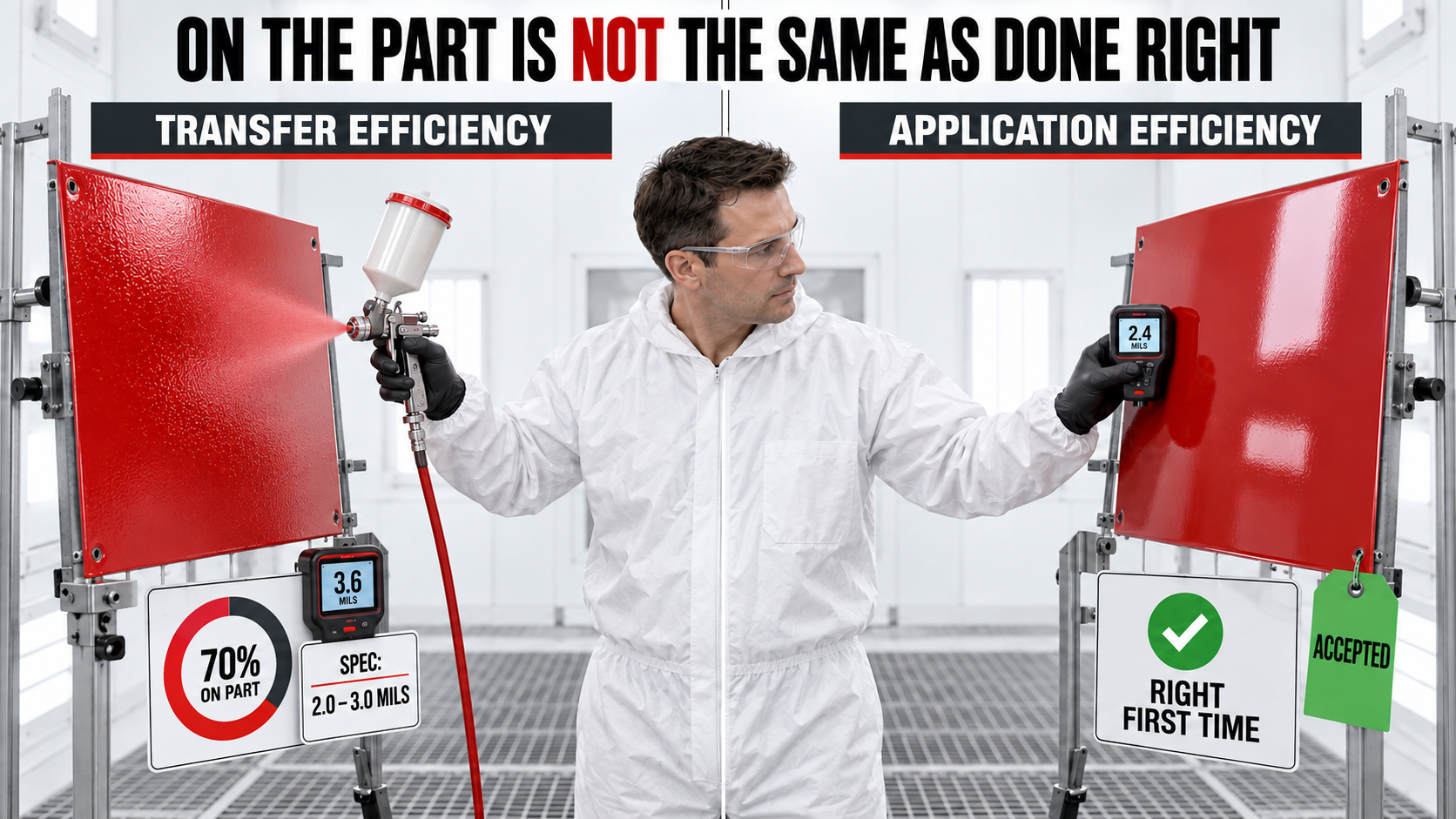 AirSprayTech.com Academy Transfer Efficiency Versus Application EfficiencyPutting Paint on the Part Is Only Half the Job A spray gun can put a high percentage of its coating on the part and still operate inside an inefficient finishing process. That may sound contradictory, but it is not. Transfer efficiency and application efficiency answer two different questions.
One measures material deposition. The other examines the practical performance of the finishing operation. A coating on the part is not automatically a coating applied correctly. It must also be in the right place, at the right thickness, with the required appearance and performance. What Is Transfer Efficiency?Transfer efficiency is the percentage of coating solids discharged by the application equipment that deposits on the intended part or product. Transfer Efficiency Coating solids deposited on the part ÷ Total coating solids sprayed × 100 Suppose a spray system discharges 10 pounds of coating solids during a production run, and 7 pounds of those solids are deposited on the intended parts. The transfer efficiency is 70 percent. The remaining 30 percent may become booth overspray, filter loading, floor and wall accumulation, rack buildup, exhaust-system contamination, or material collected for disposal or possible recovery. What Transfer Efficiency Does Not Tell YouTransfer efficiency alone does not tell you whether:
A heavy coat applied to the center of a panel may create excellent material deposition while leaving edges, recesses, or complex geometry below the required film thickness. The coating reached the part, but the application did not produce an acceptable part. What Is Application Efficiency?Application efficiency is a broader operational measure of how well the entire coating-application process converts labor, time, material, equipment capacity, and energy into acceptable finished work. Unlike transfer efficiency, application efficiency does not have one universal formula that fits every finishing operation. A company should define the measurement according to its process, products, specifications, and business objectives. Useful application-efficiency measurements may include:
A Useful Production Measure Accepted parts ÷ Total coated parts × 100 This calculation is commonly described as first-pass yield when it measures parts accepted without repair or reprocessing. It does not replace transfer-efficiency testing, but it reveals something transfer efficiency cannot: whether the process produced acceptable work the first time. Side-by-Side Comparison
High Transfer Efficiency, Poor Application EfficiencyConsider an operator who sprays very slowly and holds the gun too close to the surface. Most of the coating lands on the part, producing high transfer efficiency. Unfortunately, the film is too heavy, solvent becomes trapped, sags develop on vertical surfaces, and the parts require repair. The transfer-efficiency number may look impressive. The finishing result does not. Other examples include:
Why More Coating on the Part Is Not Always BetterTransfer efficiency measures how much coating reaches the part, not whether the amount deposited was necessary. If a specification requires 2.0 to 3.0 mils dry-film thickness and the process consistently applies 4.5 mils, much of that coating is technically transferred—but it may still be wasted. Excess film can increase material cost and contribute to solvent popping, sagging, slow cure, cracking, poor appearance, or other performance problems. Overspray is waste, but over-application is also waste. One misses the part. The other lands where it is not needed. What Influences Transfer Efficiency?
A spray technology may offer the potential for higher transfer efficiency, but equipment labels do not guarantee shop-floor results. Poor setup and technique can defeat the advantages of good equipment. What Influences Application Efficiency?Application efficiency includes everything that helps or prevents the process from producing conforming parts:
The Role of the ApplicatorEquipment creates capability. The applicator turns that capability into results. Good manual spray technique includes:
The applicator should not be treated as the last uncontrolled variable in the process. Experienced painters often recognize changes in viscosity, atomization, booth airflow, grounding, or equipment performance before the problem appears on an inspection report. They should be included in process reviews and improvement teams. Liquid and Powder Coating ConsiderationsLiquid CoatingsLiquid-coating transfer efficiency is affected by overspray, bounce-back, atomizing pressure, droplet size, gun distance, part geometry, booth airflow, and electrostatic attraction when used. Coating that reaches booth filters or accumulates on walls and floors did not transfer to the intended part. Powder CoatingsPowder coating introduces another distinction: first-pass transfer efficiency versus overall material utilization. First-pass transfer efficiency measures the powder deposited on the part during its first trip through the spray zone compared with the powder delivered by the guns. Reclaimed overspray may improve overall powder utilization, but it does not retroactively improve the first-pass transfer-efficiency measurement. A reclaim system can reduce disposal and fresh-powder consumption, but it also requires control of contamination, particle-size distribution, virgin-to-reclaim ratio, color change, booth cleaning, and finished-film quality. How to Measure the Whole ProcessDo not rely on one number. A useful finishing dashboard should combine material, production, and quality measurements.
Conduct a Controlled Application Trial
Ask Better QuestionsInstead of asking only, “Which spray gun has the highest transfer efficiency?” ask:
The Bottom LineTransfer efficiency matters. Higher transfer efficiency can reduce overspray, coating consumption, booth loading, emissions, cleanup, and waste. But it is one measurement inside a much larger finishing process. Application efficiency asks whether the coating operation produced acceptable parts at the required rate and cost. It connects the spray gun to preparation, racking, booth conditions, operator technique, film control, cure, inspection, maintenance, rework, and final acceptance. The best finishing process does not merely put more coating on the part. It puts the correct coating in the correct place, at the correct thickness, and produces an acceptable part the first time. Measure where the coating went—but do not stop there. Measure whether the finished part was worth the material, time, labor, and effort required to produce it. Technical ReferenceTechnical notice: Transfer-efficiency results depend on the defined test boundary, materials, parts, equipment, and test method. Confirm all regulatory, permit, customer, and coating-manufacturer requirements before using test results for compliance or equipment-selection decisions.
Copyright © 2026 Azimuth Spray Systems, LLC. All rights reserved. Tags:
transfer efficiency, application efficiency, spray gun efficiency, coating transfer efficiency, paint application efficiency, coating material waste, overspray reduction, first-pass yield, coating cost per part, spray finishing productivity, film thickne
|