 Understanding Paint Volume Solids
The number printed beside “solids by volume” on a coating data sheet may look like just another technical specification. In practice, it is one of the most useful numbers available to an applicator, estimator, inspector, or coatings professional.
Paint volume solids help determine how much coating remains on the surface after drying or curing. The value is used to estimate wet-film thickness, dry-film thickness, theoretical coverage, material requirements, and the effect of adding thinner.
Understanding volume solids can help answer three important questions:
- How thick must the wet coating be to achieve the required dry-film thickness?
- How much surface can one gallon or liter theoretically cover?
- What happens to film build when thinner or reducer is added?
What Are Paint Volume Solids?
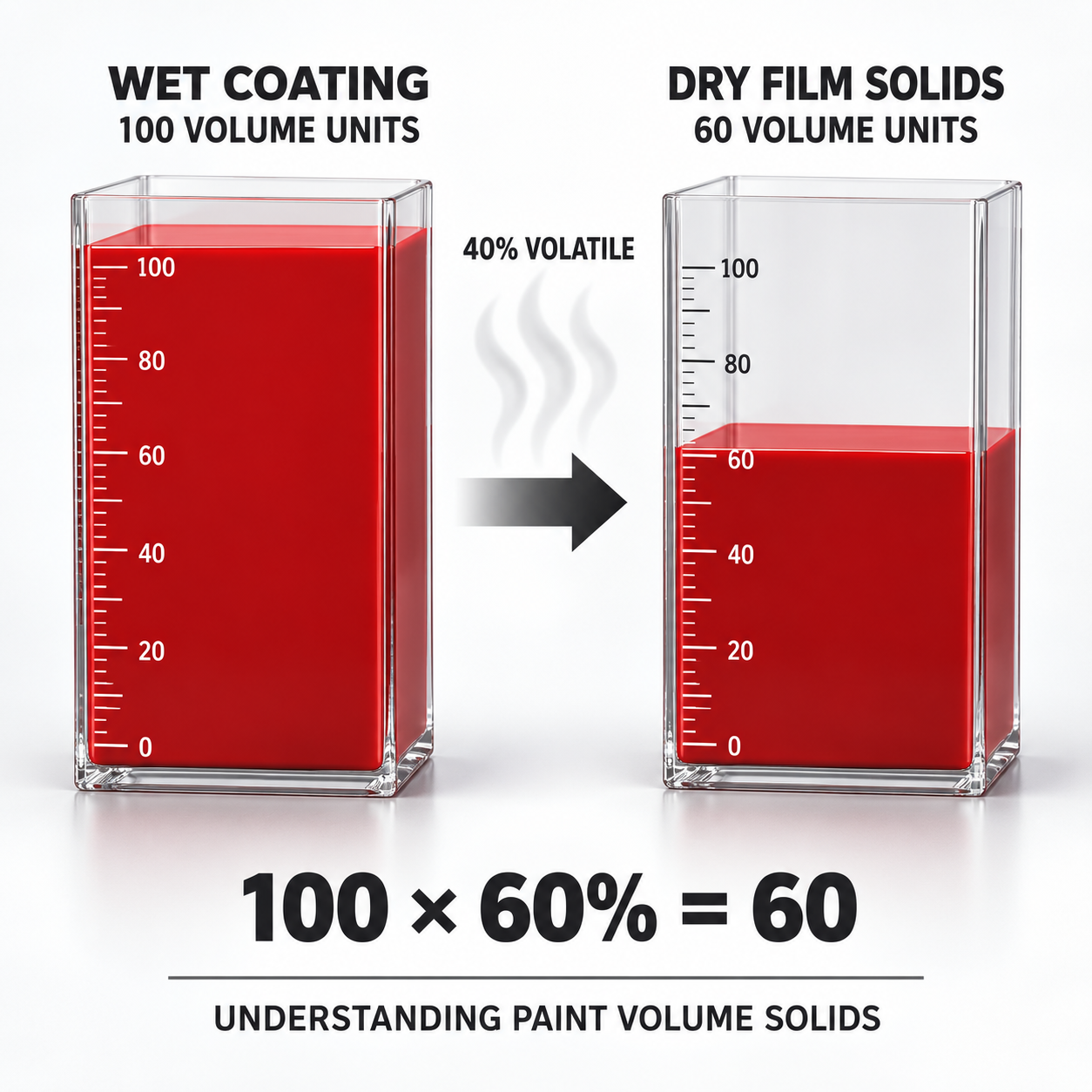
Volume solids are the percentage of the liquid coating’s volume that theoretically remains as part of the dry paint film after the volatile portion has left.
A liquid coating generally contains two broad categories of material:
- Nonvolatile material: Binder, pigment, extenders, and other ingredients that become part of the dry coating film.
- Volatile material: Solvents, water, and other ingredients that leave the coating during drying or curing.
If a coating is listed as 60% solids by volume, approximately 60% of its applied liquid volume theoretically remains in the dry film. The other approximately 40% is the volatile portion that leaves during drying or curing.
A Simple Volume-Solids Example
Imagine applying 10 gallons of a coating containing 60% solids by volume.
Theoretically:
- Approximately 6 gallons of volume become part of the dry coating film.
- Approximately 4 gallons of volume leave as water, solvent, or other volatile material.
This is a simplified theoretical example. Actual application also involves overspray, material remaining in equipment, surface roughness, uneven film build, and other losses.
Where Is the Volume-Solids Value Found?
The coating manufacturer normally lists volume solids on the product data sheet or technical data sheet. It may appear as:
- Volume solids
- Solids by volume
- Volume nonvolatile
- Nonvolatile matter by volume
- Percent solids by volume
The value may include a manufacturing or testing tolerance, such as 60% plus or minus 2%. Color, tint base, batch, and test method can sometimes affect the reported value.
When working with a multicomponent coating, use the volume-solids value for the properly mixed material—not the value of one individual component.
How Are Volume Solids Determined?
Coating manufacturers and laboratories may determine volume nonvolatile matter using recognized test methods.
Referenced methods include:
- ASTM D2697—Volume Nonvolatile Matter in Clear or Pigmented Coatings
- ISO 3233-1—Determination of Percentage Volume of Nonvolatile Matter
- U.S. EPA Method 24—Determination of Volatile Matter, Water, Density, Volume Solids, and Weight Solids
These standards are copyrighted or controlled technical documents. The complete current method should be obtained and followed when laboratory determination or contractual compliance is required.
Volume Solids Versus Weight Solids
Volume solids and weight solids are not interchangeable.
Volume Solids
Volume solids describe how much of the coating’s liquid volume theoretically remains in the dry film. This is the value used for:
- Wet-film thickness calculations
- Dry-film thickness estimates
- Theoretical spreading rate
- Coverage calculations
- Estimating coating quantities
Weight Solids
Weight solids describe how much of the coating’s liquid weight remains after the volatile material leaves.
Pigments and fillers can be much denser than resins, water, or solvents. Consequently, a coating may have a high percentage of solids by weight but a significantly lower percentage of solids by volume.
Volume Solids Versus VOC
Volume solids and volatile organic compound content, or VOC, are also different properties.
VOC describes regulated organic compounds that can be released from a coating. Volume solids describe the percentage of liquid volume theoretically remaining in the dry film.
A waterborne coating may contain a substantial volatile portion made primarily of water while having relatively low VOC content. Therefore, a low-VOC coating is not automatically a high-volume-solids coating.
Likewise, two coatings with similar volume-solids percentages can have different VOC contents because the chemistry and composition of their volatile portions differ.
Using Volume Solids to Calculate Wet-Film Thickness
The most common field use of volume solids is calculating the wet-film thickness required to produce a specified dry-film thickness.
For an unreduced coating:
Example: Calculating Required WFT
A coating must produce 4 mils DFT and contains 60% solids by volume.
The theoretical wet-film target is approximately 6.7 mils.
In metric units, the formula works the same way. If the required DFT is 100 microns and the coating is 60% solids by volume:
Using Volume Solids to Estimate DFT
If the measured wet-film thickness is known, the expected dry-film thickness may be estimated:
Example: Estimating DFT
A 60%-volume-solids coating is applied at 7 mils WFT.
The theoretical dry-film thickness is approximately 4.2 mils.
This is an estimate, not a substitute for measuring the coating after it has dried or cured.
How Thinning Changes Effective Volume Solids
Thinner or reducer normally increases liquid volume without adding film-forming solids. The amount of solid material remains essentially the same, but it is distributed through a larger volume of liquid.
The result is a lower effective percentage of solids by volume in the mixed coating.
When thinner is added as a percentage of the original coating volume, effective volume solids may be estimated as:
Example: Adding 10% Thinner
A coating contains 60% solids by volume and is reduced by adding 10% thinner based on the original coating volume.
The mixed coating now has an estimated effective volume-solids content of approximately 54.5%.
If the required DFT remains 4 mils:
Without thinner, approximately 6.7 mils WFT was required. After adding 10% thinner, approximately 7.3 mils WFT is theoretically required to produce the same 4 mils DFT.
This example assumes the thinner contributes no film-forming solids and that “10% reduction” means 10% of the original coating volume. Always confirm the manufacturer’s terminology and instructions.
Thinning Does Not Create More Coating Solids
Adding thinner may make a coating easier to atomize or apply under approved conditions, but it does not normally create more usable dry film.
Thinner may:
- Reduce viscosity.
- Change atomization.
- Change flow and leveling.
- Increase the liquid volume being applied.
- Increase the required WFT for the same DFT.
- Increase the amount of volatile material released.
- Increase the possibility of runs, sags, or solvent entrapment.
- Cause the finished film to be too thin if the WFT target is not adjusted.
Using Volume Solids to Calculate Theoretical Coverage
Volume solids can also be used to estimate the theoretical area that a coating can cover at a specified DFT.
U.S. Formula: Square Feet per Gallon
Example
A coating is 60% solids by volume and will be applied at 4 mils DFT.
The theoretical coverage is approximately 241 square feet per gallon.
Metric Formula: Square Meters per Liter
For a 60%-volume-solids coating applied at 100 microns DFT:
Theoretical Coverage Is Not Actual Coverage
Theoretical coverage assumes that every usable drop of coating forms a perfectly uniform film at the specified thickness. Real-world coating application does not work that way.
Actual coverage may be reduced by:
- Overspray
- Material remaining in containers, pumps, hoses, or spray guns
- Surface profile and roughness
- Porous or absorbent substrates
- Wind and ventilation
- Part geometry
- Edges, corners, welds, bolts, and stiffeners
- Uneven application
- Excessive overlap
- Application technique
- Mixing and transfer losses
- Spillage and cleanup
- Thinning or reduction
For this reason:
The efficiency factor should be based on experience with the coating, equipment, part geometry, application environment, and project conditions. One universal loss factor does not fit every job.
Does Higher Volume Solids Mean Better Paint?
Not automatically.
Higher-volume-solids coatings may provide certain advantages:
- More dry film from a given wet-film thickness.
- Potentially greater film build per coat.
- Potentially lower volatile emissions.
- Fewer coats for some applications.
- Reduced solvent loss.
- Potentially improved material efficiency.
However, high-solids coatings can also present application challenges:
- Higher viscosity.
- Greater equipment demands.
- More difficult atomization.
- Shorter pot life for some multicomponent coatings.
- More sensitivity to temperature.
- Greater risk of excessive film build.
- More demanding mixing and proportioning requirements.
A lower-volume-solids coating may be exactly right for a particular substrate, finish, application method, or service condition. Coating quality cannot be determined from volume solids alone.
What Does “100% Solids” Mean?
A coating described as 100% solids is formulated so that essentially all of its applied volume is intended to become part of the cured film.
Examples may include certain:
- Plural-component epoxies
- Tank and pipeline linings
- Flooring materials
- Elastomeric systems
- UV-cured coatings
In a simplified calculation, a 100%-solids coating applied at 20 mils wet would be expected to produce approximately 20 mils dry.
Actual results may still be affected by mixing accuracy, chemical reaction, trapped air, surface profile, temperature, application technique, material tolerance, and the test method used to determine solids content.
Multicomponent Coatings and Volume Solids
Two-component and plural-component coatings must be mixed in the correct ratio before their applied volume-solids value is meaningful.
Errors in proportioning can affect:
- Cure
- Film formation
- Hardness
- Chemical resistance
- Adhesion
- Volume solids
- Expected coverage
- Final film thickness
Do not calculate application requirements using the volume solids of the base component alone. Use the manufacturer’s value for the properly combined material at the specified mixing ratio.
Why Calculated DFT May Differ From Measured DFT
The equation connecting WFT, volume solids, and DFT is valuable, but field results may not match the calculation exactly.
Possible reasons include:
- The WFT measurement represents only a small location.
- The coating may flow or level after measurement.
- Solvent may evaporate before the WFT reading is taken.
- The surface may be rough, profiled, porous, or absorbent.
- The volume-solids value may include a stated tolerance.
- The coating may have been reduced incorrectly.
- The components may have been mixed at the wrong ratio.
- Film build may vary across the spray pattern.
- The DFT gauge may require adjustment for the substrate or surface profile.
- The coating may not have completed its drying or curing process.
Common Volume-Solids Mistakes
Using Weight Solids in the WFT Formula
This is one of the most common mistakes. Use solids by volume for film-thickness and coverage calculations.
Using the Volume Solids of One Component
For a multicomponent coating, use the value for the properly mixed material.
Ignoring Thinner
Approved thinner changes the effective volume-solids percentage and increases the WFT required to achieve the same DFT.
Assuming Theoretical Coverage Is Guaranteed
Theoretical coverage does not include normal jobsite losses.
Assuming High Solids Means High Quality
Volume solids describe film-forming volume. They do not independently establish adhesion, durability, weathering resistance, or suitability for service.
Confusing Volume Solids With VOC
Water and exempt compounds can affect the relationship between volatile content, VOC, and volume solids.
Ignoring the Manufacturer’s Tolerance
A data sheet may state a nominal volume-solids value with an allowable variation. Calculations should not be treated as more precise than the source data.
Practical Jobsite Checklist
Before calculating wet-film thickness or material requirements:
- Obtain the current product data sheet.
- Confirm the correct product and color.
- Identify the specified DFT range.
- Locate the solids-by-volume value.
- Do not substitute solids by weight.
- Confirm the mixing ratio for multicomponent coatings.
- Determine whether thinning is permitted.
- Account for any approved thinner.
- Calculate the target WFT.
- Estimate theoretical coverage.
- Apply an appropriate loss or efficiency factor for estimating.
- Measure WFT during application.
- Measure DFT after drying or curing when required.
- Document the values and calculations used.
The Bottom Line
Volume solids tell you how much of the liquid coating theoretically remains to form the dry paint film. That one value connects the material in the container to wet-film thickness, dry-film thickness, spreading rate, and coating consumption.
Use solids by volume—not solids by weight. Account for approved thinner. Recognize that theoretical coverage does not include application losses. Measure the wet film while applying the coating, and verify the dry film after it cures.
Technical Notice: This article provides general educational information and does not replace the coating manufacturer’s current product data sheet, project specification, safety requirements, or complete ASTM, ISO, or regulatory test methods. Product values, mixing instructions, reduction limits, and application requirements vary. Always follow the current written instructions for the specific coating.
Copyright © 2026 Azimuth Spray Systems, LLC. All rights reserved. AirSprayTech.com—The Finishing Authority®. No portion of this article may be reproduced, distributed, republished, or transmitted without prior written permission.