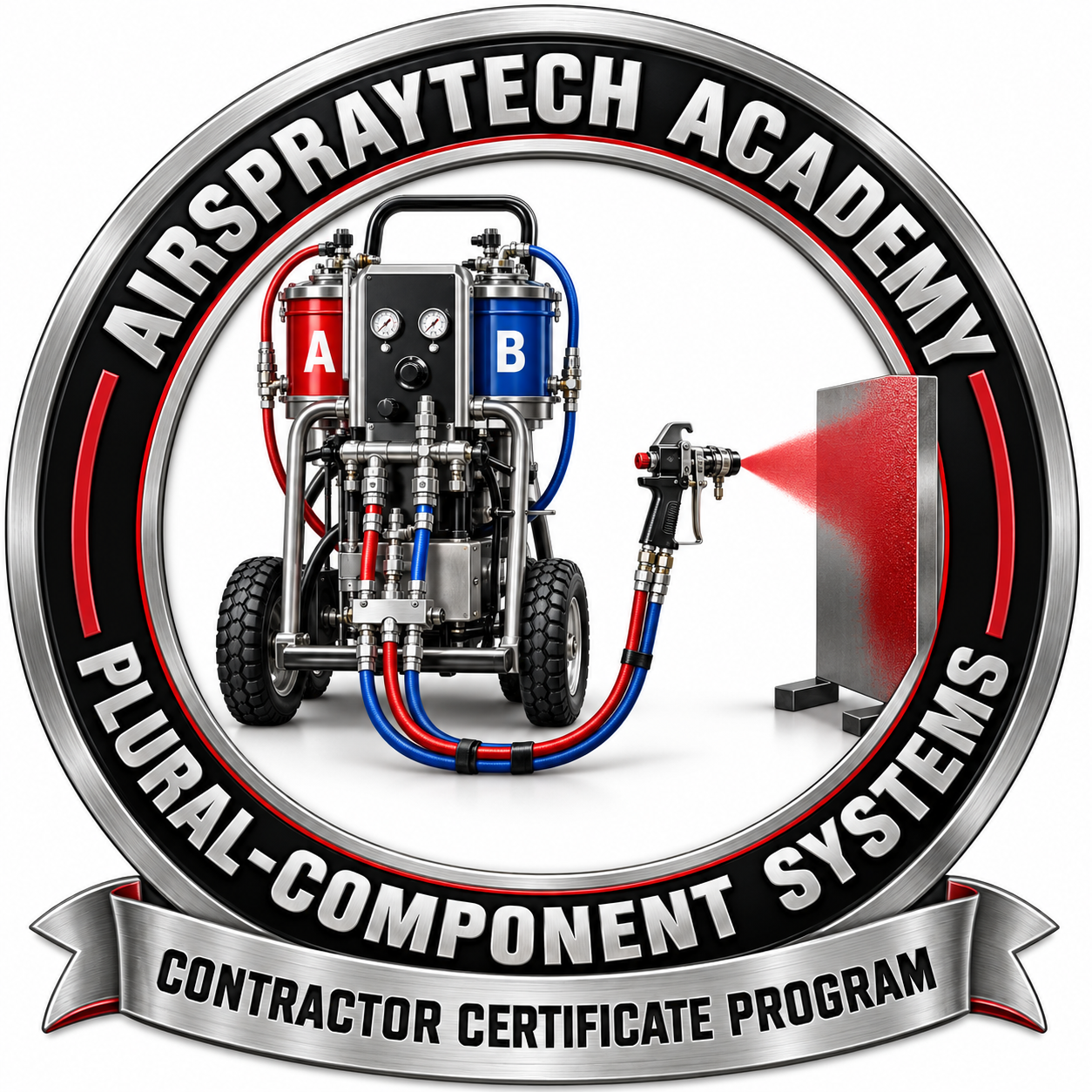
AirSprayTech Academy — Series 13
Portable Plural-Component Coating Systems for Contractors
From Material Supply and Ratio Control to Application and Final Acceptance
A practical, contractor-focused certificate program covering the selection,
setup, calibration, operation, troubleshooting, maintenance, and quality
control of portable plural-component coating equipment used on commercial
and industrial jobsites.
Review the 24-Article Course
Plural-Component Application Is a Controlled Process
A plural-component system must do more than pump two materials toward a
spray gun. It must deliver components A and B at the specified ratio,
temperature, pressure, and flow rate—and maintain those conditions
throughout application.
An incorrect ratio, blocked passage, cold component, worn pump, unsuitable
mixer, pressure imbalance, or poor shutdown procedure can leave behind
material that never develops its intended properties. The failure may not
be visible until the coating is already in service.
Contractor and Jobsite Focus
This program concentrates on portable and mobile plural-component systems
used by contractors in the field. It addresses equipment transported to a
project, supplied from pails, drums, or totes, and operated under changing
jobsite and environmental conditions.
Stationary factory systems used for automated OEM 2K and 3K product
finishing will be addressed separately in AirSprayTech Academy Series 14.
Applications and Materials Covered
Coating Technologies
- Plural-component epoxies and novolac epoxies
- Polyurethane and hybrid systems
- Polyurea and polyurethane-polyurea systems
- High-solids and rapid-cure protective coatings
- Specialty membranes, linings, and elastomeric systems
Contractor Applications
- Protective linings and secondary containment
- Concrete, flooring, and waterproofing systems
- Roofing and reinforced liquid-applied membranes
- Steel, pipelines, tanks, and infrastructure
- High-production corrosion-protection projects
What the Course Teaches
- Plural-component terminology, chemistry, ratios, and reaction control
- How to read product data sheets, equipment manuals, and project specifications
- Selecting a proportioner for the material and production requirement
- Supplying materials from pails, drums, totes, and transfer pumps
- Heating, recirculation, viscosity control, and heated-hose operation
- Ratio verification, calibration, pressure balance, and output testing
- Mix manifolds, static mixers, impingement mixing, guns, and spray tips
- Mobile rig utilities, generators, compressors, ventilation, and jobsite setup
- Startup, application, shutdown, flushing, storage, and preventive maintenance
- Recognizing off-ratio material and documenting application quality
24-Article Certificate Course
-
Understanding Portable Plural-Component Coating Systems
-
Component A, Component B, Mix Ratios, and Stoichiometry
-
Pot Life, Working Time, Gel Time, Cure, and Reaction Temperature
-
Plural-Component Materials and Contractor Applications
-
Reading Product Data Sheets, Manuals, and Project Specifications
-
How Portable Proportioning Equipment Works
-
Selecting the Correct Proportioner for the Material and Project
-
Pails, Drums, Totes, Feed Pumps, and Material Supply
-
Material Conditioning, Agitation, Temperature, and Viscosity
-
Primary Heaters, Heated Hoses, Recirculation, and Temperature Control
-
Proportioning Pumps, Ratio Control, and Pressure Balance
-
Filters, Valves, Gauges, Sensors, and Protective Controls
-
Mix Manifolds, Static Mixers, and Impingement Mixing
-
Plural-Component Spray Guns, Chambers, Tips, and Nozzles
-
Building a Safe and Productive Mobile Plural-Component Rig
-
Hose Selection, Pressure Ratings, Connections, Grounding, and Bonding
-
Calibration, Ratio Verification, Output Testing, and Records
-
Jobsite Setup, Prestart Inspection, Priming, and Startup
-
Pressure, Temperature, Spray Pattern, and Application Technique
-
Coverage, Film Thickness, Recoat Windows, and Cure Verification
-
Recognizing and Correcting Off-Ratio Material
-
Shutdown, Flushing, Pressure Relief, and Material Storage
-
Troubleshooting and Preventive Maintenance
-
Safety, Quality Control, Documentation, and Final Acceptance
Technical Standards and Industry Resources
Applicable standards and industry resources will be identified by name and
number within the articles where they apply. References may include:
- OSHA requirements for respiratory protection, hazardous materials, pressure equipment, and construction safety
- NFPA 33 requirements for spray application using flammable or combustible materials
- AMPP and SSPC surface-preparation and protective-coating guidance
- ASTM D4414 for wet-film-thickness measurement
- ASTM D7091 for nondestructive dry-film-thickness measurement on metal
- ASTM D4541 and ASTM D7234 for pull-off adhesion testing
- Manufacturer manuals, product data sheets, safety data sheets, and approved application procedures
Manufacturer-Neutral Instruction
The operating principles taught in this course apply across professional
plural-component equipment. Equipment from WAGNER, Graco, WIWA, Sames,
and other manufacturers may be discussed when a specific design provides
a useful technical example.
AirSprayTech represents WAGNER Industrial equipment commercially.
That relationship will be disclosed whenever relevant. Course instruction
is intended to remain technically accurate, manufacturer-neutral, and
useful to contractors regardless of the equipment brand they operate.
Who Should Take This Course?
- Industrial and commercial coating contractors
- Plural-component equipment operators and applicators
- Crew leaders, foremen, and field supervisors
- Equipment technicians and maintenance personnel
- Estimators, project managers, and quality-control personnel
- Contractors considering the addition of plural-component application capabilities
Certificate Program
Complete all 24 articles and pass the final course assessment to become
eligible to request an AirSprayTech Academy Certificate of Completion.
The course is free to study. The certificate recognizes completion of this
educational program. It does not replace manufacturer equipment training,
approved-applicator status, trade licensing, OSHA training, respiratory
protection qualification, project-specific certification, or supervision
by a qualified employer.
Professional responsibility:
Always follow the current project specification, coating manufacturer's
product data sheets and safety data sheets, equipment manufacturer's
operating instructions, approved application procedures, applicable
regulations, and employer safety program. Never exceed the pressure,
temperature, or material limitations of any component in the system.
Copyright © 2026 Azimuth Spray Systems, LLC. All Rights Reserved.
No part of this material may be reproduced, distributed, transmitted,
stored, or used in any form without prior written permission from
Azimuth Spray Systems, LLC, except for brief quotations used with
proper attribution.
AirSprayTech.com — The Finishing Authority®
Tags:
plural component coating systems, portable plural component equipment, plural component sprayer, two component coatings, 2K spray equipment, proportioning equipment, polyurea spraying, plural component contractor training, heated hose, static mixer, impin
| Related Articles |
> Academy Series | Professional Certificate Programs
> The Language of Finishing: A Paint and Coatings Industry Glossary
> The Language of Finishing: Paint and Coatings Glossary A–B
> The Language of Finishing: Paint and Coatings Glossary C–D
> The Language of Finishing: Paint and Coatings Glossary E–F
> The Language of Finishing: Paint and Coatings Glossary G–H
> The Language of Finishing: Paint and Coatings Glossary I–K
> The Language of Finishing: Paint and Coatings Glossary L–M
> The Language of Finishing: Paint and Coatings Glossary N–O
> The Language of Finishing: Paint and Coatings Glossary P–Q
> The Language of Finishing: Paint and Coatings Glossary R
> The Language of Finishing: Paint and Coatings Glossary S
> The Language of Finishing: Paint and Coatings Glossary T
> The Language of Finishing: Paint and Coatings Glossary U–V
> The Language of Finishing: Paint and Coatings Glossary W–Z
> The Language of Finishing: Coatings Standards and Acronyms
> Airless Spraying - From Pump to Pattern
> Airless Spraying—From Pump to Pattern | Article 01 of 18
How Airless Spray Equipment Works
> Airless Spraying—From Pump to Pattern | Article 02 of 18
How to Read an Airless Spray Tip Number
> Airless Spraying—From Pump to Pattern | Article 03 of 18
How to Choose the Correct Airless Tip Size
> Airless Spraying—From Pump to Pattern | Article 04 of 18
Understanding Airless Fan Width and Orifice Size
> Airless Spraying—From Pump to Pattern | Article 05 of 18
The Right Way to Set Airless Spray Pressure
> Airless Spraying—From Pump to Pattern | Article 06 of 18
The Perfect Airless Spray Pattern
> Airless Spraying—From Pump to Pattern | Article 07 of 18
Why an Airless Spray Pattern Develops Tails
> Airless Spraying—From Pump to Pattern | Article 08 of 18
How Tip Wear Wastes Paint and Changes the Pattern
> Airless Spraying—From Pump to Pattern | Article 09 of 18
Matching the Tip to the Sprayer’s Capacity
> Airless Spraying—From Pump to Pattern | Article 10 of 18
How Airless Hose Size and Length Affect Performance
> Airless Spraying—From Pump to Pattern | Article 11 of 18
How to Prime and Start an Airless Sprayer
> Airless Spraying—From Pump to Pattern | Article 12 of 18
Professional Airless Spray-Gun Technique
> Airless Spraying—From Pump to Pattern | Article 13 of 18
How to Shut Down, Flush, and Store an Airless Sprayer
> Airless Spraying—From Pump to Pattern | Article 14 of 18
Airless Troubleshooting: When the Pump Will Not Prime
> Airless Spraying—From Pump to Pattern | Article 15 of 18
Airless Troubleshooting: Surging, Pulsing, and Pressure Loss
> Airless Spraying—From Pump to Pattern | Article 16 of 18
Electric, Gas, or Pneumatic Airless Equipment
> Airless Spraying—From Pump to Pattern | Article 17 of 18
Choosing the Right Airless Sprayer for the Work
> Airless Spraying—From Pump to Pattern | Article 18 of 18
Airless Safety: Understanding Injection-Injury Hazards
> Airless Spraying-From Pump to Pattern
Certificate of Completion
> Airless Spraying—From Pump to Pattern | Final Assessment
> Powder Coating - From Particle To Performance
> Powder Coating—From Particle to Performance | Article 01 of 32 | The History of Powder Coating
> Powder Coating—From Particle to Performance | Article 02 of 32 | What Powder Coating Is—and What It Is Not
> Powder Coating—From Particle to Performance | Article 03 of 32 | What Is Inside a Powder Coating?
> Powder Coating—From Particle to Performance | Article 04 of 32 | How Powder Coating Is Manufactured
> Powder Coating—From Particle to Performance | Article 05 of 32 | Thermoset Versus Thermoplastic Powder Coatings
> Powder Coating—From Particle to Performance | Article 06 of 32 | Epoxy, Polyester, and Epoxy-Polyester Hybrid Powders
> Powder Coating—From Particle to Performance | Article 07 of 32 | Polyurethane, Acrylic, Fluoropolymer, and Specialty Powders
> Powder Coating—From Particle to Performance | Article 08 of 32 | Selecting the Right Powder for the Application
> Powder Coating—From Particle to Performance | Article 09 of 32 | Why Surface Preparation Determines Coating Performance
> Powder Coating—From Particle to Performance | Article 10 of 32 | Preparing Steel, Aluminum, and Galvanized Surfaces
> Powder Coating—From Particle to Performance | Article 11 of 32 | Mechanical Surface Preparation for Powder Coating
> Powder Coating—From Particle to Performance | Article 12 of 32 | Chemical Pretreatment, Rinsing, and Dry-Off
> Powder Coating—From Particle to Performance | Article 13 of 32 | How Electrostatic Powder Coating Works
> Powder Coating—From Particle to Performance | Article 14 of 32 | Corona-Charging Powder Guns
> Powder Coating—From Particle to Performance | Article 15 of 32 | Tribostatic Powder Application
> Powder Coating—From Particle to Performance | Article 16 of 32 | Fluidized-Bed Powder Coating
> Powder Coating—From Particle to Performance | Article 17 of 32: Anatomy of a Manual Powder-Coating System
> Powder Coating—From Particle to Performance | Article 18 of 32: Anatomy of an Automatic Powder-Coating System
> Powder Coating—From Particle to Performance | Article 20 of 32: Powder Feed, Recovery, Reclaim, and Color Change
> Powder Coating—From Particle to Performance | Article 21 of 32: Compressed-Air Quality for Powder-Coating Equipment
> Powder Coating—From Particle to Performance | Article 22 of 32: How to Set Up and Start a Powder-Coating System
> Powder Coating—From Particle to Performance | Article 23 of 32: Setting Powder Flow, Pattern Air, kV, and Current
> Powder Coating—From Particle to Performance | Article 24 of 32: Professional Manual Powder-Gun Technique
> Powder Coating—From Particle to Performance | Article 25 of 32: Setting Up Automatic Guns and Reciprocators
> Powder Coating—From Particle to Performance | Article 26 of 32: Faraday-Cage Effect, Back Ionization, and Poor Coverage
> Powder Coating—From Particle to Performance | Article 27 of 32: Curing Powder Coating—Time at Metal Temperature
> Powder Coating—From Particle to Performance | Article 29 of 32: Measuring Powder-Coating Film Thickness
> Powder Coating—From Particle to Performance | Article 30 of 32: Testing Adhesion, Cure, Gloss, Color, and Appearance
> Powder Coating—From Particle to Performance | Article 31 of 32: Powder-Coating Defects and Corrective Action
> Powder Coating—From Particle to Performance | Article 32 of 32: Powder-Coating Safety, Housekeeping, and Preventive Maintenance
> Powder Coating—From Particle to Performance | Final Course Assessment
> Powder Coating—From Particle to Performance | Certificate of Completion
> Finishing Quality - From Spec to Sign-Off | AirSprayTech Academy
> Finishing Quality—From Spec to Sign-Off | Article 01 of 28: Quality Begins with the Specification
> Finishing Quality—From Spec to Sign-Off | Article 02 of 28: From Specification to Control Plan
> Finishing Quality—From Spec to Sign-Off | Article 03 of 28: Document Control and Traceability
> Finishing Quality—From Spec to Sign-Off | Article 04 of 28: Incoming Materials and Receiving Inspection
> Finishing Quality—From Spec to Sign-Off | Article 05 of 28: Incoming Process Water Quality
> Finishing Quality—From Spec to Sign-Off | Article 06 of 28: Process Water Treatment Systems
> Finishing Quality—From Spec to Sign-Off | Article 07 of 28 Treating and Releasing Finishing Wastewater
> Finishing Quality—From Spec to Sign-Off | Article 08 of 28: Surface Cleaning and Contamination Control
> Finishing Quality—From Spec to Sign-Off | Article 09 of 28 Surface Pretreatment and Conversion Coating Control
> Finishing Quality—From Spec to Sign-Off | Article 10 of 28 Coating Material Storage, Mixing, and Conditioning
> Finishing Quality—From Spec to Sign-Off | Article 11 of 28 Compressed-Air Quality and System Control
> Finishing Quality—From Spec to Sign-Off | Article 12 of 28 Temperature, Humidity, and Environmental Control
> Finishing Quality—From Spec to Sign-Off | Article 13 of 28 Application Equipment Setup and Process Verification
> Finishing Quality—From Spec to Sign-Off | Article 14 of 28 Wet-Film Thickness and Application Control
> Finishing Quality—From Spec to Sign-Off | Article 15 of 28 Dry-Film Thickness Measurement and Control
> Finishing Quality—From Spec to Sign-Off | Article 16 of 28 Cure Verification and Oven Performance
> Finishing Quality—From Spec to Sign-Off | Article 17 of 28 Appearance, Color, Gloss, and Texture Inspection
> Finishing Quality—From Spec to Sign-Off | Article 18 of 28 Coating Adhesion Testing and Interpretation
> Finishing Quality—From Spec to Sign-Off | Article 19 of 28 Hardness, Impact, Flexibility, and Abrasion Testing
> Finishing Quality—From Spec to Sign-Off | Article 20 of 28 Corrosion, Chemical, and Environmental Exposure Testing
> Finishing Quality—From Spec to Sign-Off | Article 21 of 28 Holiday, Porosity, and Coating-Continuity Testing
> Finishing Quality—From Spec to Sign-Off | Article 22 of 28 Building and Controlling the In-House Finishing Laboratory
> Finishing Quality—From Spec to Sign-Off | Article 23 of 28 Sampling Plans and Inspection Frequency
> Finishing Quality—From Spec to Sign-Off | Article 24 of 28 Building the Finishing Process Data Highway
> Finishing Quality—From Spec to Sign-Off | Article 25 of 28 Nonconformance, Root Cause, and Corrective Action
> Finishing Quality—From Spec to Sign-Off | Article 26 of 28 Final Product Audit, Acceptance, and Release
> Finishing Quality—From Spec to Sign-Off | Article 27 of 28 Build a Quality Team That Includes the People Doing the Work
> Finishing Quality—From Spec to Sign-Off | Article 28 of 28 Your Vendors Are Part of the Quality Team
> Finishing Quality—From Spec to Sign-Off | Final Assessment
> Finishing Quality—From Spec to Sign-Off | Certificate Request
> Paint Shop Planning - From Floor Plan to First Spray
> Paint Shop Planning—From Floor Plan to First Spray | Article 02 of 28 | Build a Project Team Before You Build the Shop
> Paint Shop Planning—From Floor Plan to First Spray | Article 03 of 28 | Meet the Authority Having Jurisdiction Early
> Paint Shop Planning—From Floor Plan to First Spray | Article 04 of 28 | Creating the Owner’s Project Requirements
> Paint Shop Planning—From Floor Plan to First Spray | Article 05 of 28 | Understanding NFPA 33 and Spray-Application Fire Protection
> Paint Shop Planning—From Floor Plan to First Spray | Article 06 of 28 | Understanding the NEC in a Paint Shop
> Paint Shop Planning—From Floor Plan to First Spray | Article 07 of 28 | Flammable and Combustible Liquid Storage
> Paint Shop Planning—From Floor Plan to First Spray | Article 08 of 28 | Building, Fire, and Mechanical Codes
> Paint Shop Planning—From Floor Plan to First Spray | Article 09 of 28 | Environmental Permits and Emissions Planning
> Paint Shop Planning—From Floor Plan to First Spray | Article 10 of 28 | Planning the Shop Layout and Product Flow
> Paint Shop Planning—From Floor Plan to First Spray | Article 11 of 28 | Spray-Booth and Preparation-Station Selection
> Paint Shop Planning—From Floor Plan to First Spray | Article 12 of 28 | Air-Makeup and Exhaust-System Planning
> Paint Shop Planning—From Floor Plan to First Spray | Article 13 of 28 | Planning the Compressed-Air System
> Paint Shop Planning—From Floor Plan to First Spray | Article 14 of 28 | Electrical Service, Controls, and Hazardous Locations
> Paint Shop Planning—From Floor Plan to First Spray | Article 15 of 28 | Natural Gas, Heating, and Curing Requirements
> Paint Shop Planning—From Floor Plan to First Spray | Article 16 of 28 | Fire Suppression, Detection, and Emergency Systems
> Paint Shop Planning—From Floor Plan to First Spray | Article 17 of 28 | Writing an Equipment Specification Vendors Can Quote
> Paint Shop Planning—From Floor Plan to First Spray | Article 18 of 28 | How to Compare Paint-Booth Proposals
> Paint Shop Planning—From Floor Plan to First Spray | Article 19 of 28 | Who Is Responsible for What?
> Paint Shop Planning—From Floor Plan to First Spray | Article 20 of 28 | Site Preparation and Construction Coordination
> Paint Shop Planning—From Floor Plan to First Spray | Article 21 of 28 | Change Orders: Where Paint-Shop Budgets Go to Die
> Paint Shop Planning—From Floor Plan to First Spray | Article 22 of 28 | Pre-Startup Inspection and Documentation
> Paint Shop Planning—From Floor Plan to First Spray | Article 23 of 28 | Testing Booth Airflow and Pressure
> Paint Shop Planning—From Floor Plan to First Spray | Article 24 of 28 | Testing Safety Interlocks and Emergency Controls
> Paint Shop Planning—From Floor Plan to First Spray | Article 25 of 28 | Commissioning the Complete Paint Shop
> Paint Shop Planning—From Floor Plan to First Spray | Article 26 of 28 | Training Operators and Maintenance Personnel
> Paint Shop Planning—From Floor Plan to First Spray | Article 27 of 28 | Final Acceptance: Do Not Sign Off Until It Performs
> Paint Shop Planning—From Floor Plan to First Spray | Article 28 of 28 | Planning for Maintenance, Expansion, and the Next Ten Years
> Paint Shop Planning—From Floor Plan to First Spray | Article 01 of 28 | Before You Buy a Booth: Define the Finishing Process
> Paint Shop Planning—From Floor Plan to First Spray | Final Assessment
> Paint Shop Planning—From Floor Plan to First Spray | Certificate of Completion Request
> Automotive Refinish - From Repair Plan to Road Ready
> Automotive Refinish—From Repair Plan to Road Ready | Article 01 of 28 | Start Before the Sandpaper: Vehicle Intake and Refinish Planning
> Automotive Refinish—From Repair Plan to Road Ready | Article 02 of 28 | PPE Is Part of the Process: Protecting the Automotive Painter
> Automotive Refinish—From Repair Plan to Road Ready | Article 03 of 28 | Fire, Fumes, and Ignition Sources: Everyday Refinish-Shop Safety
> Automotive Refinish—From Repair Plan to Road Ready | Article 04 of 28 | A Clean Shop Paints Cleaner Cars: Housekeeping and Contamination Control
> Automotive Refinish—From Repair Plan to Road Ready | Article 05 of 28 | Know What You Are Painting: Automotive Substrate Identification
> Automotive Refinish—From Repair Plan to Road Ready | Article 06 of 28 | Clean Before You Cut: Washing, Degreasing, and Contamination Removal
> Automotive Refinish—From Repair Plan to Road Ready | Article 07 of 28 | Stop Corrosion Before It Starts: Bare Metal and Corrosion Protection
> Automotive Refinish—From Repair Plan to Road Ready | Article 08 of 28 | Sand With a Purpose: Abrasives, Grit Selection, and Surface Profiles
> Automotive Refinish—From Repair Plan to Road Ready | Article 09 of 28 | Build It Straight: Fillers, Glazes, Primers, and Sealers
> Automotive Refinish—From Repair Plan to Road Ready | Article 10 of 28 | Mask the Repair, Not the Mistake: Paper, Plastic, Tape, and Technique
> Automotive Refinish—From Repair Plan to Road Ready | Article 11 of 28 | Choose the Complete System: Modern Automotive-Refinish Materials
> Automotive Refinish—From Repair Plan to Road Ready | Article 12 of 28 | Control the Mix: Paint Storage, Mixing Rooms, and Material Management
> Automotive Refinish—From Repair Plan to Road Ready | Article 13 of 28 | Match It Before You Spray It: Color Tools, Spray-Outs, and Color Acceptance
> Automotive Refinish—From Repair Plan to Road Ready | Article 14 of 28 | Choose the Right Spray Gun: Match the Equipment to the Finish
> Automotive Refinish—From Repair Plan to Road Ready | Article 15 of 28 | Feed the Finish: Air-Compressor Operation and Maintenance
> Automotive Refinish—From Repair Plan to Road Ready | Article 16 of 28 | Keep the Gun Honest: Spray Equipment Operation and Maintenance
> Automotive Refinish—From Repair Plan to Road Ready | Article 17 of 28 | Paint With a Plan: Professional Basecoat and Clearcoat Application
> Automotive Refinish—From Repair Plan to Road Ready | Article 18 of 28 | Control the Booth: Airflow, Filters, Lighting, and Maintenance
> Automotive Refinish—From Repair Plan to Road Ready | Article 19 of 28 | Balance the Booth: Air-Makeup Unit Operation and Maintenance
> Automotive Refinish—From Repair Plan to Road Ready | Article 20 of 28 | Cure It by the Numbers: Flash, Bake, and Return-to-Service
> Automotive Refinish—From Repair Plan to Road Ready | Article 21 of 28 | Correct Without Creating: Denibbing, Sanding, and Polishing
> Automotive Refinish—From Repair Plan to Road Ready | Article 22 of 28 | Put It Back Right: Reassembly Without Damaging the Finish
> Automotive Refinish—From Repair Plan to Road Ready | Article 23 of 28 | Inspect It Before the Customer Does: Final Quality Control
> Automotive Refinish—From Repair Plan to Road Ready | Article 24 of 28 | Deliver More Than Shine: Customer Handoff and Fresh-Paint Care
> Automotive Refinish—From Repair Plan to Road Ready | Article 25 of 28 | Control the Waste Stream: Paint, Solvent, Filters, and Compliance
> Automotive Refinish—From Repair Plan to Road Ready | Article 26 of 28 | Troubleshoot the Process: Find the Cause Before Repainting
> Automotive Refinish—From Repair Plan to Road Ready | Article 27 of 28 | Make Quality Repeatable: Procedures, Training, and Team Accountability
> Automotive Refinish—From Repair Plan to Road Ready | Article 28 of 28 | Road Ready Is Earned: Audit the Complete Refinish Process
> Automotive Refinish—From Repair Plan to Road Ready | Final Assessment
> Automotive Refinish—From Repair Plan to Road Ready | Certificate of Completion Request
> Corrosion Protection for Industrial Coating Contractors - 00 Course Overview
> Corrosion Protection for Industrial Coating Contractors - Article 01: Understanding Corrosion
> Corrosion Protection for Industrial Coating Contractors - Article 02: Common Forms of Corrosion
> Corrosion Protection for Industrial Coating Contractors - Article 03: Evaluating the Structure and Service Environment
> Corrosion Protection for Industrial Coating Contractors - Article 04: Protective Coatings as the Primary Barrier
> Corrosion Protection for Industrial Coating Contractors - Article 05: Selecting the Correct Coating System
> Corrosion Protection for Industrial Coating Contractors - Article 06: Surface Cleanliness and Contaminant Testing
> Corrosion Protection for Industrial Coating Contractors - Article 07: Abrasive Blasting and Surface-Preparation Standards
> Corrosion Protection for Industrial Coating Contractors - Article 08: Surface Profile and Anchor Pattern
> Corrosion Protection for Industrial Coating Contractors - Article 09: Environmental Conditions and Dew Point Control
> Corrosion Protection for Industrial Coating Contractors - Article 10: Selecting Coating Systems for the Service Environment
> Corrosion Protection for Industrial Coating Contractors - Article 11: Primers and Their Role in Corrosion Protection
> Corrosion Protection for Industrial Coating Contractors - Article 12: Intermediate Coats, Finish Coats, and Stripe Coating
> Corrosion Protection for Industrial Coating Contractors - Article 13: Coating Application Methods and Spray Technique
> Corrosion Protection for Industrial Coating Contractors - Article 14: Coating Mixing, Thinning, Induction Time, and Pot Life
> Corrosion Protection for Industrial Coating Contractors - Article 15: Wet Film and Dry Film Thickness Control
> Corrosion Protection for Industrial Coating Contractors - Article 16: Holidays, Pinholes, and Discontinuity Testing
> Corrosion Protection for Industrial Coating Contractors - Article 17: Coating Adhesion Testing and Failure Interpretation
> Corrosion Protection for Industrial Coating Contractors - Article 18: Coating Defects and Failure Diagnosis
> Corrosion Protection for Industrial Coating Contractors - Article 19: How Coatings and Cathodic Protection Work Together
> Corrosion Protection for Industrial Coating Contractors - Article 20: Final Inspection, Repair Verification, and Project Documentation
> Corrosion Protection for Industrial Coating Contractors - Final Assessment
> Corrosion Protection for Industrial Coating Contractors - Final Certificate of Completion Request
> Protective Linings for Industrial Coating Contractors | 00 - Course Overview
> Protective Linings for Industrial Coating Contractors | Article 01 of 20 - Protective Linings: What They Are and Why They Fail
> Protective Linings for Industrial Coating Contractors | Article 02 of 20 - Understanding the Lining Service Environment
> Protective Linings for Industrial Coating Contractors | Article 04 of 20 - Selecting a Lining for the Material Being Contained
> Protective Linings for Industrial Coating Contractors | Article 05 of 20 - Epoxy Linings and Where They Are Used
> Protective Linings for Industrial Coating Contractors | Article 06 of 20 - Novolac Epoxy Linings for Severe Chemical Service
> Protective Linings for Industrial Coating Contractors | Article 07 of 20 - Vinyl Ester and Polyester Lining Systems
> Protective Linings for Industrial Coating Contractors | Article 08 of 20 - Polyurethane, Polyurea, and Elastomeric Linings
> Protective Linings for Industrial Coating Contractors | Article 09 of 20 - Cementitious and Specialty Lining Systems
> Protective Linings for Industrial Coating Contractors | Article 10 of 20 - Inspecting Steel and Concrete Before Lining Work Begins
> Protective Linings for Industrial Coating Contractors | Article 11 of 20 - Preparing Steel for Protective-Lining Application
> Protective Linings for Industrial Coating Contractors | Article 12 of 20 - Preparing Concrete for Protective Linings
> Protective Linings for Industrial Coating Contractors | Article 13 of 20 - Moisture in Concrete: When a Lining Should Not Be Applied
> Protective Linings for Industrial Coating Contractors | Article 14 of 20 - Environmental Conditions, Dew Point, and Condensation Control
> Protective Linings for Industrial Coating Contractors | Article 15 of 20 - Mixing, Induction Time, Pot Life, and Material Temperature
> Protective Linings for Industrial Coating Contractors | Article 16 of 20 - Applying High-Build and Plural-Component Linings
> Protective Linings for Industrial Coating Contractors | Article 17 of 20 - Stripe Coating, Edges, Welds, Penetrations, and Difficult Areas
> Protective Linings for Industrial Coating Contractors | Article 18 of 20 - Film Thickness, Recoat Windows, Curing, and Return to Service
> Protective Linings for Industrial Coating Contractors | Article 19 of 20 - Inspecting Protective Linings
> Protective Linings for Industrial Coating Contractors | Article 20 of 20 - Final Acceptance, Repairs, and Lining Maintenance
> Protective Linings for Industrial Coating Contractors - Final Assessment
> Protective Linings for Industrial Coating Contractors | Certificate of Completion Request
> Moisture Vapor Barriers and Mitigation Membranes for Industrial Coating Contractors | 00 - Course Overview
> Moisture Vapor Barriers and Mitigation Membranes for Industrial Coating Contractors | Article 01 of 20 - Why Moisture Causes Coating and Flooring Fail
> Moisture Vapor Barriers and Mitigation Membranes for Industrial Coating Contractors | Article 03 of 20 - Moisture Vapor Versus Hydrostatic Pressure
> Moisture Vapor Barriers and Mitigation Membranes for Industrial Coating Contractors | Article 02 of 20 - How Moisture Moves Through Concrete
> Moisture Vapor Barriers and Mitigation Membranes for Industrial Coating Contractors | Article 04 of 20 - Sources of Moisture in Concrete Slabs and Str
> Moisture Vapor Barriers and Mitigation Membranes for Industrial Coating Contractors | Article 05 of 20 - Recognizing Moisture-Related Coating Failures
> Moisture Vapor Barriers and Mitigation Membranes for Industrial Coating Contractors | Article 06 of 20 - Relative-Humidity Testing of Concrete Slabs
> Moisture Vapor Barriers and Mitigation Membranes for Industrial Coating Contractors | Article 07 of 20 - Calcium-Chloride Moisture-Vapor-Emission Test
> Moisture Vapor Barriers and Mitigation Membranes for Industrial Coating Contractors | Article 08 of 20 - Electronic Moisture Meters and Surface-Moistu
> Moisture Vapor Barriers and Mitigation Membranes for Industrial Coating Contractors | Article 09 of 20 - Concrete pH and Alkalinity at the Bond Line
> Moisture Vapor Barriers and Mitigation Membranes for Industrial Coating Contractors | Article 10 of 20 - Dew Point, Condensation, and Environmental Co
> Moisture Vapor Barriers and Mitigation Membranes for Industrial Coating Contractors | Article 11 of 20 - Osmotic Blistering, Delamination, and Efflore
> Moisture Vapor Barriers and Mitigation Membranes for Industrial Coating Contractors | Article 12 of 20 - When a Coating Should Not Be Applied
> Moisture Vapor Barriers and Mitigation Membranes for Industrial Coating Contractors | Article 13 of 20 - Selecting a Moisture-Mitigation System
> Moisture Vapor Barriers and Mitigation Membranes for Industrial Coating Contractors | Article 14 of 20 - Surface Preparation for Moisture-Mitigation M
> Moisture Vapor Barriers and Mitigation Membranes for Industrial Coating Contractors | Article 15 of 20 - Applying Moisture-Mitigation Membranes
> Moisture Vapor Barriers and Mitigation Membranes for Industrial Coating Contractors | Article 16 of 20 - Pinholes, Holidays, and Membrane Inspection
> Moisture Vapor Barriers and Mitigation Membranes for Industrial Coating Contractors | Article 17 of 20 - Primers, Underlayments, Adhesives, and System
> Moisture Vapor Management | 18 - Repairing Coating and Flooring Failures
> Moisture Vapor Management | 19 - Documentation, Warranties, and Contractor Liability
> Moisture Vapor Management | 20 - Complete Moisture-Management Plan
> Moisture Vapor Management | Course Assessment
> Moisture Vapor Management | Certificate Request
> Commercial and Industrial Floor Coatings - Course Overview
> Commercial and Industrial Floor Coatings | Article 01 of 24 | What Floor Coatings Must Do
> Commercial and Industrial Floor Coatings | Article 02 of 24 | Defining the Service Environment
> Commercial and Industrial Floor Coatings | Article 03 of 24 | Evaluating Existing Concrete and Previous Floors
> Commercial and Industrial Floor Coatings | Article 04 of 24 | Concrete Moisture and Floor-Coating Failure
> Commercial and Industrial Floor Coatings | Article 05 of 24 | Removing Oil, Grease and Chemical Contamination
> Commercial and Industrial Floor Coatings | Article 06 of 24 | Mechanical Surface Preparation
> Commercial and Industrial Floor Coatings | Article 07 of 24 | Concrete Surface Profile and Preparation Acceptance
> Commercial and Industrial Floor Coatings | Article 08 of 24 | Repairing Cracks, Joints, Spalls and Damaged Concrete
> Commercial and Industrial Floor Coatings | Article 09 of 24 | Primers, Patches, Underlayments and Moisture Mitigation
> Commercial and Industrial Floor Coatings | Article 10 of 24 | Understanding Resinous Floor-Coating Chemistries
> Commercial and Industrial Floor Coatings | Article 11 of 24 | Epoxy Floor-Coating Systems
> Commercial and Industrial Floor Coatings | Article 12 of 24 | Polyurethane and Polyaspartic Floor Coatings
> Commercial and Industrial Floor Coatings | Article 13 of 24 | Urethane-Cement Flooring for Heavy-Duty and Sanitary Service
> Commercial and Industrial Floor Coatings | Article 14 of 24 | Methyl Methacrylate and Rapid-Return Flooring Systems
> Commercial and Industrial Floor Coatings | Article 15 of 24 | Broadcast, Slurry, Mortar, and Self-Leveling Floor Systems
> Commercial and Industrial Floor Coatings | Article 16 of 24 | Slip Resistance, Texture, Cleanability, and Appearance
> Commercial and Industrial Floor Coatings | Article 17 of 24 | Coves, Drains, Penetrations, Edges, and Floor Transitions
> Commercial and Industrial Floor Coatings | Article 18 of 24 | Mixing, Staging, Pot Life, and Installation Sequence
> Commercial and Industrial Floor Coatings | Article 19 of 24 | Coverage, Film Thickness, Aggregate, and Material Control
> Commercial and Industrial Floor Coatings | Article 20 of 24 | Environmental Conditions, Cure, Recoat Windows, and Return to Service
> Commercial and Industrial Floor Coatings | Article 21 of 24 | Warehouse, Manufacturing, Vehicle and Aircraft-Hangar Floors
> Commercial and Industrial Floor Coatings | Article 22 of 24 | Food, Beverage, Sanitary, Healthcare and Cleanroom Floors
> Commercial and Industrial Floor Coatings | Article 23 of 24 | Inspection, Testing, Defects and Repairs
> Commercial and Industrial Floor Coatings | Article 24 of 24 | Estimating, Documentation, Warranties, Maintenance and Final Acceptance
> Commercial and Industrial Floor Coatings | Final Course Assessment
> Commercial and Industrial Floor Coatings | Certificate of Completion Request
> Commercial and Industrial Roof Coatings | 00 Certificate Program
> Commercial and Industrial Roof Coatings | 01 of 25: What They Must Dand
> Commercial and Industrial Roof Coatings | 02 of 25 | Coatings vs. Membranes
> Commercial and Industrial Roof Coatings | 03 of 25 | Roof Assemblies and Substrates
> Commercial and Industrial Roof Coatings | 04 of 25 | Reading the Specification
> Commercial and Industrial Roof Coatings | 05 of 25 | Codes, Fire, Wind, and Energy
> Commercial and Industrial Roof Coatings | 06 of 25 | New-Construction Readiness
> Commercial and Industrial Roof Coatings | 07 of 25 | Restore or Replace
> Commercial and Industrial Roof Coatings | 08 of 25 | Roof Moisture Surveys
> Commercial and Industrial Roof Coatings | 09 of 25 | Drainage and Ponding Water
> Commercial and Industrial Roof Coatings | 10 of 25 | Repairs Before Coating
> Commercial and Industrial Roof Coatings | 11 of 25 | Cleaning and Contamination Removal
> Commercial and Industrial Roof Coatings | 12 of 25 | Surface Preparation by Substrate
> Commercial and Industrial Roof Coatings | 13 of 25 | Adhesion Testing
> Commercial and Industrial Roof Coatings | 14 of 25 | Primers and Tie Coats
> Commercial and Industrial Roof Coatings | 15 of 25 | Elastomeric Coatings
> Commercial and Industrial Roof Coatings | 16 of 25 | Acrylic Systems
> Commercial and Industrial Roof Coatings | 17 of 25 | Silicone Systems
> Commercial and Industrial Roof Coatings | 18 of 25 | Polyurethane Systems
> Commercial and Industrial Roof Coatings | 19 of 25 | PMMA Membranes
> Commercial and Industrial Roof Coatings | 20 of 25 | Polyurea Membranes
> Commercial and Industrial Roof Coatings | 21 of 25 | Spray Equipment
> Commercial and Industrial Roof Coatings | 22 of 25 | Weather and Cure
> Commercial and Industrial Roof Coatings | 23 of 25 | Inspection and Repairs
> Commercial and Industrial Roof Coatings | 24 of 25 | Specifications and Warranties
> Commercial and Industrial Roof Coatings | 25 of 25 | Technical Glossary
> Commercial and Industrial Roof Coatings | Course Assessment
> Commercial and Industrial Roof Coatings | Certificate Request
> Professional Line Striping for Contractors | Course Overview
> Professional Line Striping for Contractors | Article 01 of 24 | The Contractor’s Role
> Professional Line Striping for Contractors | Article 02 of 24 | Plans, Specifications and Scope
> Professional Line Striping for Contractors | Article 03 of 24 | Site Survey and Prejob Evaluation
> Professional Line Striping for Contractors | Article 04 of 24 | MUTCD Marking Fundamentals
> Professional Line Striping for Contractors | Article 05 of 24 | Accessible Parking Spaces
> Professional Line Striping for Contractors | Article 06 of 24 | Fire Lanes and Restricted Areas
> Professional Line Striping for Contractors | Article 07 of 24 | Parking-Lot Layout and Traffic Flow
> Professional Line Striping for Contractors | Article 08 of 24 | Measuring and Layout Control
> Professional Line Striping for Contractors | Article 09 of 24 | Pavement and Existing Markings
> Professional Line Striping for Contractors | Article 10 of 24 | Surface Preparation and Marking Removal
> Professional Line Striping for Contractors | Article 11 of 24 | Selecting Marking Materials
> Professional Line Striping for Contractors | Article 12 of 24 | Marking Coating Chemistries
> Professional Line Striping for Contractors | Article 13 of 24 | Glass Beads and Retroreflectivity
> Professional Line Striping for Contractors | Article 14 of 24 | Striping Machines, Guns and Tips
> Professional Line Striping for Contractors | Article 15 of 24 | Equipment Setup and Spray Control
> Professional Line Striping for Contractors | Article 16 of 24 | Width, Thickness and Coverage
> Professional Line Striping for Contractors | Article 17 of 24 | Stencils, Symbols and Arrows
> Professional Line Striping for Contractors | Article 18 of 24 | Weather, Moisture, Drying and Cure
> Professional Line Striping for Contractors | Article 19 of 24 | Work-Zone Traffic Control
> Professional Line Striping for Contractors | Article 20 of 24 | Crew Positioning, Communication and PPE
> Professional Line Striping for Contractors | Article 21 of 24 | Estimating Line Striping Work
> Professional Line Striping for Contractors | Article 22 of 24 | Scheduling and Managing Crews
> Professional Line Striping for Contractors | Article 23 of 24 | Inspection, Defects and Acceptance
> Professional Line Striping for Contractors | Article 24 of 24 | Documentation, Maintenance and Growth
> Professional Line Striping for Contractors | Course Assessment
> Professional Line Striping for Contractors | Certificate Request
> Academy Educational Standards and Editorial Policy
> Secondary Containment Coating Systems | 00 Course Overview
> Secondary Containment Coating Systems | Article 01 of 24 | Purpose and Responsibility
> Secondary Containment Coating Systems | Article 02 of 24 | Defining the Service Environment
> Secondary Containment Coating Systems | Article 03 of 24 | Chemical Exposure Variables
> Secondary Containment Coating Systems | Article 04 of 24 | Concrete and Steel Structures
> Secondary Containment Coating Systems | Article 06 of 24 | Concrete Moisture and Failure
> Secondary Containment Coating Systems | Article 07 of 24 | Embedded Concrete Contamination
> Secondary Containment Coating Systems | Article 08 of 24 | Mechanical Concrete Preparation
> Secondary Containment Coating Systems | Article 09 of 24 | Steel Surface Preparation
> Secondary Containment Coating Systems | Article 10 of 24 | Primers and Bonding Layers
> Secondary Containment Coating Systems | Article 12 of 24 | Vinyl Ester Systems
> Secondary Containment Coating Systems | Article 14 of 24 | Fiberglass-Reinforced Linings
> Secondary Containment Coating Systems | Article 15 of 24 | Coves, Joints, Drains, and Penetrations
> Secondary Containment Coating Systems | Article 16 of 24 | Mixing, Staging, and Pot Life
> Secondary Containment Coating Systems | Article 17 of 24 | Application Methods and Equipment
> Secondary Containment Coating Systems | Article 18 of 24 | Film Thickness and Continuity
> Secondary Containment Coating Systems | Article 19 of 24 | Environmental Conditions and Cure
> Secondary Containment Coating Systems | Article 20 of 24 | Inspection, Testing, and Final Acceptance
> Secondary Containment Coating Systems | Article 21 of 24 | Defects, Failure Analysis, and Repairs
> Secondary Containment Coating Systems | Article 22 of 24 | Spill Response and Return to Service
> Secondary Containment Coating Systems | Article 23 of 24 | Inspection, Maintenance, and Service Life
> Secondary Containment Coating Systems | Article 24 of 24 | Estimating and Contractor Responsibility
> Secondary Containment Coating Systems | Course Assessment
> Secondary Containment Coating Systems | Certificate of Completion Request
> Portable Plural-Component Systems | Article 01 of 24 | Understanding the System
> Portable Plural-Component Systems | Article 02 of 24 | Ratios and Stoichiometry
> Portable Plural-Component Systems | Article 03 of 24 | Pot Life and Cure
> Portable Plural-Component Systems | Article 04 of 24 | Materials and Applications
> Portable Plural-Component Systems | Article 05 of 24 | Reading the Documents
> Portable Plural-Component Systems | Article 06 of 24 | How Proportioners Work
> Portable Plural-Component Systems | Article 07 of 24 | Selecting a Proportioner
> Portable Plural-Component Systems | Article 08 of 24 | Pails, Drums, Totes, and Feed Pumps
> Portable Plural-Component Systems | Article 09 of 24 | Pumps and Ratio Control
> Portable Plural-Component Systems | Article 10 of 24 | Material Conditioning
> Portable Plural-Component Systems | Article 11 of 24 | Heating and Temperature Control
> Portable Plural-Component Systems | Article 12 of 24 | Filters, Valves, Gauges, and Sensors
> Portable Plural-Component Systems | Article 13 of 24 | Manifolds and Mixers
> Portable Plural-Component Systems | Article 14 of 24 | Spray Guns, Tips, and Chambers
> Portable Plural-Component Systems | Article 15 of 24 | Building a Mobile Rig
> Portable Plural-Component Systems | Article 16 of 24 | Hoses and Connections
> Portable Plural-Component Systems | Article 17 of 24 | Calibration and Ratio Testing
> Portable Plural-Component Systems | Article 18 of 24 | Jobsite Setup and Startup
> Portable Plural-Component Systems | Article 19 of 24 | Pressure and Spray Technique
> Portable Plural-Component Systems | Article 20 of 24 | Film Thickness and Cure
> Portable Plural-Component Systems | Article 21 of 24 | Correcting Off-Ratio Material
> Portable Plural-Component Systems | Article 22 of 24 | Shutdown and Flushing
> Portable Plural-Component Systems | Article 23 of 24 | Troubleshooting and Maintenance
> Portable Plural-Component Systems | Article 24 of 24 | Final Acceptance
> Portable Plural-Component Coating Systems | Course Assessment
> Portable Plural-Component Systems | Certificate of Completion Request
|
|