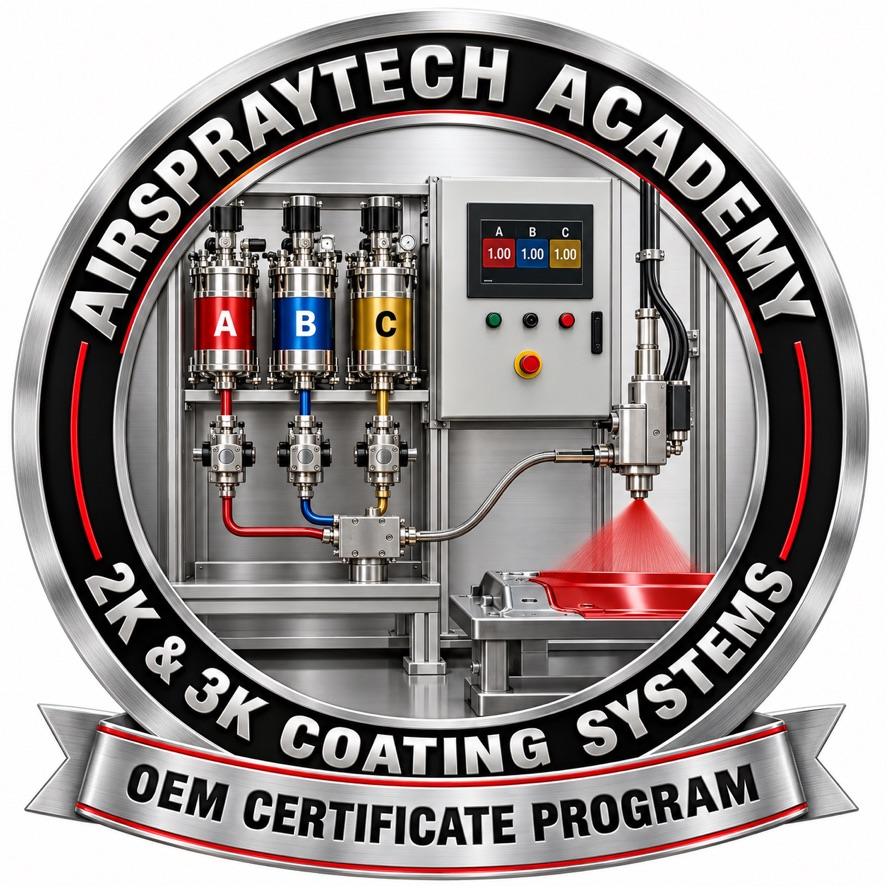
AirSprayTech Academy Certificate Program
2K and 3K Coating Systems for OEM Product Finishers
From Material Supply to Automated Process Control
Learn how stationary and automated plural-component systems meter,
proportion, mix, deliver, apply, monitor, flush, and document reactive
coatings in OEM production and industrial product-finishing operations.
Review the 24-Article Course
Production Finishing Requires Process Control
A 2K or 3K finishing system is not simply a pump connected to a spray
gun. It is a controlled production process that must deliver the correct
materials at the specified ratio, pressure, temperature, flow rate, and
mix quality throughout every production cycle.
Material supply, dosing technology, color change, catalyst management,
robot communication, application equipment, alarms, flushing, maintenance,
quality records, and operator response must function together. Failure in
one part of the system can affect cure, adhesion, appearance, production
output, material cost, and customer acceptance.
Series 14: The Factory-Finishing Program
This course complements the AirSprayTech Academy program on portable
plural-component systems for contractors. Series 14 concentrates on
stationary, automatic, and production-integrated 2K and 3K systems used
by OEM product finishers and industrial finishing operations.
- Manual production spray stations
- Automatic spray machines and reciprocators
- Robotic liquid-coating cells
- Central material-supply and circulation systems
- Multiple-color and multiple-hardener installations
- Integrated production, quality, and maintenance controls
What 2K and 3K Mean
A 2K system meters and combines two reactive components, commonly a
resin or base material and a catalyst, hardener, or activator. A 3K
system introduces a third controlled component when required by the
coating formulation or production process.
The number of components does not determine the coating chemistry.
Polyurethanes, epoxies, polyureas, adhesives, primers, clearcoats, and
other reactive materials may require different ratios, mixing methods,
fluid controls, wetted materials, temperatures, and application equipment.
The current coating manufacturer's instructions must govern the process.
Who Should Take This Course?
- OEM product finishers
- Paint-line operators
- Finishing supervisors
- Process and manufacturing engineers
- Quality-control personnel
- Maintenance technicians
- System integrators
- Equipment and coating suppliers
24-Article Course
- Understanding 2K and 3K Production Finishing Systems
- Reactive Coating Chemistries Used in OEM Finishing
- Reading Coating Data Sheets and Defining Process Requirements
- Ratio by Volume, Ratio by Weight, Density, and Tolerance
- Selecting a Metering and Proportioning Technology
- Material Supply, Day Tanks, Agitation, and Level Control
- Central Paint Circulation and Component Delivery
- Pressure, Flow, Viscosity, and Temperature Control
- Meters, Pumps, Valves, Regulators, and Sensors
- Mix Manifolds, Static Mixers, and Mixed-Material Volume
- Manual, Automatic, and Robotic Application Equipment
- Integrating the Proportioner with the Spray Process
- Color Change and Multiple-Hardener System Design
- Pot Life, Working Time, Gel Risk, and Production Interruptions
- Calibration and Independent Ratio Verification
- Flow Monitoring, Pressure Monitoring, Alarms, and Interlocks
- System Startup, Priming, Production, and Shutdown
- Flushing, Solvent Management, and Waste Reduction
- Recognizing and Containing Off-Ratio Material
- Troubleshooting Ratio, Flow, Pressure, and Mixing Problems
- Preventive Maintenance and Critical Spare Parts
- Worker Safety, Fire Protection, Ventilation, and Electrical Controls
- Quality Control, Cure Verification, Traceability, and Records
- System Specification, Acceptance Testing, Training, and Lifecycle Management
Manufacturer-Neutral Technical Education
This course explains principles that apply across professional
plural-component equipment and production-finishing systems. Equipment
designs, terminology, controls, alarms, service procedures, and approved
materials vary by manufacturer and system configuration.
Always use the current manuals and written procedures supplied by the
equipment manufacturer, coating manufacturer, system integrator, and
facility. Brand or product references used for technical explanation do
not replace the requirements for the installed system.
Technical References
Articles will identify applicable technical resources within the text
or in a reference section. Depending on the subject, references may
include coating and equipment manufacturer instructions, project
specifications, ASTM standards, OSHA requirements, NFPA 33, NFPA 70,
and other recognized industry resources.
Always verify the current edition, project adoption, jurisdictional
requirements, and manufacturer instructions before applying any standard
or procedure.
Certificate Program
Complete all 24 articles and earn the required passing score on the
final course assessment to become eligible to request an AirSprayTech
Academy Certificate of Completion.
The certificate recognizes completion of this educational program. It
is not a professional license, personnel certification, manufacturer
authorization, equipment-service qualification, employer training record,
or substitute for required safety or job-specific training.
Professional responsibility:
Follow the current coating and equipment manufacturer instructions,
safety data sheets, approved facility procedures, employer safety
programs, project specifications, and applicable regulations. Installation,
operation, maintenance, and repair must be performed by trained and
authorized personnel.
Copyright © 2026 Azimuth Spray Systems, LLC. All Rights Reserved.
No part of this material may be reproduced, distributed, transmitted,
stored, republished, or used in any form without prior written permission
from Azimuth Spray Systems, LLC, except for brief quotations used with
proper attribution.
AirSprayTech.com — The Finishing Authority®