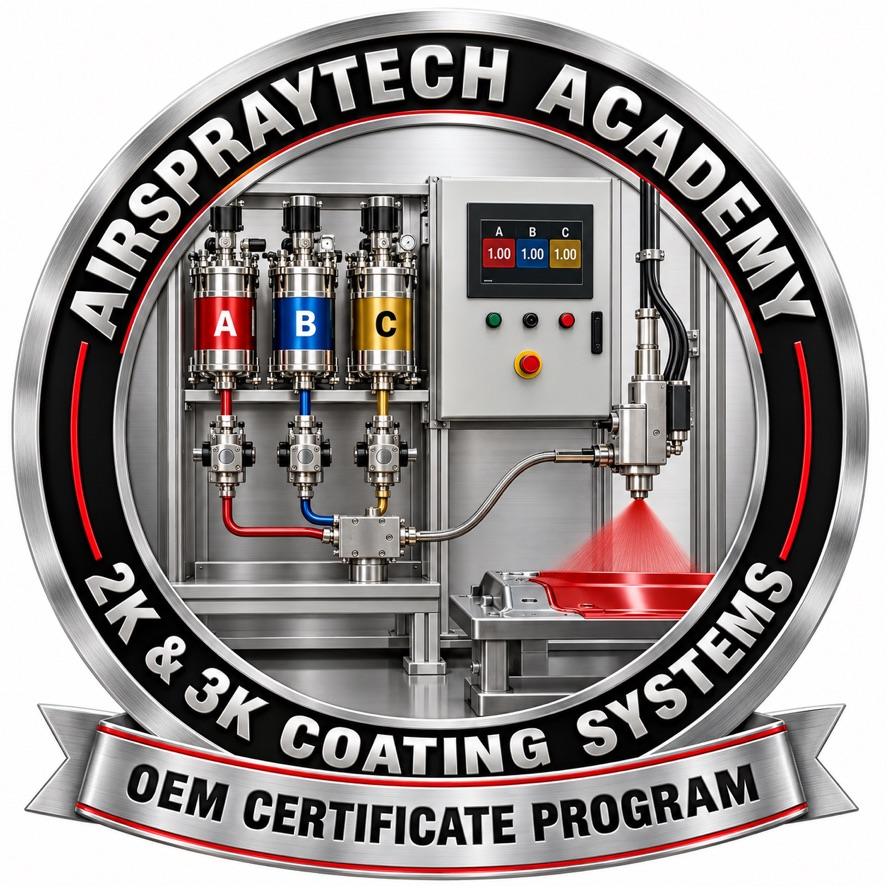
2K and 3K Coating Systems for OEM Product Finishers
Article 01 of 24
Understanding 2K and 3K Production Finishing Systems
A plural-component system is a coordinated production process—not
simply two or three pumps connected to a spray gun.
Learning Objectives
After completing this article, you should be able to:
- Explain what the terms 2K and 3K mean.
- Identify the principal functions of a production plural-component system.
- Describe the material path from storage to application.
- Explain why ratio control is a chemical requirement.
- Distinguish proportioning, mixing, delivery, and application.
- Recognize why the complete installation must be treated as one controlled process.
What Do 2K and 3K Mean?
The letter K is commonly used
in the finishing industry to identify the number of separately controlled
coating components.
-
1K: A coating supplied and
applied as one material without a separately metered reactive component.
-
2K: Two components are
metered and combined, commonly a resin or base material and a catalyst,
hardener, or activator.
-
3K: Three components are
independently controlled and combined according to the coating
manufacturer's specified formulation.
The third component in a 3K system is not always the same type of
material. Depending on the coating and process, it may be another
reactive component, a flexible blending component, an accelerator,
or another formulation-specific material.
Do not assume a component's purpose from the labels A, B, and C.
The coating manufacturer's current technical data, mixing instructions,
and approved system configuration must define each component and its ratio.
The Ratio Is Part of the Chemistry
A plural-component coating cures through a chemical reaction. The
specified ratio provides the quantity of each component required for
that reaction to proceed as intended.
An off-ratio mixture may appear sprayable and may initially look
acceptable. Appearance at the gun or immediately after application
does not prove that the material is correctly proportioned.
Off-ratio material can contribute to:
- Soft, brittle, tacky, or incompletely cured coating
- Poor adhesion or reduced cohesive strength
- Changes in gloss, color, texture, or appearance
- Reduced chemical, abrasion, or environmental resistance
- Intercoat adhesion problems
- Delayed failures after the product enters service
The Six Functions of a Production System
A complete production installation generally performs six related
functions. A problem in any one of them can affect the finished coating.
1. Store and Condition the Components
Materials may be supplied from drums, totes, pressure tanks, day tanks,
or a central paint kitchen. Agitation, filtration, temperature control,
recirculation, and level monitoring may be required to keep each
component in a usable and consistent condition.
2. Deliver Each Component
Supply pumps, circulation pumps, pressure regulators, hoses, piping,
filters, valves, and return circuits move the separate components to
the proportioning equipment. Each supply circuit must deliver material
without starvation, cavitation, excessive pressure loss, contamination,
or uncontrolled temperature change.
3. Meter and Proportion
The proportioning system measures and delivers the required amount of
each component. Systems may use gear meters, piston meters, dosing
pumps, stroke measurement, electronic controls, mechanical relationships,
or other manufacturer-approved technologies.
4. Combine and Mix
Correctly proportioned streams must be brought together and mixed
uniformly. A mix manifold, injection point, dynamic mixer, static mixer,
or combination of devices may be used. Metering establishes quantity;
the mixing device establishes uniform distribution of the components.
5. Deliver the Mixed Material
Once the components meet, the pot-life clock begins. The mixed-material
circuit may include a mixer, hose, manifold, color valve, applicator,
and other passages. Its internal volume determines how much reactive
material remains downstream of the mixing point.
6. Apply and Monitor the Coating
The material may be applied with manual or automatic air-spray,
AirCoat, air-assisted airless, airless, electrostatic, rotary-atomization,
or other approved equipment. The production controls may coordinate
material selection, part identification, robot signals, spray triggering,
flow commands, alarms, flushing, and production records.
The Material Path
Understanding the material path is one of the most useful skills for
operators, engineers, quality personnel, and maintenance technicians.
A simplified path may look like this:
- Original material container, bulk container, or day tank
- Agitation, conditioning, and filtration equipment
- Supply pump or pressure-feed system
- Separate component piping or hoses
- Meters, dosing valves, or proportioning pumps
- Mix manifold or injection point
- Static or dynamic mixing device
- Mixed-material hose and downstream controls
- Manual, automatic, or robotic applicator
When a defect or alarm occurs, the team should trace the process in
order. Jumping directly to the spray gun may overlook an upstream
supply, pressure, temperature, metering, valve, or material-condition problem.
Closed-Loop Control and Process Feedback
A production system may use sensors and electronic controls to compare
actual performance with a programmed recipe. Depending on the equipment,
the system may monitor meter pulses, pump strokes, fluid flow, component
pressure, temperature, valve position, material level, pot-life time,
flush volume, and production status.
An alarm does not automatically identify the root cause. It identifies
a condition detected by the control system. Operators must understand
what was measured, where it was measured, what limit was exceeded, and
what material may have been affected.
The correct response may require stopping application, identifying the
last known acceptable part, containing suspect material, protecting
the mixed-material circuit, recording the event, and following the
approved troubleshooting procedure.
Pot Life and Mixed-Material Volume
Pot life begins when reactive components are combined. Material
remaining downstream of the mix point continues reacting even when
the spray gun is not triggered.
A long mixed-material hose can hold a substantial volume of catalyzed
coating. Production interruptions, conveyor stops, robot faults, shift
changes, and extended troubleshooting can allow that material to increase
in viscosity, gel, or cure inside the system.
System design and operating procedures must account for coating pot
life, mixed volume, production flow, expected interruptions, flushing
time, solvent compatibility, waste generation, and safe pressure relief.
Three Levels of System Control
Equipment Control
The proportioner controls component selection, dosing, ratio, mixing,
flushing, alarms, and other equipment functions.
Application Control
The applicator, robot, reciprocator, or machine controls spray timing,
part coverage, gun movement, atomization, pattern, shaping air,
electrostatic settings, and film build.
Production Control
The plant control system may manage part identification, recipes,
color selection, conveyor permissives, booth ventilation status,
quality records, reject tracking, and communication between production
equipment. These control levels must exchange the correct signals and
respond safely when a fault occurs.
Safety Is Part of System Design
Plural-component production finishing can involve flammable or
combustible materials, hazardous vapors, high fluid pressure, compressed
air, electrical equipment, moving machinery, heated materials, reactive
chemicals, and automatic equipment movement.
OSHA 29 CFR 1910.107 addresses spray finishing using flammable and
combustible materials. Paragraph 1910.107(m) specifically addresses
organic peroxides and dual-component coatings. NFPA 33 provides
additional requirements for spray-application processes using flammable
or combustible materials.
The complete installation must be evaluated by qualified personnel.
Follow the authority having jurisdiction, current codes, equipment
manuals, safety data sheets, employer procedures, lockout/tagout
requirements, pressure-relief procedures, and applicable worker-protection rules.
What Makes a System Successful?
A successful 2K or 3K installation requires more than accurate equipment.
It requires:
- A clearly defined coating and production process
- Compatible equipment and wetted materials
- Adequate and stable component supply
- Verified calibration and ratio performance
- Controlled mixing and mixed-material volume
- Correct integration with the application equipment
- Documented alarm and fault-response procedures
- Trained operators, maintenance technicians, and quality personnel
- Preventive maintenance and critical spare parts
- Production records that support traceability and final acceptance
Key Takeaways
- 2K and 3K identify the number of separately controlled coating components.
- The coating manufacturer's instructions define component purpose and ratio.
- Proportioning and mixing are separate but equally important functions.
- The complete material path must be understood and controlled.
- Pot life begins after reactive components meet.
- An alarm identifies a detected condition—not necessarily its root cause.
- The proportioner, applicator, production controls, people, and procedures form one finishing system.
Knowledge Check
- What does the term 3K identify?
- Why can visual appearance alone not prove that material is on ratio?
- What is the difference between proportioning and mixing?
- When does the coating's pot-life clock begin?
- Why should troubleshooting begin by understanding the complete material path?
Answer guide:
1. Three separately controlled components. 2. Off-ratio material
may spray and initially appear acceptable. 3. Proportioning establishes
the required quantity of each component; mixing distributes those
components uniformly. 4. When the reactive components meet. 5. Because
a downstream symptom may originate in material storage, supply,
conditioning, metering, valves, pressure, temperature, or another
upstream part of the process.
Professional responsibility:
Always follow the current coating and equipment manufacturer instructions,
safety data sheets, facility procedures, approved control plans, employer
safety programs, and applicable regulations. Operate, inspect, maintain,
and repair plural-component systems only when trained and authorized.
Copyright © 2026 Azimuth Spray Systems, LLC. All Rights Reserved.
No part of this material may be reproduced, distributed, transmitted,
stored, republished, or used in any form without prior written permission
from Azimuth Spray Systems, LLC, except for brief quotations used with
proper attribution.
AirSprayTech.com — The Finishing Authority®